 Don’t just renew
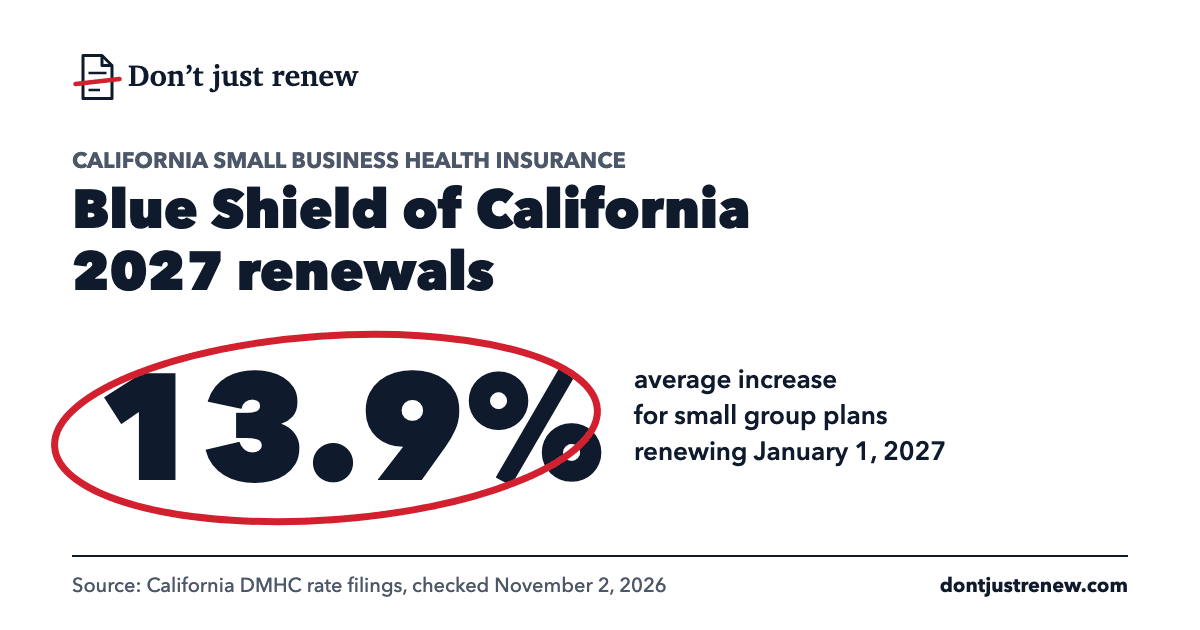
Blue Shield of California small business plans: 2027 rates are up 13.9%
If your company has Blue Shield of California and renews in January, plan on paying about 14% more. Companies that renewed with Blue Shield in January 2025 saw an average of 6.2%.
The short version
- Blue Shield’s average increase for small business plans renewing January through March 2027 is 13.9%.
- PPO and high-deductible plans are going up 14.3% on average, and HMOs 12.3%. Every plan goes up at least 10.9%.
- After renewal, Blue Shield’s small business plans average about $942 a month for each person covered.
- Rising medical costs, led by doctor visits and prescription drugs, are behind almost all of the increase.
How much is Blue Shield raising small business rates?
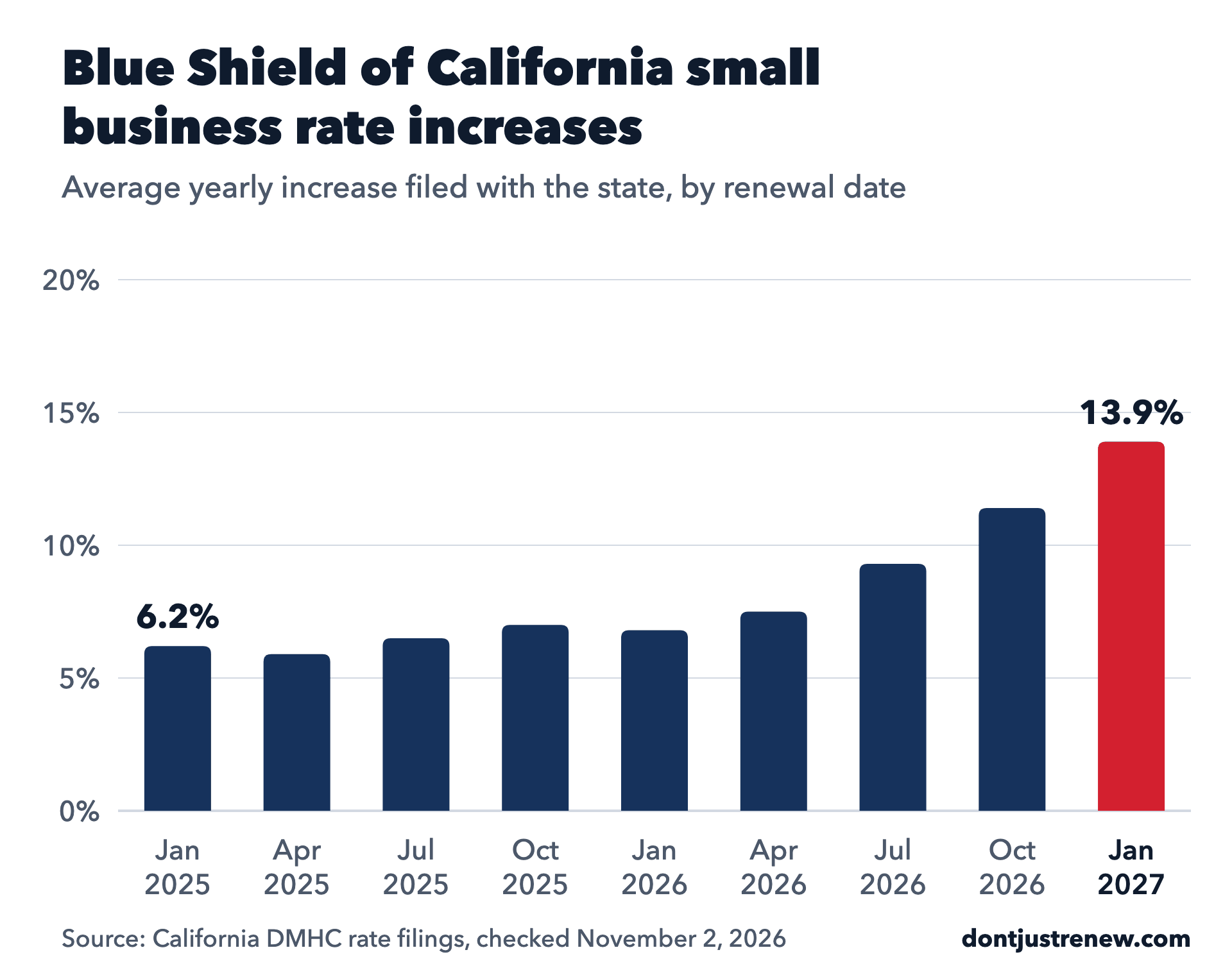
Every quarter, Blue Shield tells California’s Department of Managed Health Care (DMHC), the state agency that oversees health plans, how much it plans to raise rates for small businesses renewing over the next three months. In California, a small business plan covers a company with 1 to 100 employees. Blue Shield’s October 2026 filing listed about 372,000 people on these plans.
| Renewal date | Blue Shield of California |
|---|---|
| January 2025 | 6.2% |
| April 2025 | 5.9% |
| July 2025 | 6.5% |
| October 2025 | 7.0% |
| January 2026 | 6.8% |
| April 2026 | 7.5% |
| July 2026 | 9.3% |
| October 2026 | 11.4% |
| January 2027 | 13.9% |
Source: DMHC rate filings, checked November 2, 2026. See the January 2027 filing.
Blue Shield stayed around 6% to 7% from January 2025 through January 2026, and it has gone up every quarter since. The state hasn’t posted a final number for January 2027 yet, but the federal rate review site lists it as final at 13.9%, and in every earlier quarter the final number matched the filing.
What Blue Shield small business plans cost in 2027
Blue Shield’s filing also shows the average monthly premium for companies renewing in early 2027, per person covered. That counts employees and any family members on the plan, and it’s the full premium before you split it with your employees.
| Plan type | Average increase | Average monthly premium per person |
|---|---|---|
| HMO | 12.3% | $780 |
| PPO | 14.3% | $1,004 |
| High-deductible | 14.3% | $886 |
| All plans | 13.9% | $942 |
Source: rate filing workbook attached to Blue Shield’s January 2027 DMHC filing. Premiums are averages across ages and regions.
An HMO keeps you in a set network of doctors and usually needs a referral to see a specialist. A PPO lets people see doctors outside the network, for a higher cost. A high-deductible plan has a lower premium and a bigger deductible, and it can often be paired with a health savings account.
Your own increase depends on your plan, your employees’ ages, and where your company is located. Blue Shield’s rate disclosure shows individual plans going up between 10.9% and 15.4%.
Why is Blue Shield raising rates?
Medical care costs more and members are using more of it. Blue Shield’s filing splits the 13.9% into parts. Rising costs and its recent claims add about 15 points. It expects its members to be slightly healthier, which along with a few smaller changes takes back about 2 points. Risk adjustment, a federal program that moves money between insurers based on how healthy their members are, adds about 1 point. Its administrative costs and profit margin went down a little.
The filing projects costs rising about 8.3% a year. Doctor and other professional visits are climbing fastest, 12.9% a year, mostly because members are using more care. Prescription drugs are next at 11.0%, mostly because prices are going up. In 2025, Blue Shield’s outpatient hospital costs ran about 2.5 times what Medicare pays for the same services.
The company caps its net income at 2% of revenue under a policy it calls the 2% Pledge, and gives back anything above that. It projects that 83.6% of premiums will go to medical care, above the 80% the Affordable Care Act requires.
How Blue Shield compares with other California insurers
Blue Shield’s January increase is in the middle of the seven plans DMHC counts as statewide.
| Statewide plan | Filed increase |
|---|---|
| UHC of California | 22.6% |
| UnitedHealthcare Benefits Plan of California | 21.0% |
| Health Net (leaving the employer market) | 14.8% |
| Blue Shield of California | 13.9% |
| Anthem Blue Cross | 10.9% |
| Aetna Health of California | 7.6% |
| Kaiser Permanente | 5.6% |
Source: DMHC rate filings, checked November 2, 2026. Kaiser’s figure is for non-grandfathered plans. Plans regulated by the California Department of Insurance aren’t in this data.
Blue Shield also sells small business plans through Covered California for Small Business, the state’s marketplace, where its preliminary 2027 increase is 12.1%, against 8.6% for the marketplace overall. Across the country, the median small business increase insurers asked for in 2027 is 14%, according to KFF.
We’ve also written up the 2027 rates for Anthem Blue Cross and UnitedHealthcare.
What to do before you renew
- Find your renewal notice. California requires at least 60 days’ notice of a rate change, so a company renewing January 1 should have one by now.
- Check your plan type. Blue Shield’s PPO and high-deductible plans are going up two points more than its HMOs. If your employees mostly see doctors in one network, ask what an HMO version of your plan would cost.
- Start early. Health Net is leaving California’s employer market, with coverage ending February 28, 2027, so a lot of companies are shopping at the same time.
- Get a second opinion before you sign. An independent employee benefits advisor, often called a benefits broker, can price your plan against other insurers and other ways to fund coverage, and Blue Shield may still come out ahead.
Don’t Just Renew is not associated with, endorsed by, or sponsored by Blue Shield of California. Blue Shield of California is a trademark of its owner, and we use the name only to report public rate data. This article is general information, not insurance advice. Figures are current as of November 2, 2026.