 Don’t just renew
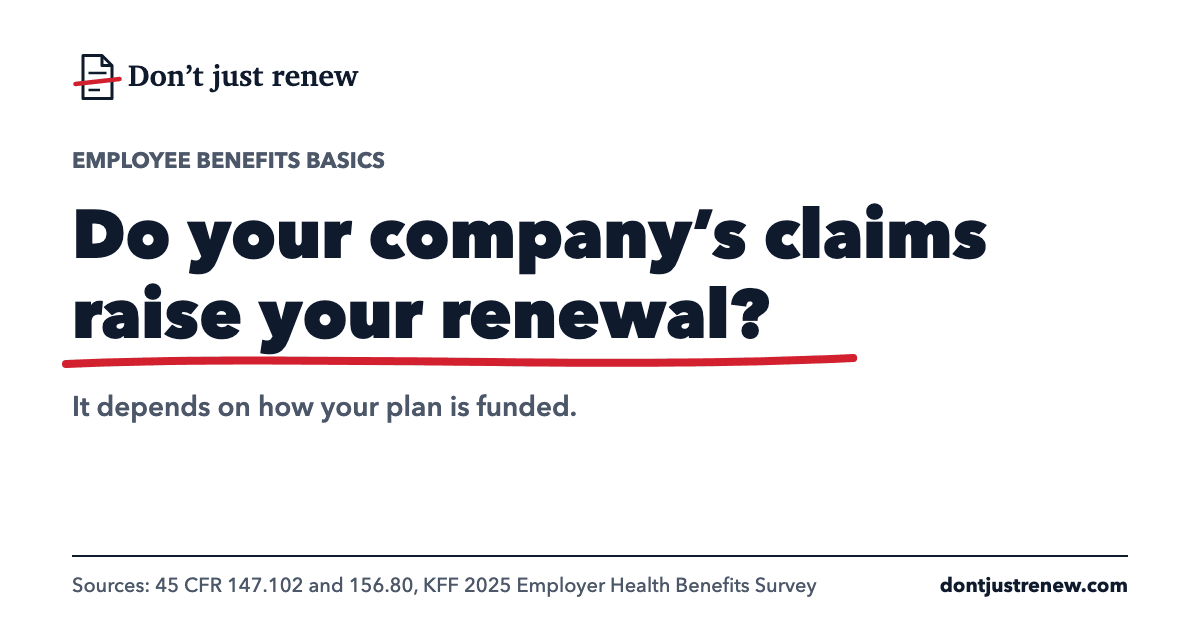
Do your company’s claims raise your health insurance renewal?
On a regular small business plan, no. Federal rules don’t let the insurer price your company on its own claims. The claims of everyone in the insurer’s small business plans in your state set the increase. Your own claims start to count when you move to a level-funded plan, a self-funded plan, or a large group plan. That’s called experience rating.
The short version
- Experience rating means pricing a company’s health plan on its own claims, the medical bills its plan has paid.
- Regular small business plans under the Affordable Care Act (ACA) can’t do that. Rates can only vary by plan, family size, location, age, and tobacco use.
- In those plans, a bad year for the insurer’s whole pool of small business customers can raise your rate even if your employees barely used the plan.
- Level-funded, self-funded, and large group plans can be priced on your own claims, so a good year can help and a bad year can hurt.
What is experience rating in health insurance?
Experience rating means the price of your plan depends on your group’s claims history. A claim is a bill the plan pays for someone’s care, like a hospital stay, a doctor visit, or a prescription. If your employees ran up a lot of claims last year, an experience-rated plan costs more next year. If they used very little, it can cost less.
The other approach is to price a big group of companies together. Everyone in the pool shares one base rate, and each company’s price is adjusted only for a short list of factors, like where it’s located and how old its employees are. That’s how regular small business plans are priced, and it’s close to what’s called community rating. Which of the two your plan uses decides whether your own claims show up in your renewal.
Do claims affect small group health insurance rates?
Not your own company’s claims, if you’re on an ACA small business plan. Federal rules say an insurer’s small business rates can vary only by whether the plan covers one person or a family, the rating area your business is in, age, and tobacco use. Age can’t move the rate more than 3 to 1 for adults. Health status and claims aren’t on the list.
The same rules make each insurer treat all of its small business customers in a state as one risk pool. The insurer sets one base rate from the combined claims of everyone in that pool, then applies the allowed adjustments. Federally, a small business is one with 1 to 50 employees, and states can raise that to 100.
Why did my group health insurance go up if we barely used it?
Because the pool’s claims went up, not yours. When an insurer’s small business customers as a whole cost more than it planned, everyone in the pool shares the increase.
Anthem Blue Cross in California is a good example. Its January 2027 filing puts the average increase at 10.9%, and 7.7 points of that come from 2025 claims across its small business plans that ran higher than Anthem had planned. We broke that down in our Anthem Blue Cross 2027 rates post. Kaiser Permanente’s 2027 California rates work the same way: they’re built from the claims of all its small business members in 2025.
Two other things raise your bill even when the pool is steady. Each employee’s rate is based on their age at renewal, so an older workforce costs a bit more each year. And the plan you’re on might be going up faster than the insurer’s average.
Federal rules also limit how much of the premium an insurer can keep. If its medical loss ratio, roughly the share of premiums it spends on care, falls below 80% for its small business plans in a state, it has to pay a rebate. For large group plans the bar is 85%.
Which health plans are experience rated?
It depends on how the plan is funded.
| Type of plan | Your own claims count? | How |
|---|---|---|
| ACA small business plan | No | Rates come from the insurer’s whole small business pool in your state. |
| Level-funded plan | Yes | You pay a set amount each month. Low claims can mean money back, and high claims are covered by stop-loss insurance. |
| Self-funded plan | Yes | The company pays its employees’ claims directly from its own funds. |
| Large group insured plan | Can, at least partly | The ACA’s small business rating limits don’t apply, and insurers can blend your claims into your rate. |
Sources: 45 CFR 147.102, 45 CFR 156.80, UnitedHealthcare, KFF 2025 Employer Health Benefits Survey, and DMHC rate filings, checked November 3, 2026.
A level-funded plan is a smaller company’s version of self-funding. KFF describes it as a small self-funded piece combined with stop-loss insurance, which pays when claims run past a set limit. UnitedHealthcare, for example, says its level-funded plans are based on the medical and pharmacy claims of the people on the plan, and that a plan may get a surplus refund at year-end when claims come in lower than expected.
In KFF’s 2025 survey, 37% of covered workers at firms with 10 to 199 workers were in a level-funded plan.
Large group plans can be experience rated because the federal rating limits above cover only the individual and small group markets. In California, for example, Kaiser files its large group pricing method with the state under the name “Blended or 100% Experience,” meaning a group’s own claims can count for part or all of its rate.
How claims play out at renewal for a small business
On an ACA small business plan, your renewal tells you how the insurer’s pool did, not how your company did. A big claim from one employee won’t single you out. A quiet year won’t earn you a discount either.
On a level-funded or self-funded plan, your renewal tracks your own group. That’s why these plans can price a healthy group lower, and why one employee’s premature baby, cancer treatment, or expensive new drug can show up in next year’s number. Stop-loss coverage limits how much a bad year costs you during the year.
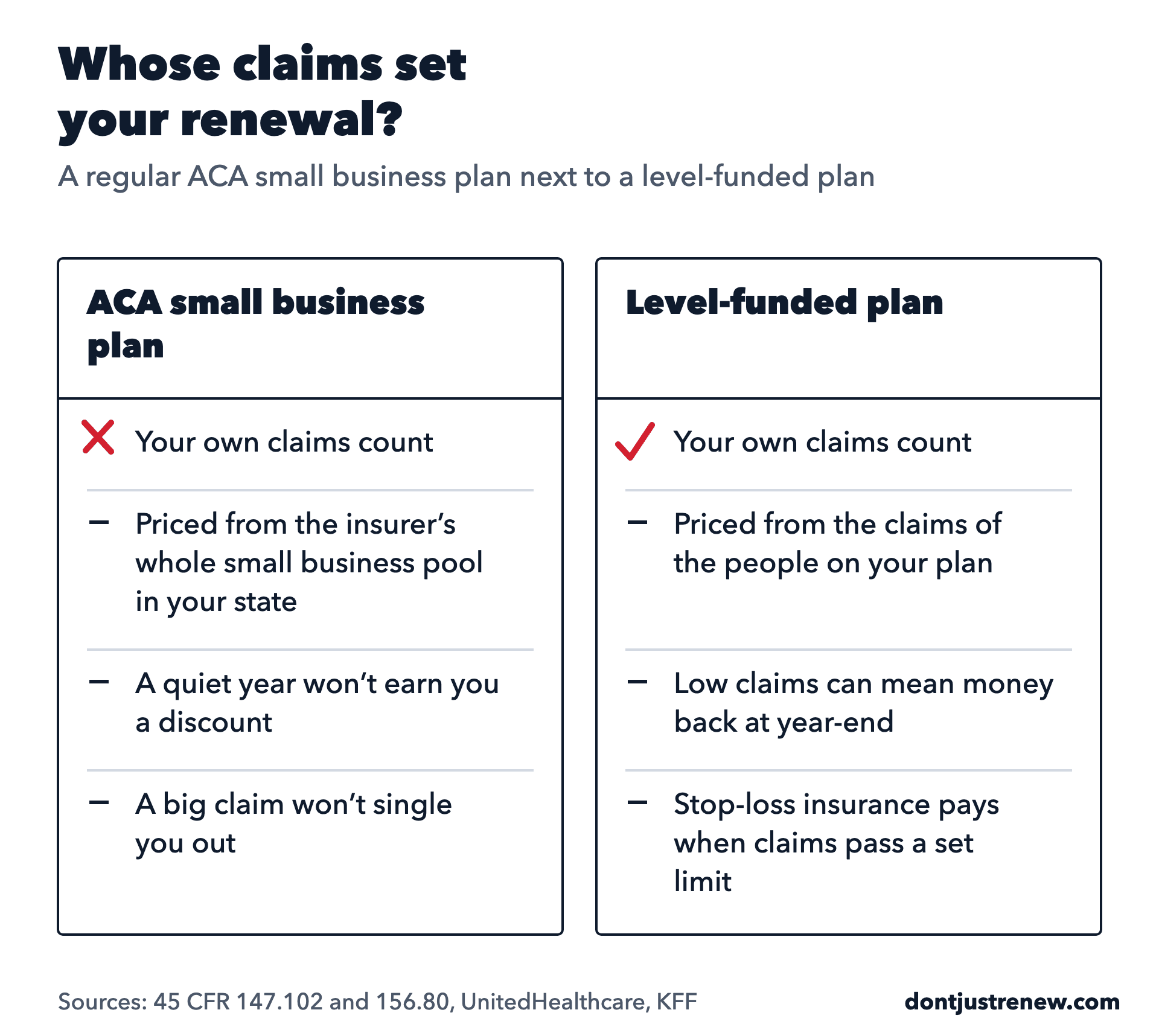
So where you look for the reason depends on the plan. On a pooled plan, look at the insurer’s rate filing. On an experience-rated plan, ask for your own claims report.
What to do before you renew
- Find out how your plan is funded. Your renewal paperwork or plan documents will say whether it’s fully insured, level-funded, or self-funded.
- If it’s a regular small business plan, look up your insurer’s rate filing for your state. It shows the average increase and why.
- If it’s level-funded or self-funded, ask for your claims report and your stop-loss renewal terms before you sign.
- Get a second opinion. An independent employee benefits advisor, often called a benefits broker, can price your plan against other insurers and other ways to fund coverage, and your current plan may still come out ahead.
This article is general information, not insurance, tax, or legal advice. Figures are current as of November 3, 2026.