 Don’t just renew
Sana Benefits renewal: what changes and what to check
Sana Benefits plans are level-funded, so your renewal is priced partly on your own group’s claims. Each year Sana sets a new price, and if your claims came in low, you may get money back about nine months after the plan year ends. That credit only comes if you renew.
The short version
- Sana’s plans are self-funded and paid through level funding: a fixed monthly amount split between a claims fund, stop-loss insurance, and fees.
- At renewal, Sana looks at your plans, your claims history, and expected use, plus wider cost trends, and sets next year’s price.
- If money is left in your claims fund after the plan year, Sana says it credits 90% of it to your invoices about nine months later, as long as you renewed.
- Your plans renew as they are unless you change them, and employees who don’t choose stay on the same plan.
Is Sana Benefits an insurance company?
Not in the usual sense. Sana says its plans are self-funded, which means your company’s plan pays its employees’ medical claims, with Sana running it. Sana says it acts as the licensed broker, third-party administrator, and managing general underwriter. In plain words, it sells the plan, processes the claims, and sets the price.
Big claims are covered by stop-loss insurance, a policy that pays once claims pass a set limit. Sana says it was founded in 2017 and is backed by venture firms and reinsurance partners. It offers medical, dental, and vision coverage, plus a virtual care service called Sana Care.
Is Sana Benefits level funded?
Yes. Your company pays a fixed amount each month based on enrollment, whether claims are high or low. Sana splits that payment into three parts: your claims fund, stop-loss insurance, and administrative fees. Everyday claims are paid from the claims fund. If that runs out, the stop-loss policy pays, and Sana says you won’t owe more than your monthly payments.
Level funding is common at smaller companies. In KFF’s 2025 Employer Health Benefits Survey, 37% of covered workers at firms with 10 to 199 workers were in a level-funded plan. KFF describes these plans as a small self-funded piece combined with stop-loss insurance. We explain why that makes your own claims count in our post on experience rating.
| ACA small business plan | Sana level-funded plan | |
|---|---|---|
| What you pay each month | A premium to the insurer | A fixed amount split into a claims fund, stop-loss, and fees |
| What sets your renewal | The insurer’s whole small business pool in your state, plus a short list of factors like age and location | Your plans, your claims history, expected use, and wider cost trends |
| Money back | A rebate only if the insurer spends less than 80% of premiums on care | A credit for 90% of leftover claims fund money, if you renew |
| Large claims | Paid by the insurer | Paid by stop-loss insurance once the claims fund runs out |
Sources: 45 CFR 147.102, 45 CFR 158.210, and Sana’s help center pages on level funding, renewals, and costs, checked November 4, 2026.
What changes at a Sana Benefits renewal?
Mostly the price. Sana says a renewal is when it reviews your policy and sets pricing for the next plan year, and that costs are likely to go up to some extent each year. It weighs things specific to your company, like the plans you offer, your claims history, and how much it expects the plan to be used. It also looks at wider factors like prescription drug and treatment costs, government-required benefits, your region, and inflation.
Your plans stay the same unless you act. By default, Sana renews your medical, dental, and vision plans as they are, and you can pick new plans or change how much you contribute. Your employees then get an open enrollment period. Sana’s automatic renewal rule puts anyone who doesn’t choose on the same plan, or the closest one if theirs is gone, and after that they can only switch after a qualifying life event.
Sana’s plans use HealthSmart networks, and Sana says some health systems, Baylor Scott & White in Texas and Sutter Health in California, need 30 days’ notice of new group enrollments. Finish open enrollment early if your employees use them.
How does the Sana year-end credit work?
It comes from whatever’s left in your claims fund. After your plan year ends, there’s a six-month run-out period, when claims from the plan year can still come in. Sana processes credits three months after that, usually about nine months after the plan year ends.
The credit covers only the claims fund, not the stop-loss or fee portions. Sana’s costs page says it credits 90% of leftover claims fund money, and its level funding page says it may keep a percentage and requires renewal. The credit shows up on your invoices, spread over several if it’s bigger than one bill. Your administrative services agreement has the exact terms.
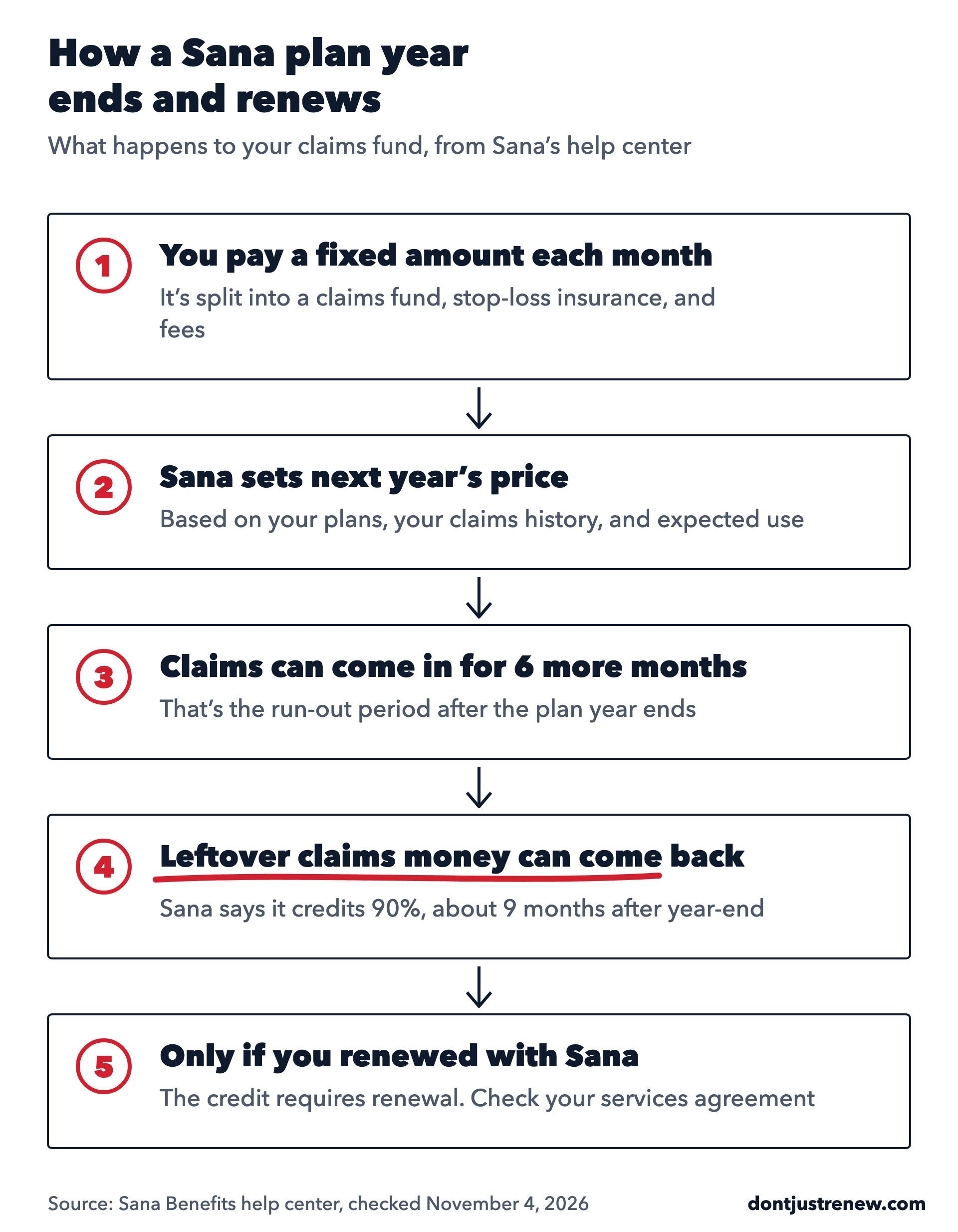
If you switch away at renewal, you’d give up any credit from the year that just ended, because it’s paid only to groups that renew. Weigh that against the new price.
Is Sana Benefits reference-based pricing?
In part. Sana lists reference-based pricing among the tools it uses to hold down costs, along with a transparent pharmacy benefit manager and case management. Reference-based pricing means paying some bills based on a set benchmark price rather than a discount negotiated with the provider in advance.
Sana offers two HealthSmart networks. One covers doctors and other services at about 1.2 million locations. The other is a PPO network of about 1.8 million locations that adds hospitals and facilities. Your employees’ ID cards show which one they’re on. Before you renew, ask Sana which bills are paid by reference price and what happens if a provider bills an employee for the rest.
Who Sana tends to fit
Sana works with companies of 2 to 500 employees headquartered in 17 states: Alabama, Arizona, Colorado, Delaware, Illinois, Indiana, Iowa, Kentucky, Maryland, Massachusetts, Michigan, Ohio, Oklahoma, Pennsylvania, Texas, Virginia, and Wisconsin. It needs at least two enrolled employees and 50% participation, not counting employees with valid waivers. The company also can’t be exempt from ERISA, the federal law that covers most private employer health plans.
A level-funded plan tends to suit a group that’s fairly healthy and can live with a price that moves with its own claims. A group with a few employees in costly treatment may see that in its renewal. On a regular ACA small business plan, those claims are spread across the insurer’s whole pool instead.
What to do before you renew
- Ask Sana for your claims history and how it fed into the new price, not just the new monthly amount.
- Find your administrative services agreement and check the credit terms, the run-out period, and what happens if you leave.
- Check whether your employees’ doctors and hospitals are in your HealthSmart network, and ask how bills outside it are paid.
Don’t Just Renew is not associated with, endorsed by, or sponsored by Sana Benefits. Sana Benefits is a trademark of its owner, and we use the name only to describe public information. This article is general information, not insurance, tax, or legal advice. Figures are current as of November 4, 2026.