 Don’t just renew
How are small business health insurance rates set?
An insurer sets one base rate for everyone on its small business plans in a state. Then it adjusts each person’s price for only a few things: age, where the business is, who’s covered, and in some states tobacco use. Your company’s own claims and health history aren’t on that list. That’s a form of community rating, and it means two companies in the same area, on the same plan, with employees of the same ages, pay the same price.
In short
- Federal rules let a small group rate change only with age, location, family size, and tobacco use.
- Age can triple a price. On the federal scale, a 64-year-old pays 3 times what a 21-year-old pays.
- Your group’s claims, health, gender, and industry can’t change the rate.
- Everyone is priced at their age on the renewal date, so the bill can rise even when rates don’t. In our example, birthdays alone add about 2.8%.
What is community rating in health insurance?
Community rating means pricing a big group of people together, instead of pricing each person or company by its health. In its purest form, everyone pays the same rate for the same plan. New York and Vermont come closest. Neither lets small business rates vary by age or tobacco use, according to CMS’s table of state rating rules.
The Affordable Care Act uses a modified version for small business and individual plans. The federal rule lets those rates vary only by age, rating area, family size, and tobacco use. That’s the opposite of experience rating, where a company’s own claims set its price. Our experience rating guide covers which plans work that way.
Does the ACA make insurers community rate every business? No. The rule covers insured small group and individual plans. Large group plans and self-funded plans, including level-funded plans, aren’t priced this way. Small group means 1 to 50 employees under federal rules, and states can raise that to 100. California, Colorado, New York, and Vermont have.
What are the rating factors for small group health insurance?
There are four, under 45 CFR 147.102:
- Age. Each person is priced by age, and no adult 21 or older can be charged more than 3 times what another adult pays for the same plan. Children 14 and under share one price, each age from 15 to 63 has its own, and everyone 64 and older pays the top rate.
- Rating area. Each state draws pricing regions, and a small business is priced by its main business address. California has 19 regions set by state law.
- Family size. A family’s premium is the sum of each member’s price, counting no more than the three oldest children under 21.
- Tobacco use. Insurers can charge tobacco users up to 1.5 times as much, subject to wellness program rules in small group plans, CMS says. Many states set a lower limit or don’t allow it.
The base rate also differs by plan. Under 45 CFR 156.80, a plan can cost more for a lower deductible, a different network, benefits beyond the required ones, or its administrative costs.
What can’t change a small group rate?
Anything not on that list. An insurer can’t charge your group more because an employee had a big claim, because of anyone’s health history or gender, or because of the work you do.
Claims still count, through the insurer’s pool. It pools the claims of everyone on its small business plans in the state and sets one base rate from that total. When the pool’s costs rise, every group’s rates rise. Insurers can reset that base rate up to four times a year, on January 1, April 1, July 1, or October 1, and a group keeps its rate for its whole plan year. Community Care Health’s 2027 filing is one example: one base rate for all its small business members around Fresno, adjusted plan by plan, for an 11.5% average increase.
How much does age change the price?
For adults, by up to three times. Most states use the CMS default age curve. It sets ages 21 to 24 at 1.000 and raises the factor every year after that, to 1.278 at 40, 1.786 at 50, and 3.000 at 64. Children 14 and under are at 0.765.
Community Care Health’s Gold 80 HMO 500/35, a real 2027 plan, has a base rate of $489.95 a month in the Fresno area, according to its rate filing. Applying the age curve gives these prices, by our math:
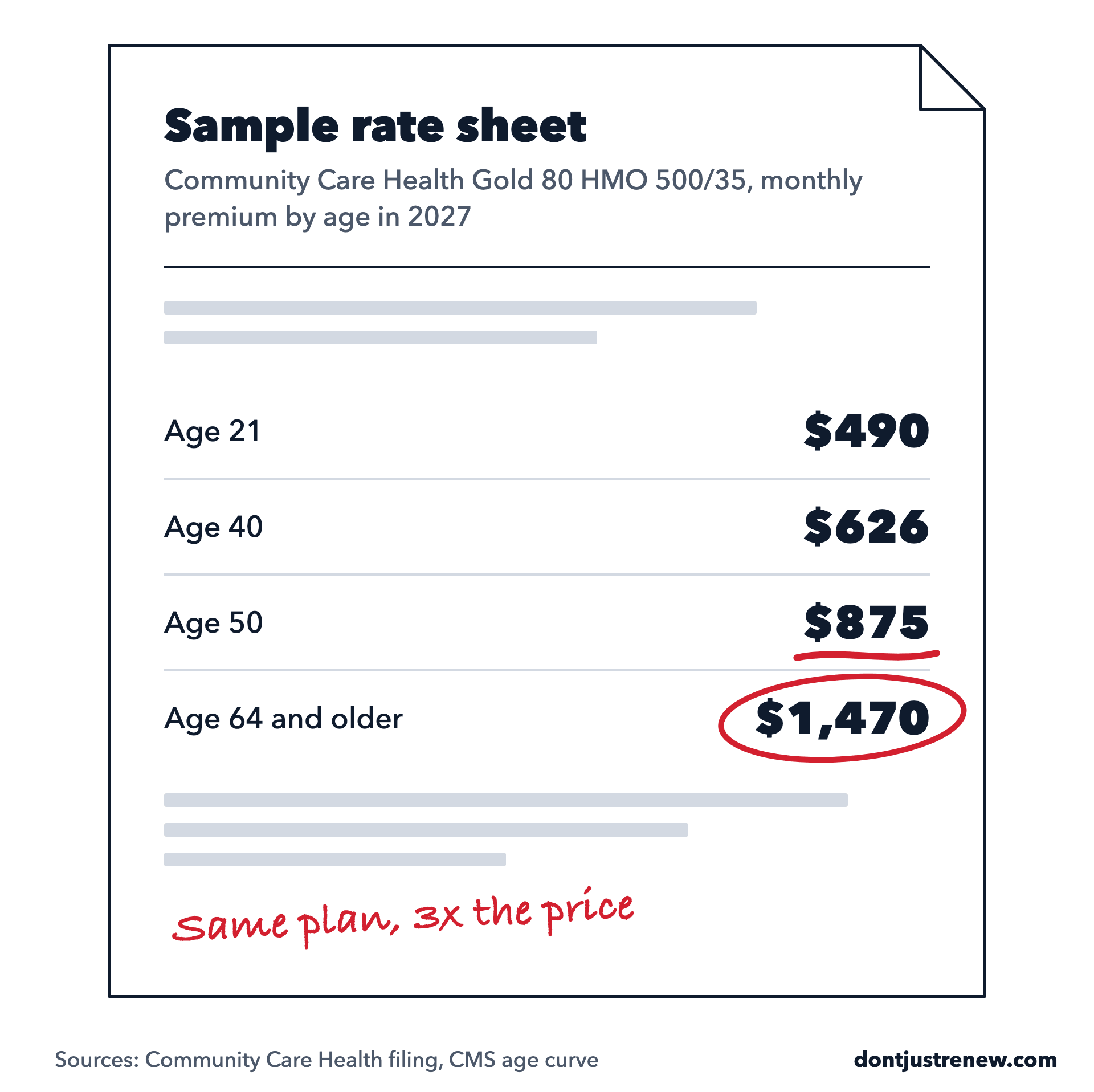
A few states use their own curves. For small business plans, CMS lists DC, Massachusetts, Minnesota, Mississippi, New Jersey, Oregon, and Utah. Massachusetts limits the spread between the youngest and oldest adults to 2 to 1, and New Jersey to about 1.8 to 1.
Some insurers offer composite rates instead: one average price for each adult and one for each child, set at the start of the plan year. The total has to match what pricing each person by age would add up to. CMS lists Delaware, DC, Oregon, and Rhode Island as states that require averaged premiums.
Why your renewal can rise even when rates don’t
Each person is priced at their age on the date the plan starts or renews. So at every renewal, everyone on the plan moves up a year on the age curve. For anyone 24 to 63, that means a higher price.
Take a five-person group on the Community Care plan above, with employees aged 25, 34, 45, 52, and 61. A year later, they’re 26, 35, 46, 53, and 62. By our math, the birthdays alone raise the group’s total about 2.8%. Add the 12.0% increase Community Care filed for that plan, and the monthly bill goes from about $3,685 to about $4,242, up about 15.1%.
Changes in who’s covered move the bill too. A new hire is priced at their own age, and a child who turns 15 moves off the single children’s rate onto a higher one.
Which states change the rules?
The federal rules are a floor. States can set tighter ones, and several have for small business plans:
| State | What’s different |
|---|---|
| California | No tobacco rating. Small group goes up to 100 employees. 19 pricing regions set by state law. |
| Colorado | Tobacco limit of 1.15 to 1. Small group goes up to 100 employees. |
| Massachusetts | Its own age curve, limited to 2 to 1. No tobacco rating. |
| New Jersey | Its own small group age curve, about 1.8 to 1. No tobacco rating. |
| New York | No age or tobacco rating. Set family price tiers. Small group goes up to 100 employees. |
| Vermont | No age or tobacco rating. Set family price tiers. Small group goes up to 100 employees. |
From CMS’s state-specific rating variations (last updated by CMS on December 10, 2021) and California Health and Safety Code 1357.512, checked November 9, 2026. CMS lists more states, mostly with lower tobacco limits. Check your state’s insurance department for current rules.
In New York, family tiers replace ages entirely. A household with two adults and children pays 2.85 times the single rate, whatever their ages.
Four things to check on your rate sheet
- Each employee’s age as of your renewal date. A birthday before renewal changes that person’s price.
- The rating area. It should match your main business address, or for a network plan that doesn’t reach that address, where most of your employees work.
- How dependents are counted. No family should be billed for more than three children under 21.
- Whether your plan is community rated at all. On a level-funded or self-funded plan, your own claims can drive the renewal.
This article is general information, not insurance, tax, or legal advice. Figures are current as of November 9, 2026.