 Don’t just renew
How do level-funded health plans compare with ACA small business plans?
The big difference is whose claims set your price. On an ACA small business plan, the insurer carries the risk and prices your plan from its whole pool of customers. On a level-funded plan, your company pays a set amount each month, but the plan is self-funded underneath, so your renewal follows your own group’s claims.
In brief
- An ACA small business plan is fully insured: the insurer pays the claims and can only price on a few things, like age and where you’re located.
- A level-funded plan is self-funded, paired with stop-loss insurance, and you pay the same amount every month of the plan year.
- The monthly bill is predictable. What isn’t is the renewal, which can swing with a single year of claims.
- In 2026, 38% of covered workers at firms with 10 to 199 workers were in a level-funded plan, according to KFF.
What is a level-funded health plan?
It’s a small self-funded plan packaged with stop-loss insurance. Self-funded means the employer, not an insurance company, is responsible for paying employees’ medical claims, often with a third party administrator handling the claims and the network. Stop-loss insurance pays when claims go past a set limit, which caps how much the employer can lose.
The employer makes a set payment each month to an insurer or administrator. That payment funds a reserve for claims, the administrative costs, and the stop-loss premium, according to KFF’s 2026 Employer Health Benefits Survey. KFF calls these plans “nominally self-funded,” because the stop-loss coverage takes on much of the risk.
They’re common at smaller companies. KFF found that 37% of firms with 10 to 199 workers that offer health benefits offered a level-funded plan in 2026, and 38% of covered workers at those firms were in one. Half of covered workers at those firms were in either a level-funded or a self-funded plan.
How does level funded health insurance work?
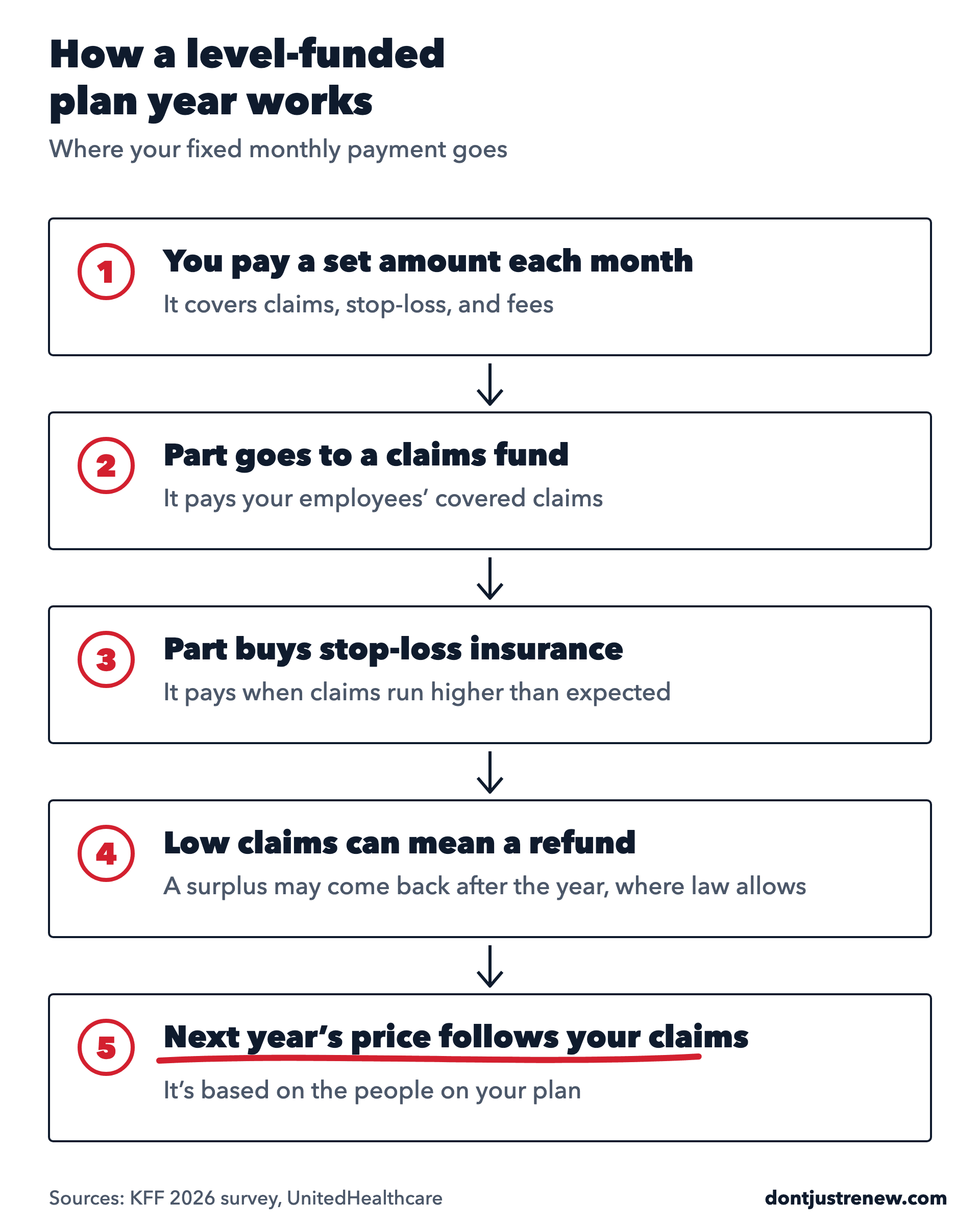
You pay one amount each month, and it doesn’t change during the plan year. UnitedHealthcare, for example, says its level-funded payment goes to three things: money set aside to pay your employees’ covered claims, administrative services like billing and claims processing, and a stop-loss policy for claims that run higher than expected.
At the end of the year, if more money went into the claims fund than came out, the plan may get a surplus refund. UnitedHealthcare says the refund comes after you renew and is available only where the law allows it. If claims ran high, stop-loss covers the overage for that year, but your group’s claims feed into next year’s price.
Three kinds of years on a level-funded plan
The easiest way to see the difference from an ACA plan is to run the same plan through a good year, an average year, and a bad one.
| Claims come in low | Claims come in as expected | Claims come in high | |
|---|---|---|---|
| During the year | Same monthly payment | Same monthly payment | Same monthly payment |
| Stop-loss insurance | Not needed | Not needed | Pays claims past the set limit |
| After the year | A surplus refund may come back, where the law allows | Little or nothing comes back | Nothing comes back |
| Next year’s price | Reflects the low claims | Follows rising costs | Reflects the high claims |
Sources: UnitedHealthcare’s level-funded page and KFF’s 2026 Employer Health Benefits Survey, checked November 7, 2026. Refund terms vary by vendor and contract.
On an ACA small business plan, all three columns look the same to you. You pay the premium, the insurer pays the claims, and next year’s price follows the increase your insurer files for its whole pool. Federal rules say that rate can vary only by whether it covers an individual or a family, the rating area, age, and tobacco use. We explain that pooling in our post on why claims raise renewals.
The smaller your company, the more one person can move a level-funded renewal. In a group of 15, one premature birth or cancer diagnosis is a big share of the year’s claims, even though stop-loss paid the largest bills.
Are level-funded plans ACA compliant?
Some of the ACA rules for insured small business plans don’t apply to them. Because a level-funded plan is self-funded, UnitedHealthcare says a business on one may be exempt from many ACA regulations and state premium taxes, including the adjusted community rating that sets small business prices. KFF notes that federal law, ERISA (the Employee Retirement Income Security Act), exempts private employers’ self-funded plans from most state insurance laws, including mandated benefits.
That cuts both ways. Insurers selling insured small business plans must cover the ACA’s essential health benefits package. A level-funded plan isn’t bound by that package, so compare the benefits line by line, not just the price.
Self-funding also moves some paperwork to your company. The administrator handles much of it, but some filings and fees become the employer’s job. Our post on self-funded health plan reporting requirements walks through them.
When does level funding make sense at renewal?
It tends to look best when your ACA renewal is high because of the insurer’s pool, not because of your own group. California’s January 2027 filings show how wide that pool effect can be: from 1.2% at Sutter Health Plan to 22.6% at one of UnitedHealthcare’s companies, for the same renewal month. For a fairly healthy group in a costly pool, being priced on your own claims instead is where the difference shows up most.
It tends to look worse when someone in your group is in expensive, ongoing treatment, since those claims would follow you into the level-funded price. The stop-loss limit, which KFF calls the attachment point, sets how much of a bad year your plan carries before the stop-loss insurer pays. Read it as closely as the monthly payment. Sana Benefits is one example of a level-funded option with its own renewal and refund rules.
What to check before you choose
- Ask how next year’s price will be set, and whether you’ll get a claims report during the year.
- Read the stop-loss terms: the limit per person, the limit for the whole group, and what happens to claims that come in after the plan year ends.
- Read the refund terms. Check how much of a surplus comes back, when, and whether you have to renew to get it.
- Check that the network covers your employees’ doctors and hospitals, and compare the benefits with the ACA plan you have now.
Don’t Just Renew is not associated with, endorsed by, or sponsored by UnitedHealthcare, Sutter Health Plan, or Sana Benefits. Their names are trademarks of their owners, and we use them only to describe public information. This article is general information, not insurance, tax, or legal advice. Figures are current as of November 7, 2026.