 Don’t just renew
What does a self-funded health plan have to report?
More than an insured plan does. When an insurance company carries the risk, it pays one federal fee and files some federal reports for you. On a self-funded plan, and on a level-funded plan, which is self-funded underneath, those jobs move to your company. A claims administrator can do much of the paperwork, but for some of it your company stays on the hook.
Quick answer
- A self-funded plan pays the PCORI fee itself. For a plan year that ended December 31, 2025, it was $3.84 per person covered, due July 31, 2026.
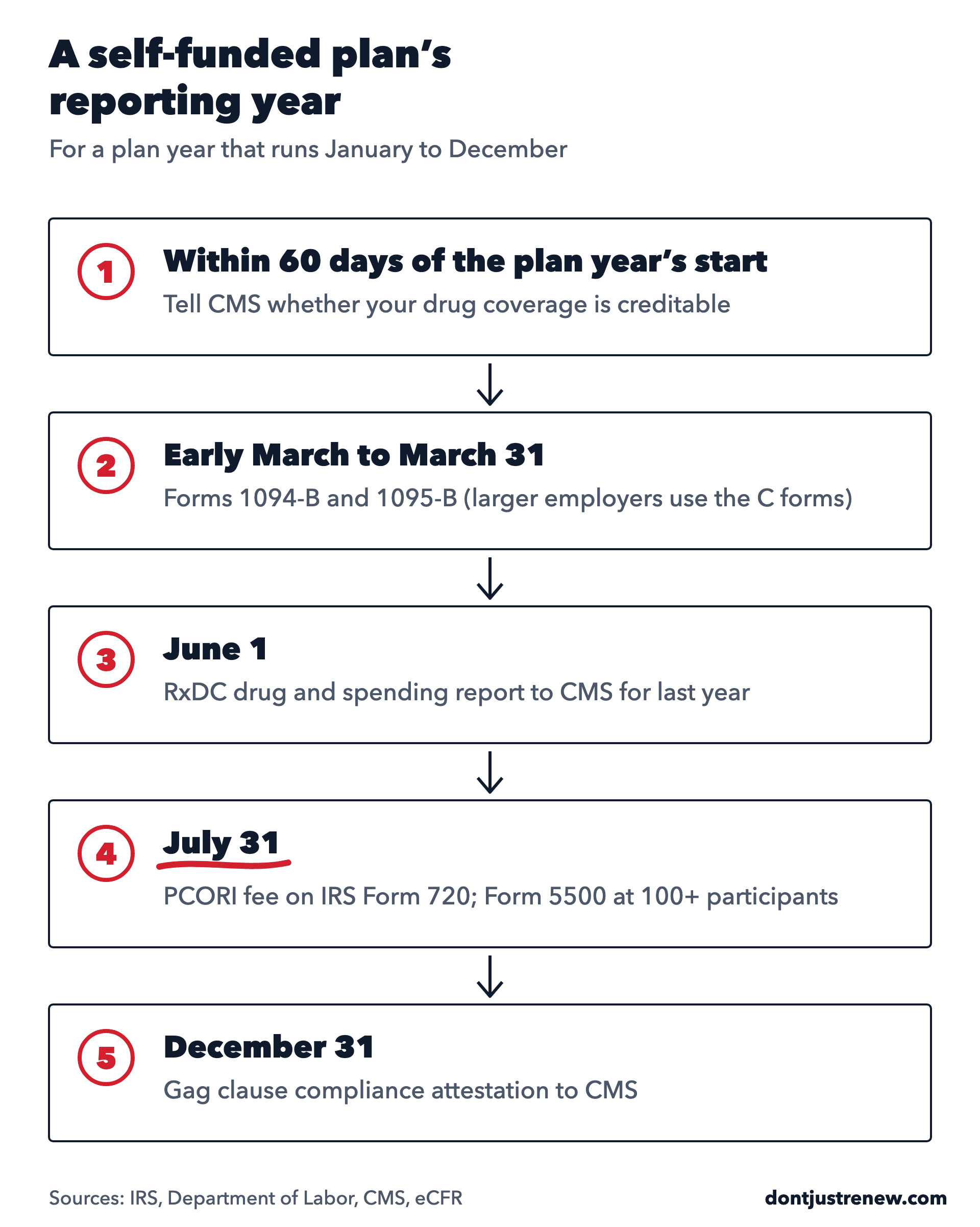
- It also files Forms 1094-B and 1095-B with the IRS (larger employers use the C forms) and owes CMS a drug and spending report, called the RxDC report, by June 1.
- Plans with fewer than 100 participants that pay claims from the company’s own accounts don’t file Form 5500.
- The fees are small. The bigger risk is a missed filing, because a vendor can file the RxDC report for you, but if it doesn’t, your plan is the one out of compliance.
What is a self-funded health plan?
A self-funded plan pays your employees’ medical claims with your company’s money instead of buying insurance that pays them. A claims administrator can run it for you, and stop-loss insurance can pay when claims pass a set limit.
It’s common at big companies and less so at small ones. In KFF’s 2026 employer survey, 71% of covered workers were in self-funded plans, including 25% at firms with 10 to 199 workers. Another 38% of covered workers at those smaller firms were in a level-funded plan, which KFF describes as a small self-funded plan paired with stop-loss insurance. KFF also notes that employers on these plans may not understand the self-funding underneath them.
What does a self-funded health plan have to report each year?
Six federal filings come up most often, and a self-funded plan handles more of them itself. The due dates below assume a plan year that runs January to December.
| Filing | Goes to | When it’s due | Fully insured plan | Self-funded plan |
|---|---|---|---|---|
| PCORI fee (Form 720) | IRS | July 31 after the plan year ends | The insurer pays it | Your company pays it |
| Forms 1094-B and 1095-B | IRS and the people covered | March 2, 2026 for 2025 coverage, or March 31 if filed electronically | The insurer files them | Your company files them, or the C forms if it’s a larger employer |
| RxDC report | CMS | June 1, for the year before | The insurer can take it on in a written agreement | A vendor can file it, but your plan stays responsible |
| Form 5500 | Department of Labor | Seven months after the plan year ends | Only at 100 or more participants | Only at 100 or more participants, if claims are paid from company accounts |
| Gag clause attestation | CMS | December 31 each year | Plans and insurers both attest | Your plan attests |
| Medicare drug coverage disclosure | CMS | Within 60 days of the plan year’s start | Your company files it | Your company files it |
Sources: IRS pages on the PCORI fee and coverage reporting, the 2025 instructions for Forms 1094-B and 1095-B, the RxDC rule at 29 CFR 2590.725-2, the Form 5500 rules at 29 CFR 2520.104-20 and 2520.104a-5, and CMS pages on the gag clause attestation and creditable coverage, all checked November 7, 2026.
Your company doesn’t have to mail every Form 1095-B. Under the IRS instructions, a plan can post a clear notice on its website saying people can ask for their form, with an email address, mailing address, and phone number, instead of mailing a form to everyone.
How much is the PCORI fee for a self-funded plan?
A few dollars per person covered, once a year. The fee funds the Patient-Centered Outcomes Research Institute, and the IRS charges it to the sponsor of a self-insured plan. It runs through plan years ending before October 1, 2029.
You report it on the second-quarter Form 720 and pay it by July 31 of the following year. The amount is the average number of people covered times the rate. For plan years ending October through December 2025, the rate was $3.84, according to the IRS rate chart, and for plan years ending January through September 2025 it was $3.47.
| Average number of people covered | Fee due July 31, 2026 |
|---|---|
| 25 | $96.00 |
| 40 | $153.60 |
| 75 | $288.00 |
Our calculation from the IRS rate chart, checked November 7, 2026. People covered includes employees’ family members on the plan.
The stop-loss policy doesn’t owe the fee, according to the IRS chart of which coverage it applies to. The plan sponsor does. A health reimbursement arrangement (HRA) can owe it too, unless it meets the rules for an excepted benefit.
ERISA and self-funded health plans: do you file Form 5500?
Only if your plan is big enough or funded a certain way. ERISA is the federal law that covers employer benefit plans, and Form 5500 is its yearly report to the Department of Labor. The small plan exemption skips the filing for a plan with fewer than 100 participants on the first day of the plan year whose benefits are paid from the company’s general assets, through insurance, or both.
So a small self-funded plan that pays claims out of company accounts doesn’t file. A plan with 100 or more participants on the first day of the plan year does, whether it’s insured or self-funded. If yours pays claims from a trust or a separate fund, ask your advisor whether the exemption still fits. When it’s required, Form 5500 is due seven months after the plan year ends, which is July 31 for a calendar-year plan. The Department of Labor’s Form 5500 page has the forms and Form 5558 for asking for more time.
Who files the RxDC report and the gag clause attestation?
A vendor can do the work, but on a self-funded plan the plan carries the responsibility. The RxDC report covers spending on prescription drugs and other health care, plus the premiums members and employers paid. CMS collects it for the federal agencies, and each year’s report is due June 1 for the year before.
The rule treats the two kinds of plans differently. An insured plan can have its insurer agree in writing to file, and then the insurer is the one in violation if it doesn’t. A self-funded plan can hire its pharmacy benefit manager or claims administrator to file, but if they don’t, the plan itself is in violation.
The gag clause attestation is a yearly statement that the plan’s contracts with doctors, networks, and administrators don’t block it from getting cost, quality, and claims data. CMS collects it, and it’s due by December 31 every year.
Do level-funded plans have the same reporting requirements?
Generally, yes. A level-funded plan is self-funded with stop-loss insurance attached, even though you pay a set amount each month like a premium. The fee and filings above follow the self-funded part of the plan, not the stop-loss policy. Sana Benefits is one example of a level-funded option for small businesses. Whoever runs yours, the services agreement should spell out which filings the vendor handles and which stay with you.
Your first year after switching
Moving from a fully insured plan to a level-funded or self-funded one at renewal adds a set of yearly deadlines, and the first ones show up after your first plan year ends. For a plan that switches on January 1, 2027, that means Forms 1095-B in early 2028, the RxDC report by June 1, 2028, and the PCORI fee by July 31, 2028. The gag clause attestation is due by December 31 each year along the way.
The Medicare drug coverage disclosure is already your company’s job on an insured plan, so that one doesn’t change. If your company grows past 100 participants, Form 5500 starts too.
Before you sign a self-funded or level-funded contract
- Get a written list from your claims administrator of the filings it handles, like the RxDC report, Forms 1095-B, and the gag clause attestation, and the ones it leaves to you.
- Put the PCORI fee on the calendar for July 31 after your first plan year ends, and decide who will count the average number of people covered.
- Check how many participants the plan will have on the first day of the plan year and how claims get paid, so you know whether Form 5500 applies.
- Read the plan documents to confirm whether the plan is fully insured, level-funded, or self-funded.
This article is general information, not insurance, tax, or legal advice. Figures are current as of November 7, 2026.