 Don’t just renew
Employer of record vs PEO: who’s the employer, and whose health plan covers your team?
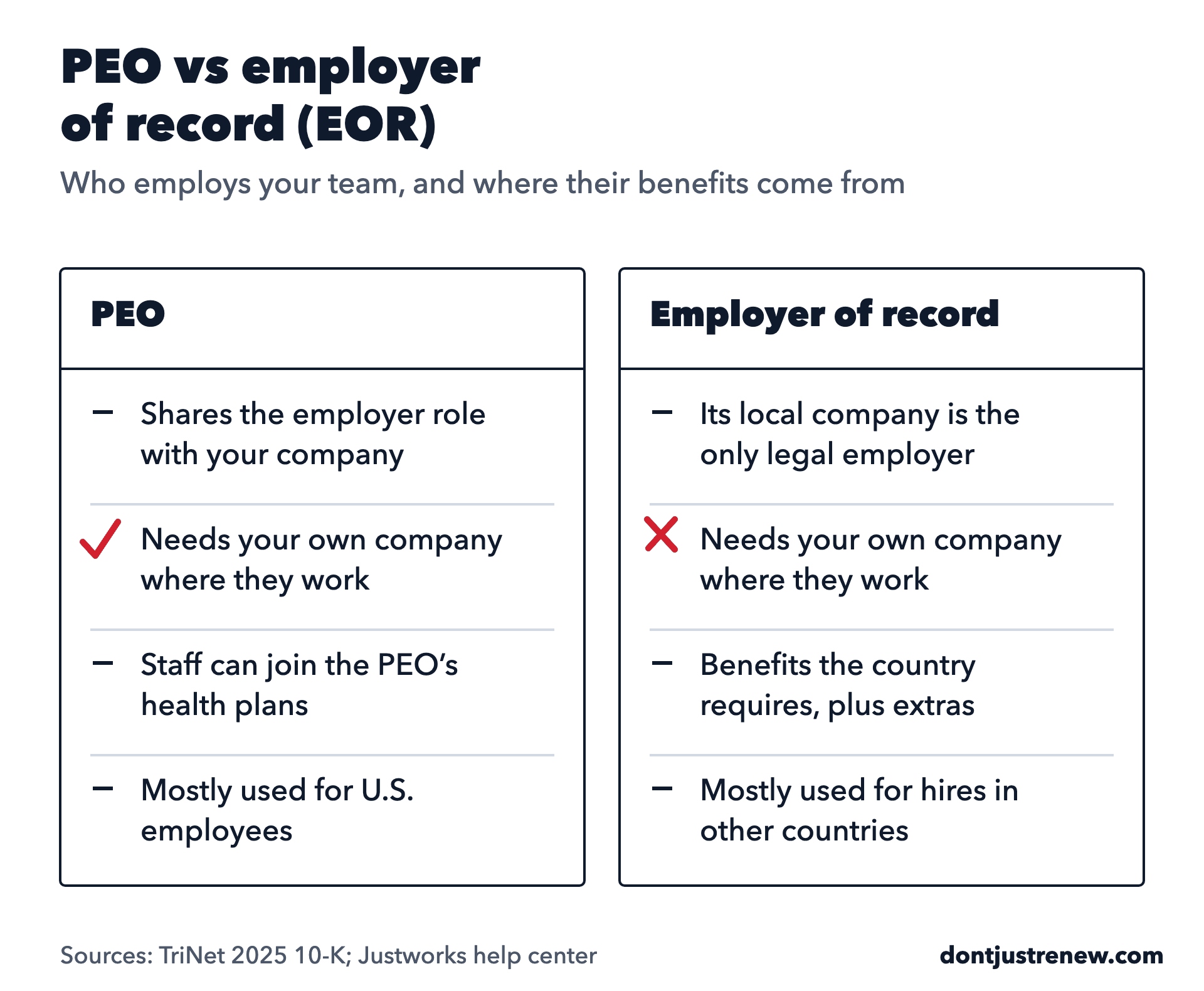
An employer of record, or EOR, becomes the only legal employer of someone who works for you, usually in a country where your company doesn’t exist. A PEO shares the employer role with your own company, mostly for employees in the U.S. That difference decides whose health plan, and which country’s rules, cover the person.
In brief
- With a PEO, your company has to exist where the employees work. The PEO becomes a co-employer and can put them on its health plans.
- With an EOR, the EOR’s own local company employs the person while you direct the work. They get the benefits their country requires, plus any extras offered there.
- PEOs also call themselves the “employer of record” for payroll taxes and benefits, which is why the two terms get mixed up.
- At Justworks, which sells both, the EOR fee is about five times the fee for its PEO with health benefits, by our math.
What is an employer of record?
An employer of record is a company that legally employs a worker on your behalf, in a place where your business has no legal presence. Justworks, which sells this service, describes it this way: its company in that country is the legal employer, and you keep directing the role, including the job title, duties, salary, and day-to-day work.
The EOR writes a local employment contract, runs local payroll, and withholds and pays both the employee’s and the employer’s taxes. The worker gets the same protections and required benefits as anyone else employed in that country. Justworks lists 43 countries and territories where it can hire this way, by our count, from Brazil to the United Kingdom.
An EOR worker isn’t a contractor. A contractor runs their own business, sets their own hours and methods, and pays their own taxes. Justworks notes that the laws where the person lives decide which one they are, based on how the work is really done, whatever the contract calls it.
Why PEOs call themselves the employer of record too
TriNet, one of the largest PEOs, says in its 2025 annual report (Form 10-K) that it’s the employer of record “for certain employment-related administrative and regulatory purposes”: paying wages, withholding and paying payroll taxes, running benefit programs like health and life insurance, and covering workers’ compensation. Its clients stay responsible for the employees’ day-to-day work.
So in a PEO, “employer of record” describes a set of tasks the PEO handles while your company stays an employer too. That’s co-employment, which our post on what a PEO is walks through. The IRS backs up one piece of it: a certified PEO is generally solely liable for the federal employment taxes on the wages it pays your employees.
TriNet uses the term the other way too. For clients with employees outside the U.S., it says it provides payroll and HR support through “international employer of record partners.” Less than 1% of its revenue comes from outside the U.S.
EOR vs PEO: the main differences
The biggest difference is whose company does the employing where the person works. Justworks says that with a PEO, you have to own the local company and enter a co-employment arrangement, where the law allows one. An EOR lets you hire in another country without a company there, including where co-employment isn’t allowed. The EOR’s local company employs the person directly.
Price is the other big gap. Justworks’ pricing page lists its EOR at $599 a month per employee and its PEO Plus plan, the one with health insurance, at $124. By our math, that’s about $7,190 a year per employee for the EOR against about $1,490 for the PEO. Both are service fees. Wages, employer taxes, and benefit costs come on top.
How does health coverage work under each?
With a PEO, your U.S. employees can join the PEO’s health plans. TriNet says its co-employment model gives worksite employees access to TriNet-sponsored benefit plans. Some PEOs also set up small group plans in your company’s name instead, like the open market plans in our Justworks health insurance post.
With an EOR abroad, coverage starts with whatever that country requires employers to provide. Justworks says its EOR employees get statutory benefits and leave, and that companies can add supplemental benefits in certain markets. Those extras renew on their own schedule. Justworks’ supplemental plan for its EOR employees in Canada, insured by Sun Life, renewed on April 1, 2026, and Justworks says its premiums can change each year with claims and health care costs.
Can a small business use a PEO and an EOR at the same time?
Yes, and some providers sell it that way. Justworks offers its EOR as an add-on to both of its PEO plans. TriNet runs its PEO for U.S. employees and sends clients’ employees abroad to EOR partners. A company with 20 people in the U.S. and two in Portugal could have the 20 in a PEO and the two through an EOR.
At renewal, the two run on separate tracks. Your U.S. employees’ health plan renews when the PEO’s plan does. For Justworks’ own large group plans, the current plan year started November 1. Changes in what the PEO charges for health coverage show up in its invoice. An EOR employee’s benefits aren’t part of that renewal. Their costs come from the EOR’s fee, the country’s required employer costs, and any extras you added there.
How to tell which one you need
- Where the person will live and work, and whether your company is registered there.
- Whether you’ll direct their day-to-day work. If they’ll set their own hours and methods on a defined project, they may be a contractor instead.
- For U.S. employees in a PEO, whether they’d join the PEO’s health plan or a plan in your company’s name.
- For a hire abroad, which benefits that country requires and which extras the EOR offers there.
Don’t Just Renew is not associated with, endorsed by, or sponsored by Justworks or TriNet. Their names are trademarks of their owners, and we use them only to describe public information. This article is general information, not insurance, tax, or legal advice. Figures are current as of November 12, 2026.