 Don’t just renew
What is a PEO, and what happens to your health plan when you join one?
A PEO, short for professional employer organization, is a company that becomes a co-employer of your staff, sharing the employer role with you by contract, so it can run payroll, HR, and benefits for you. When you join one, your employees can get their health coverage through the PEO’s plan, a single plan that covers workers at many client companies. That changes who sponsors the plan, which rules apply to it, and what sets your price each year.
At a glance
- A PEO runs payroll, payroll taxes, HR paperwork, and benefits as a co-employer. Your company still runs the work.
- Its health plan covers employees of many clients at once. The four public PEOs we checked all say they carry part of the claims cost themselves.
- The Labor Department says a PEO plan covering two or more client companies is a multiple employer arrangement that states can regulate. TriNet, a large public PEO, says it’s the single employer.
- By our math, insurance was 84% of TriNet’s 2025 revenue, and benefits were about 65% of revenue at ADP’s PEO.
What does a PEO do?
A PEO company takes on a set of employer jobs for you under a contract, usually called a client service agreement. In TriNet’s version, described in its 2025 annual report (Form 10-K), the PEO pays wages from its own bank accounts, withholds and pays payroll taxes, and gives your employees access to the health and retirement plans it sponsors. Your company still manages the work, reports hours and pay, and pays the PEO’s invoice for wages, taxes, and fees.
The IRS says PEOs are typically paid a fee based on payroll costs, and it certifies PEOs that apply and qualify. A certified PEO (CPEO) is generally solely liable for the federal employment taxes on the wages it pays your employees. The certification is about payroll taxes only.
The health plan comes with co-employment. TriNet also sells a lighter service without co-employment, and its 10-K says those clients don’t get TriNet’s health plans.
How does PEO health insurance work?
The PEO sponsors one health plan, buys coverage from one or more carriers, and enrolls employees from all its clients. Your employees pick from its plan options at open enrollment, and the cost shows up on the PEO’s invoice instead of an insurer’s premium bill.
Three of the four public PEOs below describe their plans as fully insured, and all four say they carry part of the claims cost themselves. It works a bit like a level-funded plan, spread across all of the PEO’s clients.
| PEO | What its latest annual report says about the plan | Latest cost change it reported |
|---|---|---|
| ADP TotalSource | ADP keeps the risk on benefits it bills to clients and passes through at zero margin (no markup) | Benefit pass-throughs up 7% in fiscal 2026, with 2% more worksite employees |
| Insperity | Fully insured; UnitedHealthcare’s policy covers about 85% of costs, and Insperity accounts for it as partly self-funded | Health cost per covered employee up 9.2% in 2025 |
| Paychex | Fully insured guaranteed-cost plans, or fully insured plans where Paychex keeps some risk | PEO direct insurance costs up 8% in fiscal 2026, to $563.2 million |
| TriNet | Mostly fully insured “risk-based” policies, where TriNet repays carriers for each person’s claims up to a set amount | Insurance costs were 91% of insurance revenue in 2025, up from 84% in 2023 |
Sources: ADP fiscal 2026 10-K, Insperity 2025 10-K, Paychex fiscal 2026 10-K, and TriNet’s 2025 10-K.
On a guaranteed-cost policy, the carrier sets the premium and pays the claims. Our post on Insperity PEO health insurance walks through one plan in detail.
Is a PEO plan one big plan or many small ones?
It depends on who you ask, and the answer decides which rules apply. Big PEOs like TriNet see themselves as the employer and their plan as one employer’s plan. The Labor Department sees a plan that covers employees of more than one employer.
The Labor Department’s guide to multiple employer welfare arrangements, updated in April 2022, says a PEO plan that covers employees of two or more client employers is a MEWA (its term for one benefit arrangement covering several employers) under ERISA, the federal law for employer benefit plans. It says a PEO’s “co-employer” label under other laws doesn’t settle the question, and that states can apply their insurance laws to these arrangements, to a degree that depends on how the plan is set up.
TriNet disagrees. Its 10-K says it’s the sole employer of its worksite employees under ERISA, so its health plans are single-employer plans, and that other national PEOs take the same position.
Some PEO plans do report as MEWAs. In the Labor Department’s 2023 Form M-1 bulletin, the three largest arrangements filing as MEWA plans all appeared to be PEO plans, each with more than 200,000 participants. By our math, those three held about a third of the nearly 3 million people reported on these filings.
State laws differ. Texas licenses PEOs, lets one sponsor a single plan for employees of many clients, and treats a fully insured plan (or a self-funded one the state approves) as a single-employer plan under state law, under Texas Labor Code section 91.041. Florida licenses this kind of shared-employer setup as employee leasing and bars the companies from self-insuring a health plan unless its insurance code or ERISA allows it.
How the plan is treated where you are decides, for example, whether the small business rating rules in our post on how small business rates are set apply to your employees’ coverage.
How much of what a PEO charges is the health plan?
Most of it, judging by the revenue of the two big PEOs that break it out. By our math from TriNet’s 10-K, insurance (health benefits and workers’ compensation) brought in $4.22 billion of its $5.01 billion in 2025 revenue, or 84%. ADP’s PEO booked $4.61 billion in benefit costs it passes through with no markup, out of $7.13 billion in PEO revenue for the year ended June 30, 2026. That’s about 65%.
So the plan’s claims drive much of a PEO’s price. Insperity said its cost of group health insurance and related benefits rose $61 per worksite employee per month in 2025, or 9.2% per covered employee.
What changes at renewal when you’re in a PEO?
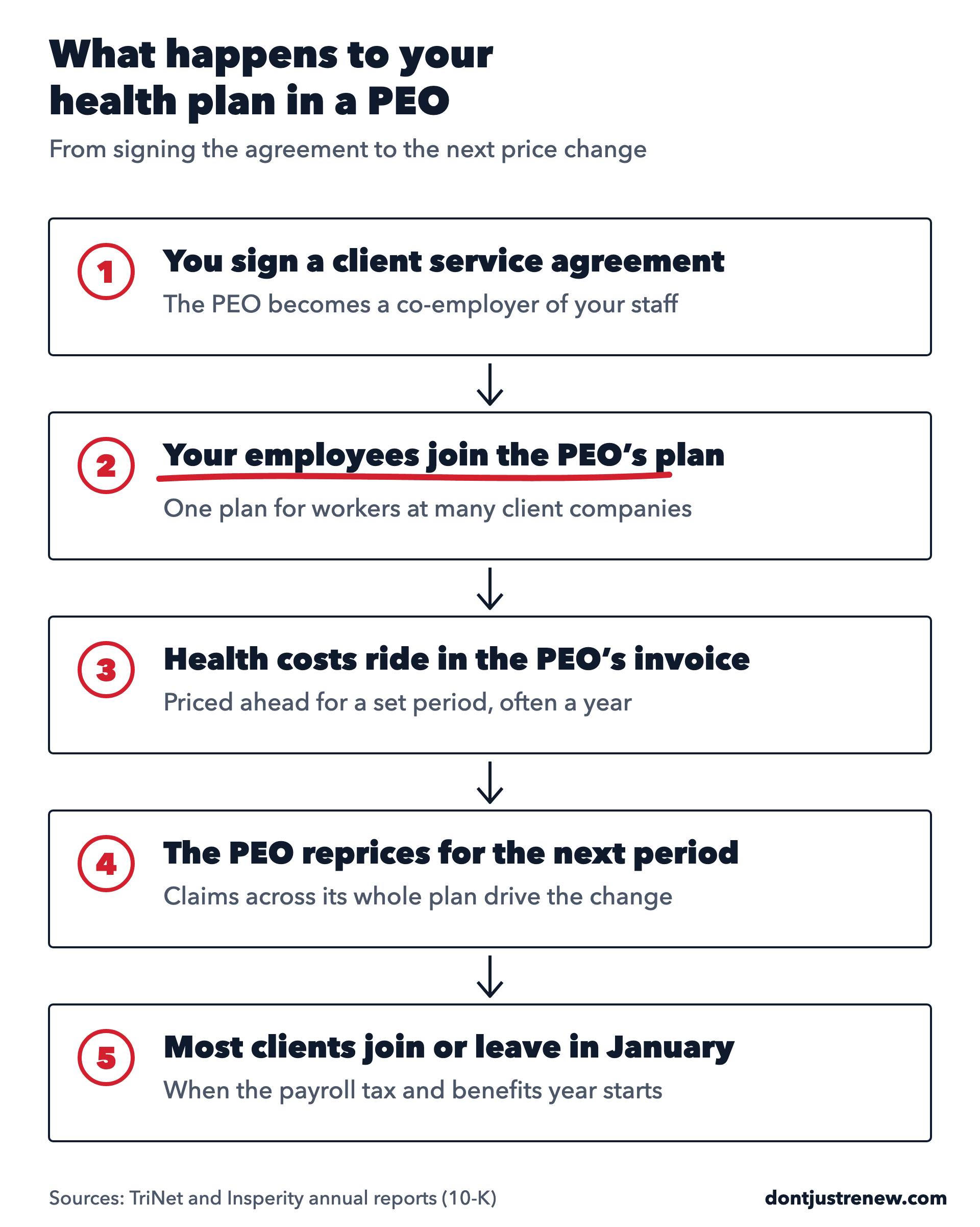
Your renewal follows the PEO’s own plan and pricing. TriNet sets its insurance fees ahead of time for fixed benefit periods. Insperity’s contracts generally set pricing for 12 months, or two years for its larger clients, and most can be ended by either side on 30 days’ notice.
When claims come in higher than the PEO planned for, it absorbs the difference until it reprices. At TriNet, higher prices for outpatient care and doctors’ services and more use of costly drugs, including diabetes and obesity drugs, pushed insurance costs to 91% of insurance revenue in 2025. It raised prices, and it says that repricing was part of why its worksite employees fell 10% that year.
ADP’s benefit pass-throughs rose 7% in its latest fiscal year while its average worksite employees grew 2%. By our math, that’s roughly 5% more per worksite employee.
Most moves happen in January. TriNet says PEO clients generally switch at the start of the payroll tax and benefits year, so that’s when it gains and loses the most clients.
Companies with at least 50 full-time employees, counting full-time equivalents, fall under the ACA’s employer mandate. In the typical case, where the PEO isn’t your employees’ common law employer (the one that directs and controls their work), an offer of coverage through the PEO’s plan counts as yours only if your fee for an employee who enrolls is higher than for the same employee who doesn’t. That’s the IRS rule in 26 CFR 54.4980H-4, and the 2014 rule that set it names PEOs.
What to ask about a PEO’s health plan
- Whether the plan is fully insured, partly insured, or self-funded, and which insurer covers your employees in your state. Texas requires licensed PEOs to tell each client this.
- How long your price is locked, and how much notice you get before it changes.
- Whether your price moves with your own employees’ claims or only with the whole plan’s costs.
- If you have 50 or more full-time employees, whether your fee is higher for employees who enroll, since that’s what makes the PEO’s offer count as yours.
Don’t Just Renew is not associated with, endorsed by, or sponsored by ADP, Insperity, Paychex, or TriNet. Their names are trademarks of their owners, and we use them only to describe public information. This article is general information, not insurance, tax, or legal advice. Figures are current as of November 11, 2026.