 Don’t just renew
How does Insperity PEO health insurance work, and what sets your renewal?
With Insperity, your employees get health coverage through one large plan that Insperity sponsors for all its clients, mostly insured by UnitedHealthcare. Your company doesn’t buy a policy of its own. The plan’s cost is built into the service fee Insperity charges you, and that price is usually reset once a year.
The short answer
- Insperity sponsors a single health plan for the employees of its PEO clients. About 85% of its health insurance costs run through a UnitedHealthcare policy.
- Your health cost is part of Insperity’s service fee, priced for 12 months at a time. Either side can end the agreement on 30 days’ notice.
- Insperity’s health plan cost per covered employee rose 9.2% in 2025 and 4.6% in the first nine months of 2026, according to its SEC filings.
- Its prices rose about 3% in 2025, behind its costs. In the third quarter of 2026, average pricing was up 4%.
What is Insperity PEO Services?
Insperity PEO Services, L.P. is one of the companies owned by Insperity, a public company based in Kingwood, Texas, according to the subsidiary list in its annual report. Insperity is a PEO, short for professional employer organization: a company that shares the employer role with yours so it can run payroll, HR, and benefits for you.
Under Insperity’s client service agreement, the two companies become co-employers of the people who work for you, according to its 2025 annual report (Form 10-K). Insperity handles personnel administration and helps with employment law, and your company keeps running the business and stays the employer for other purposes. Insperity calls those people worksite employees. It averaged 312,377 of them a month in the fourth quarter of 2025.
The health plan comes with Insperity’s two PEO offerings, HR360 and HRScale, which its site lists with employee benefits and co-employment. Its third option, HRCore, is HR software backed by a service team and isn’t listed as a PEO.
Who insures Insperity’s health plan?
Mostly UnitedHealthcare. Insperity runs one plan for its worksite employees and its own staff, and it buys coverage from several carriers: UnitedHealthcare, UnitedHealthcare of California, Kaiser Permanente, Blue Shield of California, HMSA BlueCross BlueShield of Hawaii, and Harvard Pilgrim Health Care. About 85% of the plan’s health insurance costs fall under the UnitedHealthcare policy, the 10-K says.
That policy is fully insured, so UnitedHealthcare pays covered claims. But Insperity keeps an obligation to fund the plan’s cost, so it accounts for the plan as partly self-funded. UnitedHealthcare sets funding rates 90 days before each quarter, based mainly on recent claims and expected cost trends. When claims cost more than those rates bring in, Insperity books the shortfall as money it owes; when they cost less, it books a surplus. That works a bit like a level-funded plan, run across all of Insperity’s clients at once.
In November 2025, Insperity and UnitedHealthcare extended the arrangement through 2028. The amendment lets Insperity choose each year to cap its share of any one person’s claims at $500,000, $750,000, or $1 million. Either side can cancel the contract on 180 days’ notice.
How is Insperity health insurance priced?
Insperity doesn’t publish health insurance rates. Its pricing page says the service fee has two parts. One covers the direct costs of employing your staff: payroll taxes, workers’ compensation, employee access to benefits, and employer liability coverage. The other is an HR service charge, a fixed dollar amount per employee that depends on the size of your business and doesn’t go up when you give raises. So the health plan shows up inside your quote, not on a separate premium bill.
To set that price, Insperity estimates the direct costs of your employees, including benefits, and adds a profit margin, according to its third-quarter 2026 report (Form 10-Q). Its client contracts generally set pricing for 12 months and can be canceled by either side on 30 days’ notice. The filings don’t say how much of one client’s price depends on that client’s own claims and how much on the plan as a whole.
Not every worksite employee joins the plan. In the first nine months of 2026, 62% were covered, down about a point a year from 65% in 2023.
Why Insperity’s health costs matter at your renewal
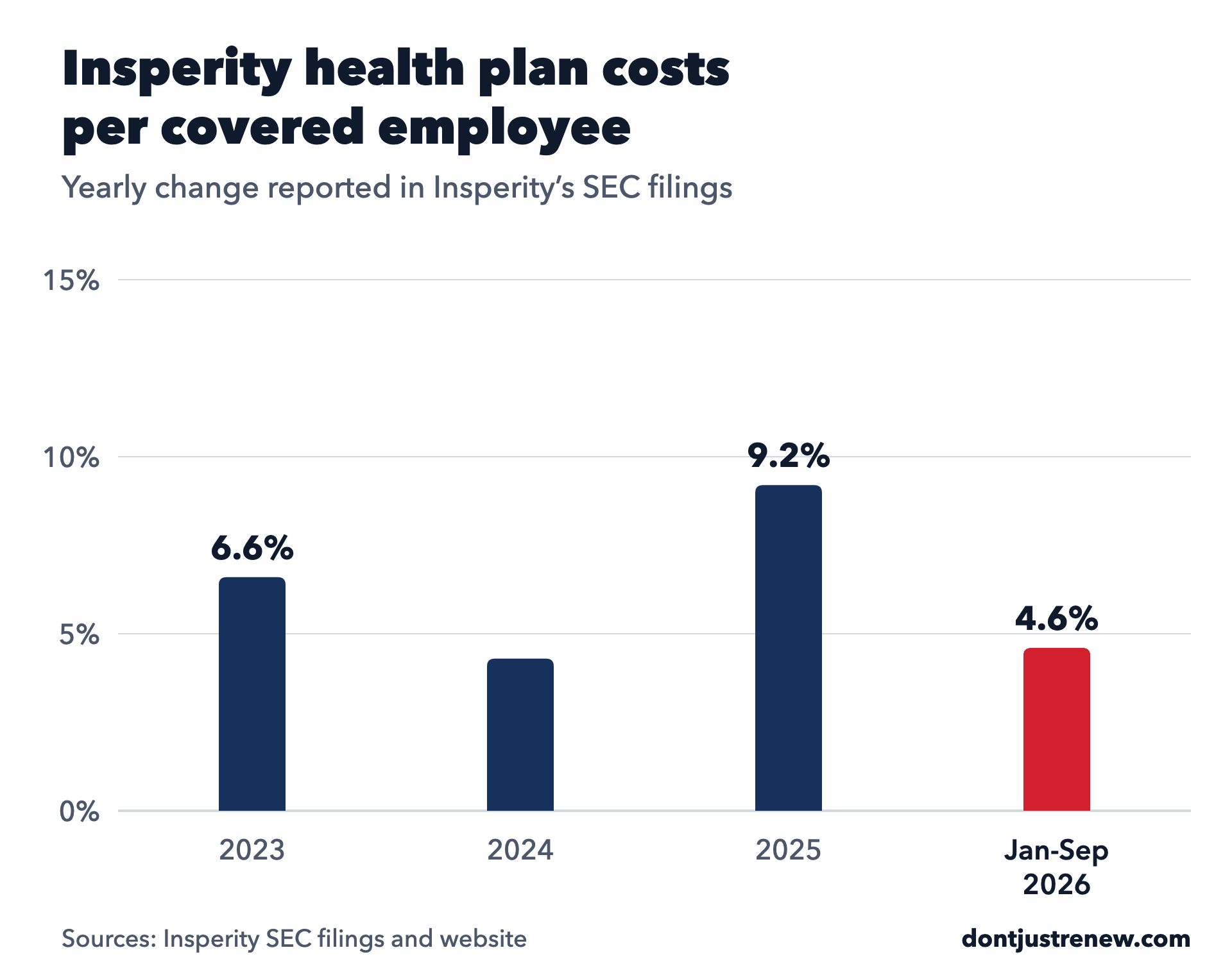
Insperity’s cost of group health insurance and related benefits per covered employee rose 6.6% in 2023 (2023 10-K), 4.3% in 2024, and 9.2% in 2025. By our math, those three years add up to about 21%. In the first nine months of 2026, the increase slowed to 4.6%.
Prices fell behind in 2025. The 10-K says Insperity’s pricing rose 3% that year while its direct costs per worksite employee rose 6%, mostly because benefits costs per participant rose 9%. It also says contracts and competition can limit or delay how fast it raises fees when plan costs jump. In 2026, average pricing was up 4% in the third quarter, and Insperity says its margin recovery efforts were one reason fewer worksite employees came from new sales and from clients who stayed.
So an Insperity renewal follows the whole plan’s costs and Insperity’s pricing goals, and neither is published ahead of time.
How it differs from an ACA small business plan
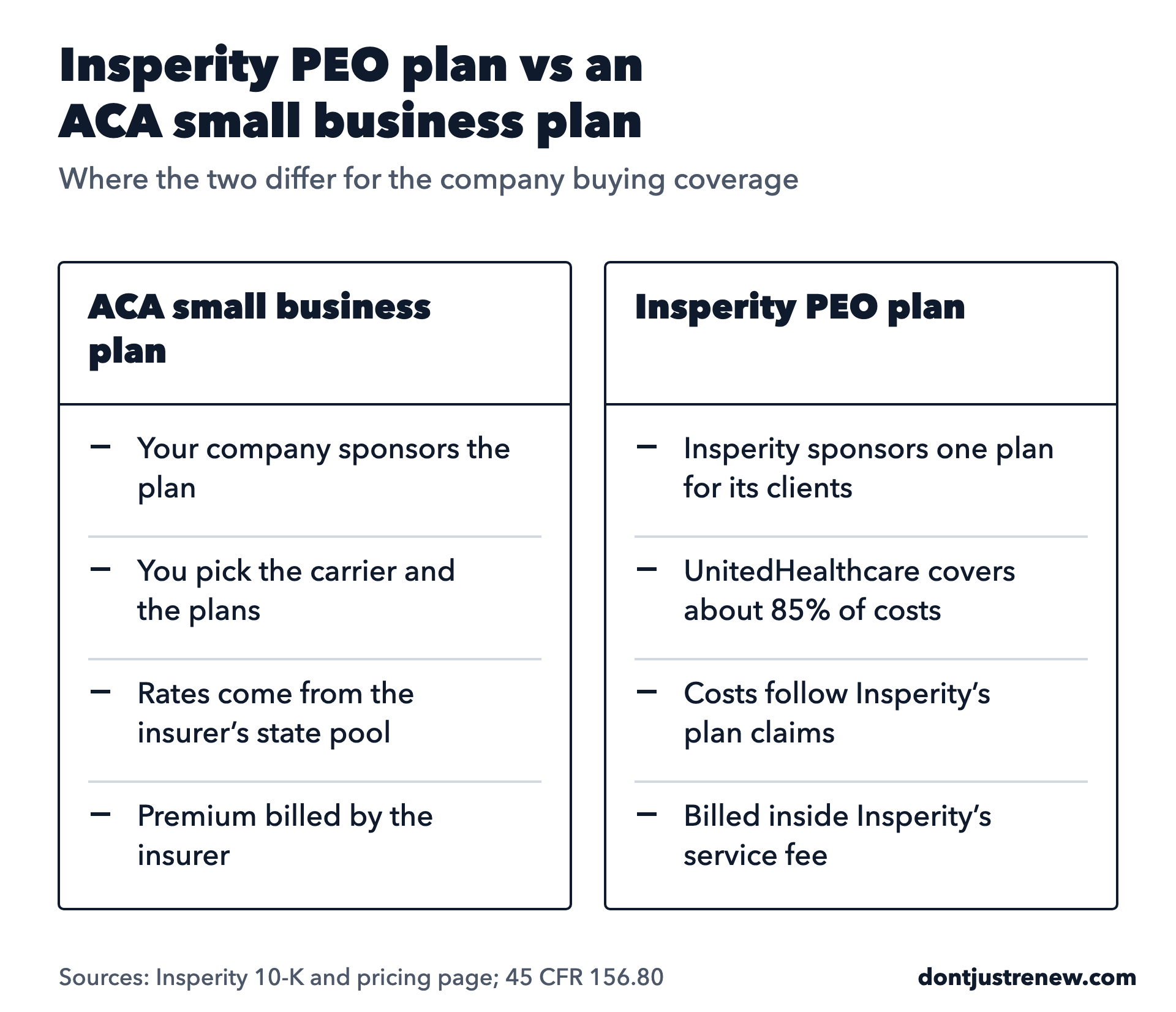
With an ACA small business plan, your company sponsors the plan and buys it from an insurer. The insurer has to price all its small business plans in your state from one pool of customers, under federal rules, and our guide to how small business rates are set walks through the rest. With Insperity, Insperity sponsors the plan, the health cost rides on one invoice with payroll and HR services, and the cost follows Insperity’s plan. Coverage through Insperity’s plan is tied to being an Insperity client, so it ends if your company leaves.
Which companies use Insperity?
Insperity sells to small and medium-sized businesses, and its site pitches a single partner and a single invoice for HR, payroll, and benefits. Companies with about 150 to 5,000 worksite employees, which it calls the middle market, made up 29% of its worksite employees in the first nine months of 2026. Clients with more than 1,000 made up 2% in 2025.
Its clients are spread across 44 sales markets. In 2025, Texas held 17% of its worksite employees (8% in Houston alone), California 15%, and New York 10%.
Four things to get in writing from Insperity
- The health plan’s share of your service fee, per employee, and how much it changed from last year.
- Which carrier and network your employees will use in your state.
- Whether your own group’s claims affect your price, or only the plan’s overall costs.
- What happens to your employees’ coverage, and when, if either side ends the agreement.
Don’t Just Renew is not associated with, endorsed by, or sponsored by Insperity. Insperity is a trademark of its owner, and we use the name only to describe public information. This article is general information, not insurance, tax, or legal advice. Figures are current as of November 10, 2026.