 Don’t just renew
The group health insurance renewal timeline, from rate filing to your notice
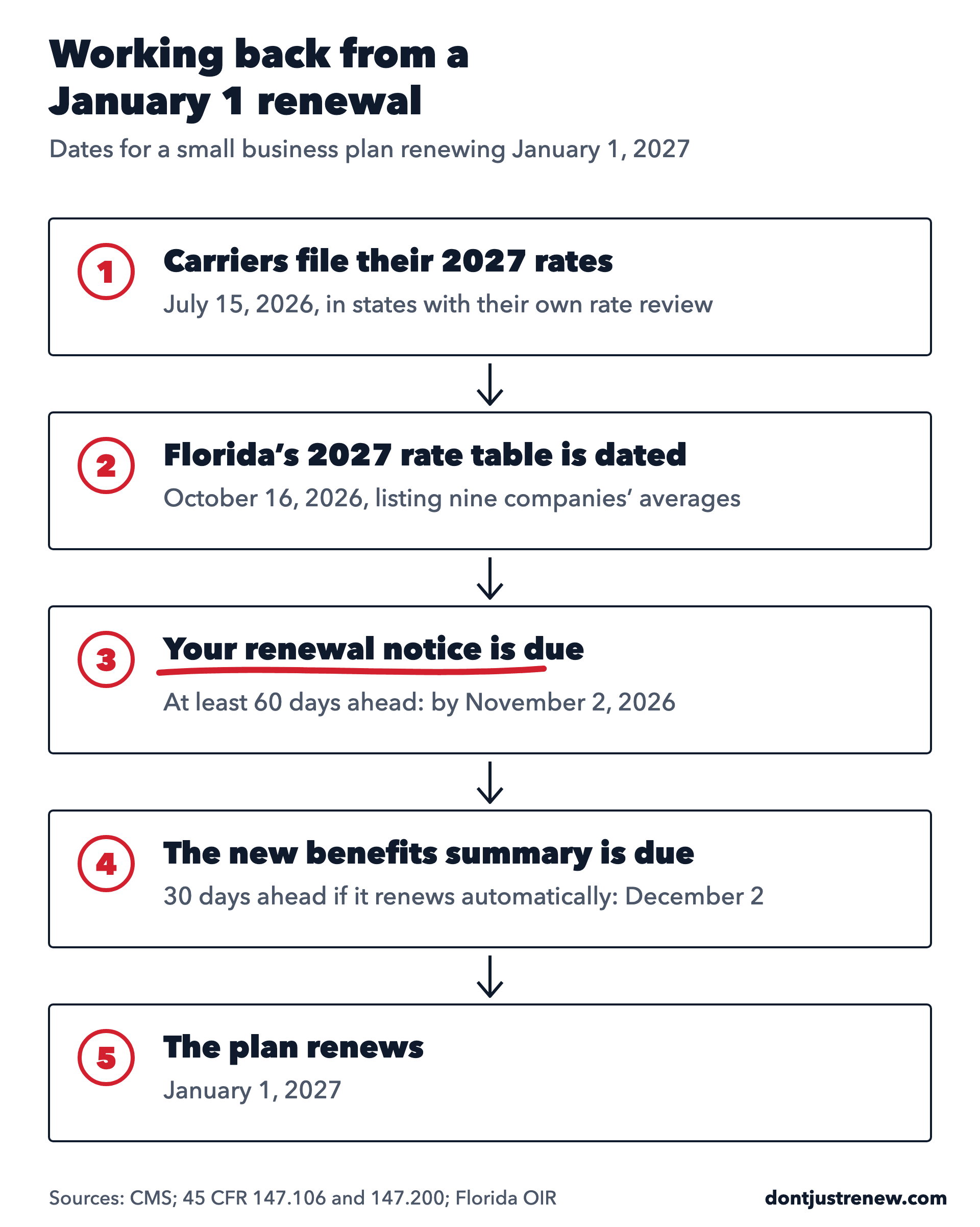
Most of a small business health insurance renewal is settled before your notice shows up. Carriers file next year’s rates in late spring or summer, and states finish reviewing them by mid-October. Federal rules only require your renewal notice 60 days before the plan renews. For a January 1 renewal, that’s November 2.
The short version
- Carriers filed their 2027 rates with the federal government by June 1 or July 15, 2026, depending on the state.
- A carrier has to send written notice of a small business renewal at least 60 days ahead, and a new benefits summary at least 30 days ahead if the plan renews automatically.
- A small business can buy coverage any time of year. Only groups that miss a carrier’s participation or contribution rules can be held to a November 15 to December 15 window.
- By our math, 110 days pass between the July 15 filing deadline and the November 2 notice deadline for a January 1 renewal. You get the 60 days after that.
When does a group health insurance renewal start?
It starts months before your notice arrives. Carriers build next year’s small business rates from claims they’ve already paid. AvMed’s 2027 Florida rates, for example, start from its small business claims for 2025, paid through March 2026, according to its actuarial memo, the technical report filed with the rates. Its actuary signed that memo on June 11, 2026. That’s 204 days before January 1, by our math.
The filing calendar comes from CMS, the federal agency that runs the rate review site. For 2027 plans, carriers had to file proposed rates by June 1, 2026, in states without their own rate review program, and by July 15 in states with one, according to CMS’s 2026 key dates. CMS aimed to post the proposed increases by July 31 and the final ones by October 30.
States with their own review had until October 15 to finish filings for plans sold only outside the government marketplaces. Florida’s insurance regulator put out its 2027 small business averages in a table dated October 16, 2026, 77 days before January 1.
How much notice does a carrier have to give before renewal?
At least 60 days. Under 45 CFR 147.106, a carrier renewing a small business plan has to send the employer written notice at least 60 calendar days before the renewal date. That includes renewals where the carrier changes the plan in the ways the rule allows at renewal. For a January 1, 2027 renewal, the notice was due by November 2, 2026.
Next comes a new summary of benefits and coverage (SBC), the standard short document that shows what a plan covers and what people pay. Under 45 CFR 147.200, if the plan renews automatically, the carrier has to provide it at least 30 days before the new plan year. That’s December 2 for a January 1 renewal. If renewing takes a written application, the SBC has to come with the application materials. Employees get theirs on the same schedule.
Carriers have to renew at the employer’s option, with a few exceptions like unpaid premiums, fraud, or not meeting the carrier’s participation or contribution rules. Ending coverage takes longer notice: 90 days if a carrier stops selling a plan, along with an offer of its other plans, and 180 days if it leaves the market. Health Net’s exit from California’s group market is running on that 180-day clock. These are the federal rules. Your state insurance department can tell you whether state law adds anything.
A January 1, 2027 renewal, date by date
| Date | What happens |
|---|---|
| 2025 | The claims year AvMed’s 2027 Florida rates are built from |
| June 11, 2026 | AvMed’s actuary signs its 2027 Florida rate memo |
| July 15, 2026 | Federal filing deadline in states with their own rate review |
| October 15, 2026 | States’ deadline to finish filings for plans sold outside the marketplaces. Notices to Medicare-eligible people on plans with drug coverage must go out before this date. |
| October 16, 2026 | Date on Florida’s table of 2027 small business averages |
| October 30, 2026 | CMS’s target for posting final rate changes |
| November 2, 2026 | Last day for the carrier’s written renewal notice |
| November 15 to December 15, 2026 | Enrollment window for groups that don’t meet a carrier’s participation or contribution rules |
| December 2, 2026 | Last day for the new SBC if the plan renews automatically |
| January 1, 2027 | The plan renews |
| March 2, 2027 | Last day to tell CMS online whether the plan’s drug coverage is creditable |
Sources: CMS key dates for 2026; 45 CFR 147.104, 147.106, and 147.200; CMS creditable coverage page; AvMed’s 2027 actuarial memo; Florida Office of Insurance Regulation. All checked November 13, 2026. Dates counted from the rules are our math.
By our math, 110 days pass between the July 15 filing deadline and the November 2 notice deadline. A carrier can send its notice sooner, but the rule doesn’t make it. Once the notice arrives, the federal minimum leaves 60 days to look it over, and the SBC can come as late as 30 days out.
The two Medicare rows apply when someone on the plan is eligible for Medicare. Plans with drug coverage have to tell those people, before October 15 each year, whether the coverage is creditable, meaning it’s expected to pay on average as much as Medicare’s standard drug coverage. They also have to report that status to CMS online within 60 days after the plan year starts, according to CMS.
What are the open enrollment rules for employers?
A small business can buy group coverage any day of the year. Under 45 CFR 147.104, carriers can’t hold employers to an open enrollment period, with one exception. If a group can’t meet a carrier’s rules on participation (how many eligible employees sign up) or on how much the employer pays, the carrier can limit it to a yearly window from November 15 to December 15.
If the carrier gets a group’s enrollment between the 1st and the 15th of a month, coverage has to start by the 1st of the next month. From the 16th on, it has to start by the 1st of the month after that. An employer can pick a later start date within the same quarter, if the carrier has rates for it.
These rules don’t set the dates of your employees’ own open enrollment, when they choose plans or make changes for the new year. Employees still get their SBCs on the schedule above.
Why renewals outside January work differently
Plenty of companies don’t renew in January. KFF’s 2026 Employer Health Benefits Survey notes that many firms have plan years that don’t line up with the calendar year. By our math, a July 1 renewal needs its notice by May 2, and an October 1 renewal by August 2.
At some carriers, the renewal month changes the price too. Florida Blue’s 2027 Florida filings set January rates and then add a slice of the year’s cost growth each quarter. So a group renewing in April, July, or October pays more for the same plan than one renewing in January, as our Florida Blue post explains.
Dates to put on your calendar
- Sixty days before renewal: the carrier’s written notice. If it hasn’t come, ask the carrier for it.
- Thirty days before: the new SBC, if your plan renews automatically. Put it next to last year’s to spot changes in deductibles and copays.
- Before October 15, if anyone on the plan is eligible for Medicare: the notice saying whether the plan’s drug coverage is creditable. Check that it went out.
- Within 60 days after renewal: the online creditable coverage report to CMS.
This article is general information, not insurance, tax, or legal advice. Figures are current as of November 13, 2026.