 Don’t just renew
Florida Blue small business plans: 11.8% for 2027, and a $380 gap between its three companies
Blue Cross and Blue Shield of Florida, Florida Blue’s main small business company, is raising rates an average of 11.8% for 2027, according to Florida’s Office of Insurance Regulation. Health Options, the company behind Florida Blue’s HMO plans, goes up 10.4%. Truli for Health, the lowest-priced of the three, goes up 8.7%. The priciest company got the biggest increase, so the price gap between them is now about $380 a month per person.
In brief
- Florida’s 2027 averages are 11.8% for Blue Cross and Blue Shield of Florida, 10.4% for Health Options, and 8.7% for Truli for Health. The statewide average is 12.9%.
- After renewal, the average premium is about $945 a month per person at Blue Cross and Blue Shield of Florida, $770 at Health Options, and $565 at Truli.
- By our math, the last six yearly increases add up to about 62% at Blue Cross and Blue Shield of Florida, 63% at Health Options, and 46% at Truli.
- Rates also step up each quarter, so a group renewing later in 2027 pays more for the same plan than one renewing in January.
Three companies under one Florida Blue name
Florida Blue sells small business health insurance through three licensed companies, and each one files its own rates. On the federal rate review site, Blue Cross and Blue Shield of Florida files for BlueOptions and BlueSelect, and Health Options files for BlueCare and SimplyBlue. Truli for Health is the trade name of BeHealthy Florida, an HMO that Florida Blue launched in 2020 for small and midsize employers. Florida Blue’s own rate notice calls the three Florida Blue, Florida Blue HMO, and Truli.
The plan lines use different networks. Florida Blue says BlueOptions, its PPO, has the most doctors, hospitals, and pharmacies of all its plans and doesn’t need referrals. It labels BlueSelect an EPO, and Health Options and Truli sell HMOs. Our HMO vs PPO guide explains how those plan types work.
Not every line sells everywhere. For 2027, Blue Cross and Blue Shield of Florida sells small business plans in all 67 Florida counties, Health Options in 56, and Truli in 18, according to the state’s county list. In nine counties around Tallahassee, Florida Blue also competes with Capital Health Plan, another company GuideWell lists among its businesses. In Florida, small business means 1 to 50 full-time equivalent employees. The filings don’t say how many people are covered: Florida keeps those counts confidential.
Six years of Florida Blue increases
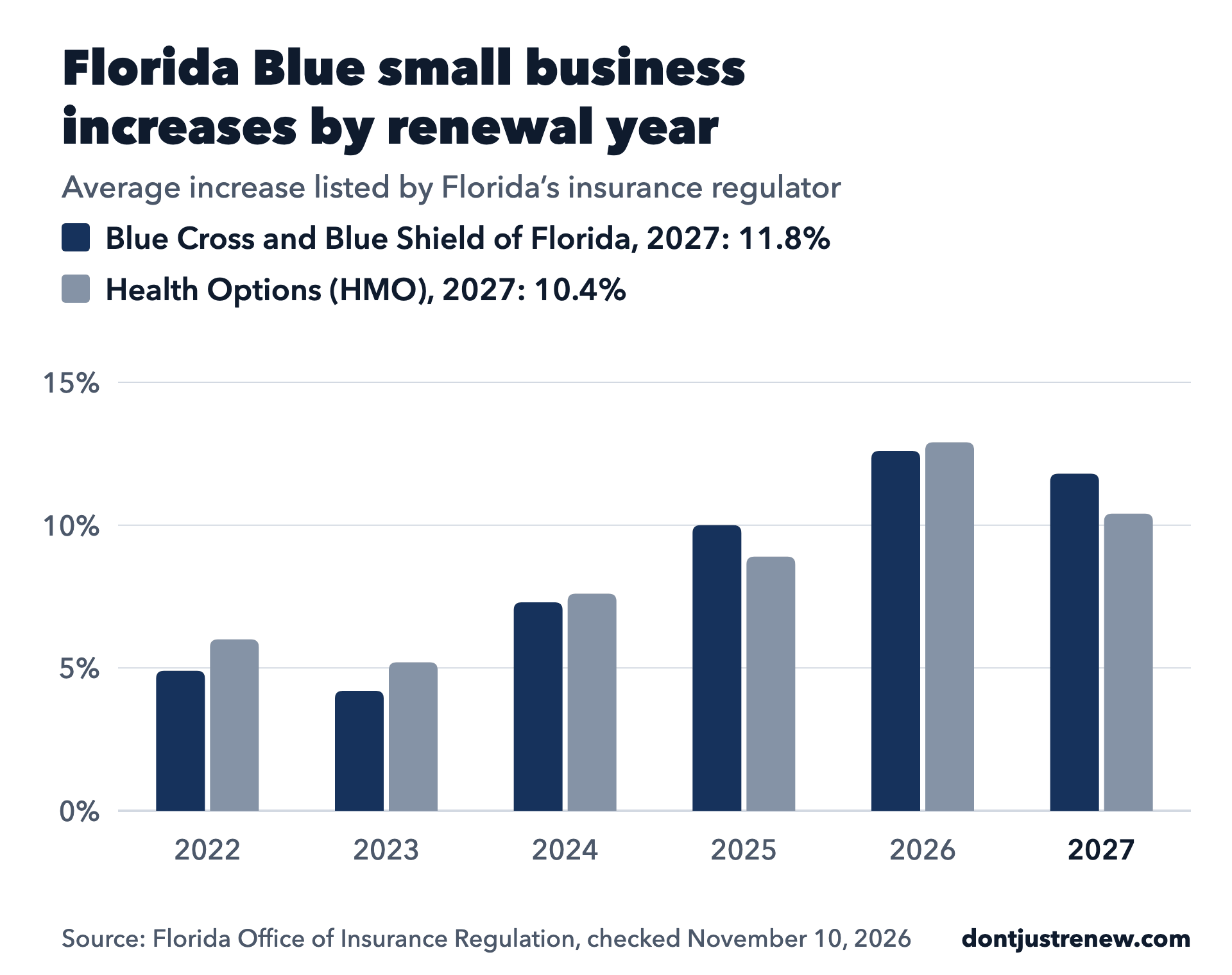
| Renewal year | Blue Cross and Blue Shield of Florida | Health Options | Truli for Health |
|---|---|---|---|
| 2022 | 4.9% | 6.0% | 4.3% |
| 2023 | 4.2% | 5.2% | 2.6% |
| 2024 | 7.3% | 7.6% | 5.6% |
| 2025 | 10.0% | 8.9% | 6.0% |
| 2026 | 12.6% | 12.9% | 12.4% |
| 2027 | 11.8% | 10.4% | 8.7% |
Sources: Florida Office of Insurance Regulation small group premium tables for 2022, 2023, 2024, 2025, 2026, and 2027, checked November 10, 2026. The state labels these as approved averages, based on each company’s enrollment at the time.
For 2022 and 2023, no Florida Blue company went above 6%. The increases then grew each year until 2026, when all three landed between 12.4% and 12.9%. The 2027 increases are a little smaller for all three, but they build on that higher base. By our math, the six increases add up to about 62% at Blue Cross and Blue Shield of Florida, 63% at Health Options, and 46% at Truli.
That’s still below Florida’s statewide figure. The state’s average for all small business plans adds up to about 75% over the same six years, by our math. For 2027, the statewide average is 12.9%, pulled up by UnitedHealthcare’s three Florida companies (UnitedHealthcare Insurance Company, UnitedHealthcare of Florida, and Neighborhood Health Partnership) at 16.7% to 17.4%.
Why does the federal site show lower numbers?
The federal rate review site lists slightly smaller averages for the same 2027 filings: 11.09% for Blue Cross and Blue Shield of Florida, 9.95% for Health Options, and 8.43% for Truli. Florida’s regulator measures its averages against the people actually enrolled in 2026, and its table notes that one group’s change can differ from the average. We use Florida’s figures as the headline. The federal site is still useful, because it splits each company’s filing by plan line:
| Plan line | 2027 filed | 2024 to 2027 together (our math) |
|---|---|---|
| BlueSelect | 12.35% | About 49% |
| BlueOptions | 10.81% | About 44% |
| BlueCare | 10.21% | About 45% |
| SimplyBlue | 9.16% | About 37% |
| Truli for Health Central | 8.43% | About 35% |
Product-level increases from the federal rate review site for the 2024, 2025, 2026, and 2027 small group filings of Blue Cross and Blue Shield of Florida, Health Options, and BeHealthy Florida, checked November 10, 2026. All are final. The four-year totals multiply each year’s increase and are our calculation.
BlueSelect, the EPO, has risen the most of the five over four years. Truli and SimplyBlue have risen the least. Single plans vary even more: from 8.26% to 14.36% at Blue Cross and Blue Shield of Florida and from 4.88% to 12.86% at Health Options, so your own notice is the number that counts.
How far apart are Florida Blue’s prices?
After the 2027 renewal, the average premium is about $945 a month per person at Blue Cross and Blue Shield of Florida, $770 at Health Options, and $565 at Truli, according to the state’s 2027 table. Compared with each company’s 2026 average in the same table, that’s about $100 more a month per person ($1,200 a year), $73 more ($876 a year), and $45 more ($540 a year), by our math.
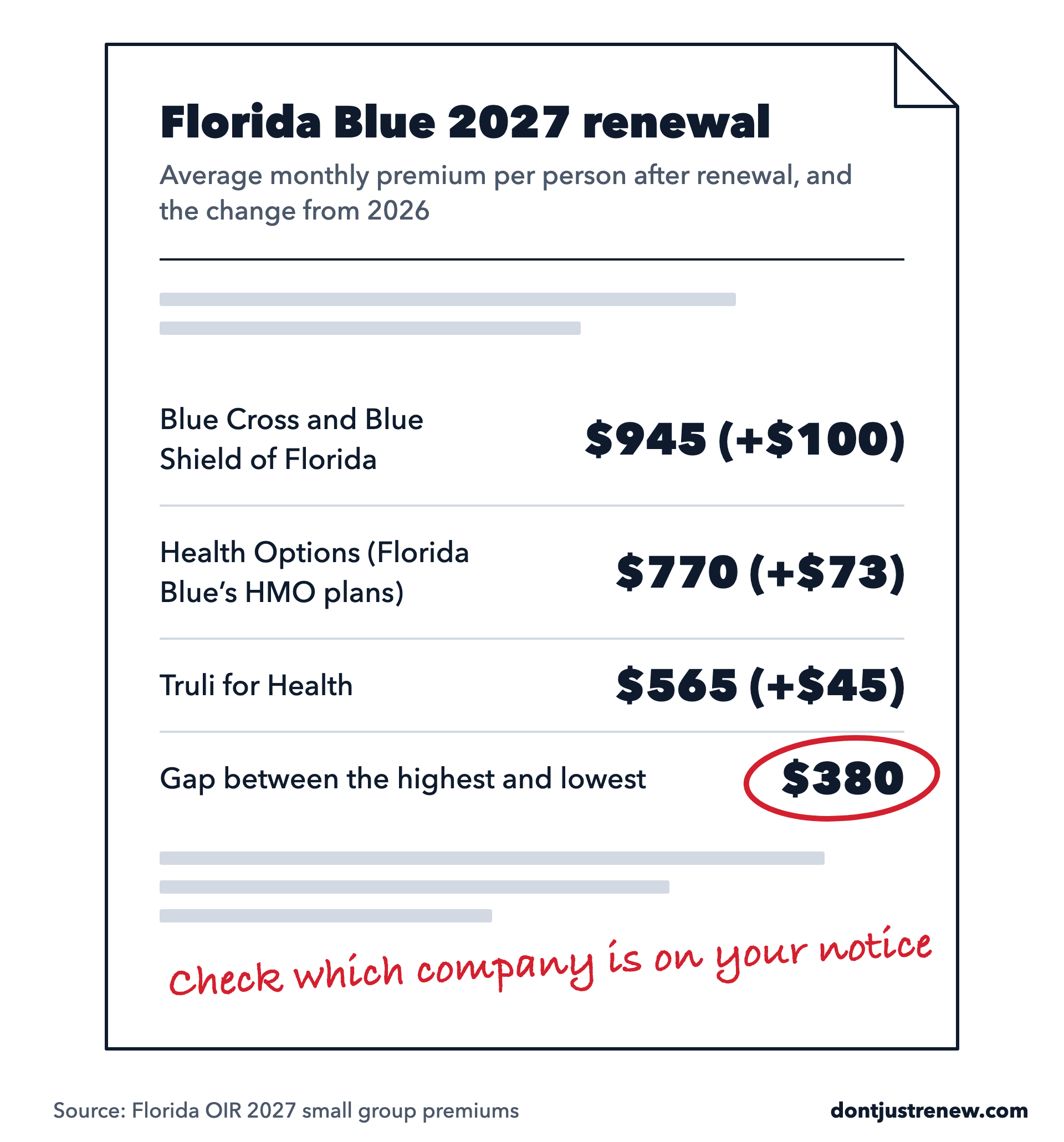
The gap has widened since 2022. In that year’s table, a Blue Cross and Blue Shield of Florida plan averaged $232 a month more per person than a Truli plan. It was $273 for 2025, $313 for 2026, and $380 for 2027, by our math. These averages depend on who was enrolled each year, so they’re a guide to the spread, not a quote for your group.
What’s driving the 2027 increases?
All three companies give the same reasons in their actuarial memos, the technical reports filed with the rates (Blue Cross and Blue Shield of Florida, Health Options, Truli):
- Rising medical costs: higher prices from doctors and hospitals, more use of care, specialty drugs, and new procedures and technology.
- Fixed copays. When a copay stays at the same dollar amount while costs rise, the plan pays all of the rise.
- Changes to covered benefits, and federal changes to risk adjustment, the program that moves money between insurers based on how sick their members are. Our Chinese Community Health Plan post explains how it can push a rate up.
- Fees, which barely move: a federal risk adjustment fee drops from 20 cents to 18 cents per member a month.
Florida lets carriers keep the size of each reason secret. Every page of the memos is marked as a trade secret under section 624.4213 of Florida law, and the exhibits with the cost trend, claims, and enrollment are withheld. Your own group’s claims don’t set these rates; the company’s whole small business pool does, as our guide to claims and renewals explains.
The Blue Cross and Blue Shield of Florida and Health Options memos also say their 2027 enrollment forecasts count on some groups moving to level-funded plans. Florida Blue sells one, Balanced Funding, with fixed monthly payments and a possible refund if claims come in lower than expected. Our level-funded plans guide covers how those differ from these plans.
Your rate also moves during the year
Florida Blue’s 2027 filings set January rates, then add a slice of the yearly cost growth each quarter. The memos say the quarterly step is the annual trend rate raised to the fraction of the year that has passed. So a group renewing in April, July, or October pays more for the same plan than a group renewing in January. The memos leave out the trend rate itself, so the size of each step isn’t public.
What to look for on your Florida Blue notice
- The company and plan line. BlueOptions and BlueSelect come from Blue Cross and Blue Shield of Florida, BlueCare and SimplyBlue from Health Options, and Truli from BeHealthy Florida. Their 2027 averages run from 8.43% to 12.35%.
- Your renewal month. If it’s after January, ask how much of your increase is the quarterly step.
- Your county, if you’re pricing a different Florida Blue line. Truli sells in 18 counties and Health Options in 56.
- If you’re offered Balanced Funding, the refund terms and how the monthly payment is set at the next renewal.
Don’t Just Renew is not associated with, endorsed by, or sponsored by Florida Blue, Blue Cross and Blue Shield of Florida, Health Options, or Truli for Health. These names are trademarks of their owners, and we use them only to report public rate data. This article is general information, not insurance advice. Figures are current as of November 10, 2026.