 Don’t just renew
HMO vs PPO vs EPO: how group health plan networks differ
The difference is what happens when an employee sees a doctor outside the plan’s network. An HMO or an EPO generally doesn’t pay for that care except in an emergency. A PPO does pay, but the employee pays more, and the PPO itself costs more. In California’s 2027 small business filings, that extra cost runs from about 25% to 41% at the same insurer.
Quick answer
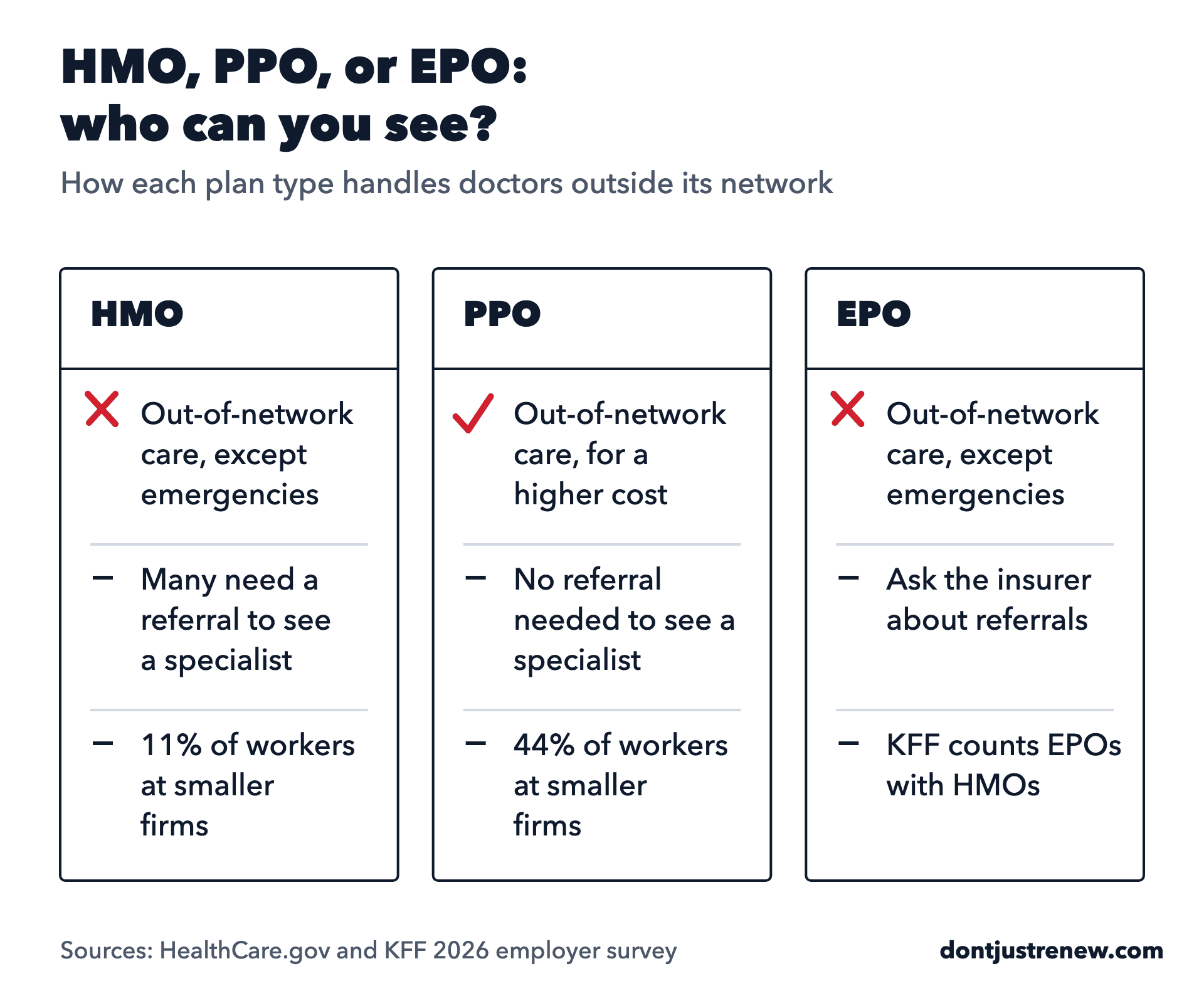
- HMOs and EPOs cover care only from the plan’s own doctors and hospitals, except in emergencies. PPOs also cover care outside the network, for a higher cost.
- Many HMOs need a referral from a primary care doctor before someone sees a specialist. PPOs don’t.
- PPOs are the most common plan type at smaller companies, covering 44% of their workers in 2026.
- The price gap between an insurer’s PPO and its HMO can be much bigger than national averages suggest.
What is a health insurance network?
A network is the group of doctors, hospitals, and other providers your insurer has a contract with, as HealthCare.gov puts it. Those providers have agreed to the insurer’s prices. When employees stay in the network, they pay the plan’s normal copays and deductibles.
The plan type, like HMO or PPO, sets the rules for using that network: whether care outside it is covered and whether people need a referral to see a specialist. The network itself sets which doctors are in. Two PPOs from different insurers can have very different doctor lists.
HMO vs PPO: what’s the difference?
An HMO (health maintenance organization) usually limits coverage to doctors who work for or contract with it, and generally won’t cover out-of-network care except in an emergency. It may also require people to live or work in its service area. In many HMOs, employees need a referral from their primary care doctor before seeing anyone else, or the plan may not pay.
A PPO (preferred provider organization) costs less when people use its network, but it also lets them see doctors outside it without a referral, for an extra cost. PPOs cost more to buy, too. In KFF’s 2026 Employer Health Benefits Survey, the average PPO premium for one person was $10,272 a year, against $9,804 for all employer plans. Those are national figures for companies with 10 or more workers.
EPO vs PPO, and where POS plans fit
An EPO (exclusive provider organization) covers care only from doctors, specialists, and hospitals in its network, except in an emergency. So the big EPO vs PPO difference is the same as HMO vs PPO: no out-of-network coverage. KFF counts EPOs together with HMOs in its survey.
A POS (point-of-service) plan sits between the two. Like a PPO, it covers care in and out of the network, with lower costs in the network. Like many HMOs, it requires a referral from a primary care doctor to see a specialist.
| Plan type | Out-of-network care covered? | Referral to see a specialist? |
|---|---|---|
| HMO | No, except emergencies | Often required |
| EPO | No, except emergencies | Check the plan |
| POS | Yes, for a higher cost | Required |
| PPO | Yes, for a higher cost | Not required |
Sources: HealthCare.gov’s plan and network types and its glossary entries for HMO, EPO, and referral, and the plan definitions in KFF’s 2026 survey, checked November 5, 2026.
How much more does a PPO cost?
Nationally, not much more on paper. KFF’s figures put the average PPO premium for one person about $468 a year, or about 5%, above the average for all plans. But that compares PPOs with a mix of every plan type, across the whole country.
Compare a PPO and an HMO from the same insurer, and the gap gets much bigger. Here’s what California’s 2027 small business filings show for insurers that sell both.
| Insurer | HMO | PPO | PPO costs more by |
|---|---|---|---|
| Anthem Blue Cross | $737 | $920 | $183 (25%) |
| Blue Shield of California | $780 | $1,004 | $224 (29%) |
| UnitedHealthcare | $709 | $998 | $289 (41%) |
Sources: the rate filing workbooks attached to each insurer’s January 2027 small business filing with DMHC, checked November 2, 2026. UnitedHealthcare’s HMO and PPO come from two separate companies. Premiums are averages across ages and regions, and the people on each plan type differ, so this isn’t a quote for any one company.
The gap isn’t only price for the same coverage. The PPO covers more, and the people on each plan type aren’t the same people. Still, at these insurers a company with 20 people on the PPO is paying roughly $3,700 to $5,800 more a month than the same people would on the HMO’s average premium, by our math.
Which plan types do small businesses offer?
PPOs lead at smaller companies too. In KFF’s 2026 survey, 44% of covered workers at firms with 10 to 199 workers were in a PPO. Another 27% were in a high-deductible plan that works with a health savings account (HSA), which KFF counts as its own type. POS plans covered 16% and HMOs 11%.
| Plan type | Firms with 10 to 199 workers | All firms |
|---|---|---|
| PPO | 44% | 50% |
| HSA-qualified high-deductible plan | 27% | 29% |
| POS | 16% | 8% |
| HMO (including EPOs) | 11% | 12% |
Source: KFF 2026 Employer Health Benefits Survey, Section 5, checked November 5, 2026. The all-firms column is for firms with 10 or more workers. Conventional plans, under 1%, aren’t shown.
The mix depends on the region. KFF found 23% of covered workers in the West are in an HMO, against 5% in the Midwest. In parts of California, some insurers sell mostly or only HMOs. Sharp Health Plan, Sutter Health Plan, and Kaiser Permanente are examples.
What is a narrow network health plan?
A narrow network plan has a smaller list of doctors and hospitals than usual, which can keep the premium down. KFF says these plans are generally more restrictive than standard HMO networks. In 2026, 8% of firms that offer health benefits offered one, and 5% switched to a plan with a tiered or narrower network in response to higher costs.
Most employers still describe their main plan’s network as broad. In the same survey, 51% called it “very broad” and 38% “somewhat broad.” Whatever a plan is called, its doctor list is what tells you how broad it is for your employees.
What about emergencies and surprise bills?
Emergencies are covered on every plan type. The federal No Surprises Act, in effect since January 1, 2022, protects people on most health plans from unexpected out-of-network bills for emergency room visits, air ambulance rides, and some non-emergency care tied to a visit to an in-network hospital or surgery center.
It doesn’t make a planned visit to an out-of-network doctor covered on an HMO or EPO. For that, employees need a PPO or POS plan, and they’ll pay more for it.
Plan types don’t rise together at renewal
Insurers price each plan type on its own, so your increase depends on which one you’re on. For January 2027 renewals in California, Aetna’s PPOs are going up 18.7% on average and its HMOs 7.1%, according to the final figures on the federal rate review site. At Anthem it runs the other way: HMOs up 12.8%, PPOs 10.6%. Networks also change between plan years as doctors and hospitals sign or end contracts, so a plan with the same name can come with a different doctor list next year.
Checking your network before you renew
- Find the plan type on your renewal notice, and look up the increase for that type, not the insurer’s average.
- Search next year’s directory, not this year’s, for your employees’ main doctors and nearby hospitals.
- On an HMO or EPO, check where your employees live and work against the plan’s service area.
- On a PPO, ask how many employees actually used out-of-network care last year. That’s the main thing the extra premium buys.
This article is general information, not insurance, tax, or legal advice. Figures are current as of November 5, 2026.