 Don’t just renew
Chinese Community Health Plan small business plans: 18.6% for 2027, and about half is risk adjustment
Chinese Community Health Plan (CCHP) filed an 18.6% average increase for its California small business plans renewing in 2027. For five years before that, its increases stayed between 1.7% and 6.3%. About half of the new increase comes from risk adjustment, a federal program that moves money between health plans.
At a glance
- CCHP’s 2027 small business filing averages 18.6%, with every plan between 17.9% and 19.7%.
- Risk adjustment adds 9.3 points. CCHP expects to pay about $332 per member each month into it in 2027.
- CCHP expects the cost of care to grow about 6.2% a year, the lowest assumption in the California filings we’ve covered.
- Some plans cover a bit less in 2027, with higher out-of-pocket limits and specialist copays.
A small San Francisco HMO with one renewal date
CCHP is a San Francisco health plan that sells under the name Balance by CCHP. It files with the Department of Managed Health Care (DMHC), the state agency that oversees health plans, and it sets small business rates once a year, for the full calendar year. Small business here means 1 to 100 employees.
It’s a small group of members. The monthly data in its filing shows about 640 people on these plans in 2025, in the San Francisco, San Mateo, and Alameda pricing regions. DMHC lists the 2027 average increase as 18.6%, and the federal rate review site lists 18.54%. The increase is the same in every region.
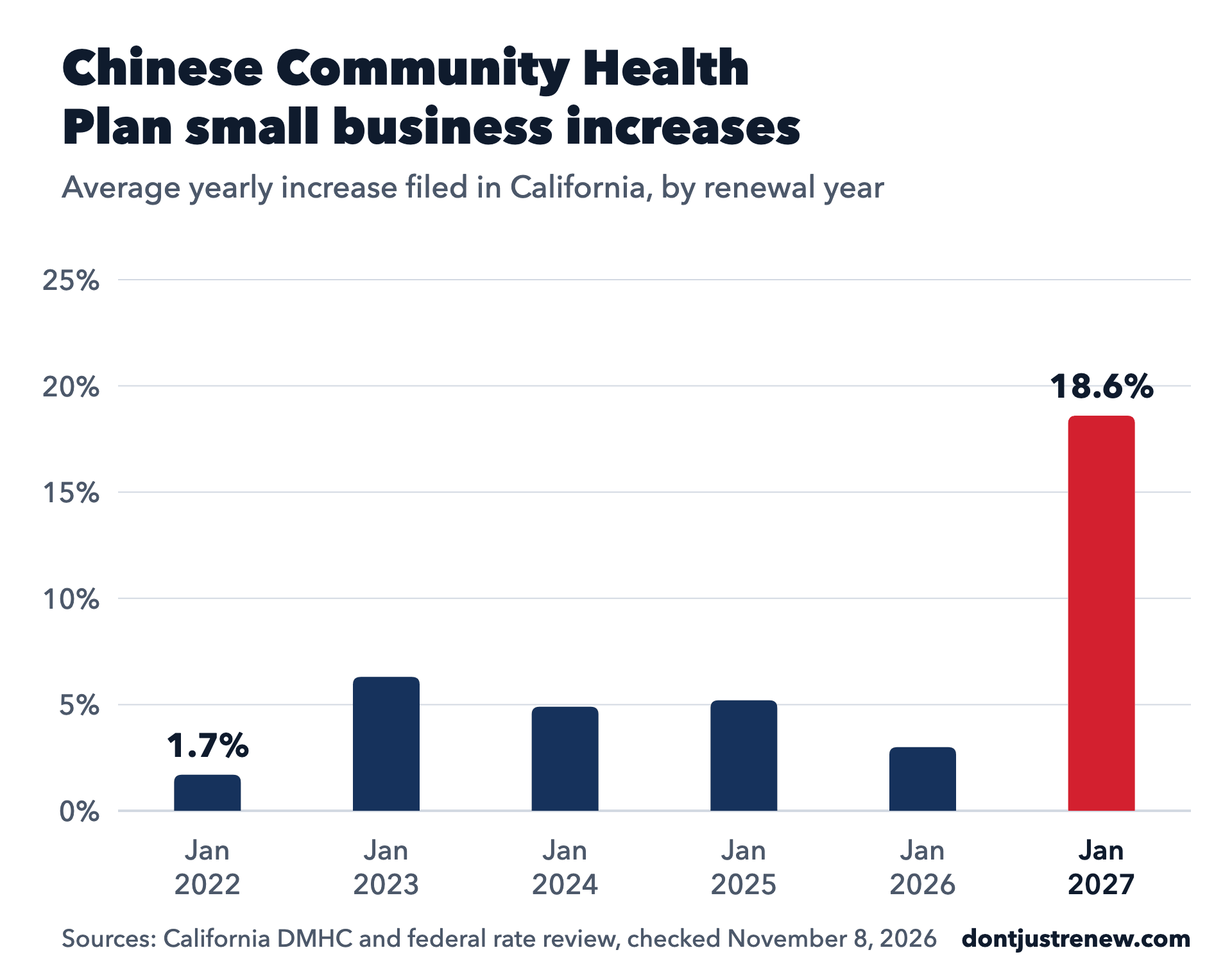
| Renewal date | CCHP small business plans |
|---|---|
| January 2022 | 1.7% |
| January 2023 | 6.3% |
| January 2024 | 4.9% |
| January 2025 | 5.2% |
| January 2026 | 3.0% |
| January 2027 | 18.6% |
Sources: DMHC rate filings for Chinese Community Health Plan’s small business plans, checked November 8, 2026, and the federal rate review site. See the 2027 DMHC filing, CCHP’s rate increase justification, and its actuarial memo. The 2027 figure is as filed. The earlier ones are final.
By our math, the five increases from 2022 through 2026 add up to about 23%. The 2027 increase alone is 18.6%. Over the last two Januaries together, though, CCHP’s total is about 22%, close to Anthem Blue Cross at 22.5% and Blue Shield of California at 21.6%, because its 2026 increase was small.
What is risk adjustment, and why does CCHP pay so much into it?
Risk adjustment is a federal program that moves money between health plans in the same market based on how healthy their members are. Plans whose members are expected to need more care than average receive money. Plans whose members need less pay in. CCHP is a payer. Its filing says its members’ risk is expected to stay below the state average, so it sets premiums at the average level and expects to pass part of that premium to plans with sicker members.
Next to its premiums, the payments are large. In 2025, CCHP collected about $749 per member each month from these plans, spent about $348 on care, and owed about $303 in risk adjustment, according to the filing workbook. By our math, that’s about 40 cents of every premium dollar going to risk adjustment and about 46 cents to care.
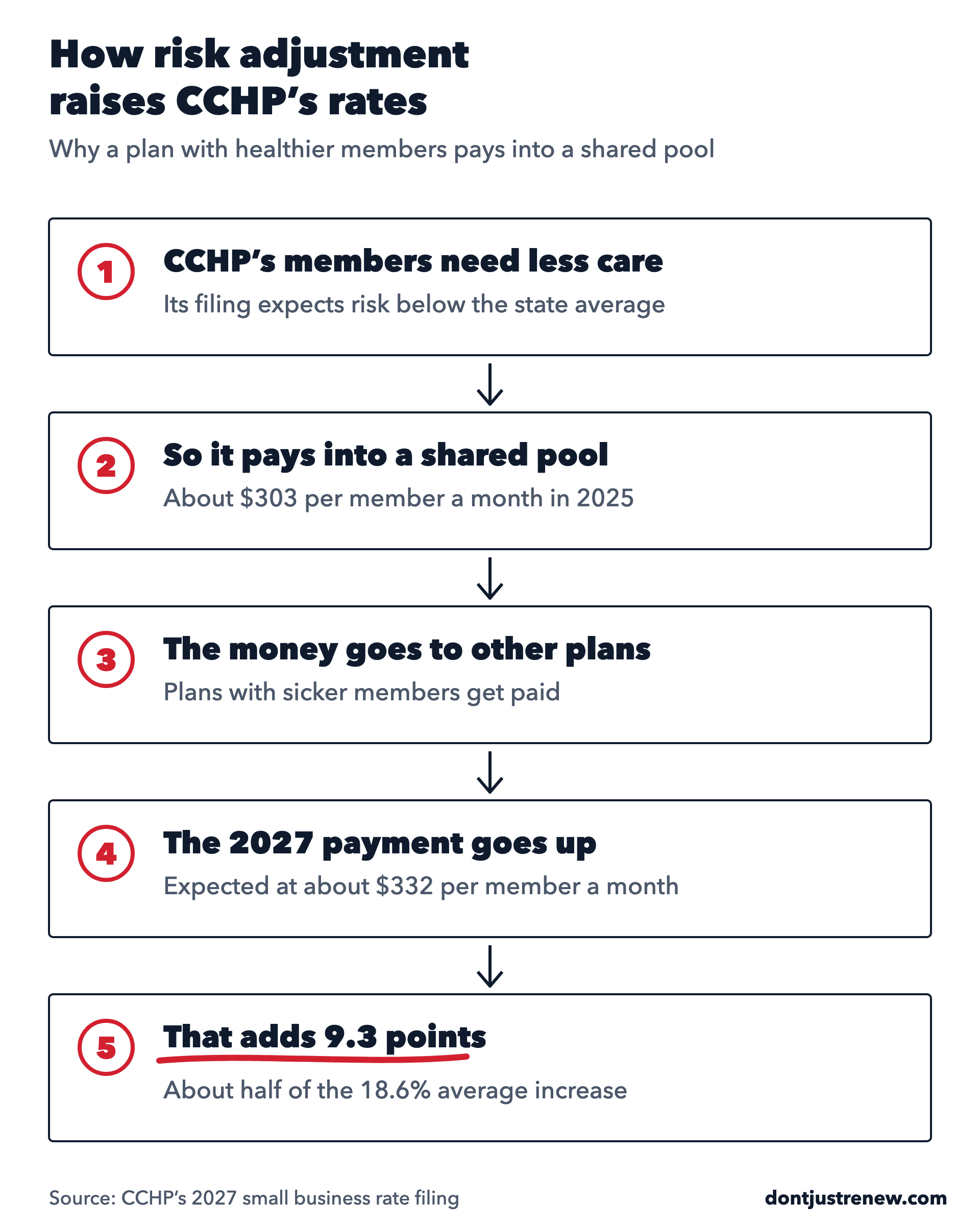
The 2027 increase is partly a correction. Last year’s filing expected to pay $260 per member a month for 2026. Then the actual figure for 2025 came in at about $303, and the 2027 filing expects about $332. That’s about $72 more per member each month than the last filing planned for, by our math, or about 28%.
| Plan | Pays in or receives | About |
|---|---|---|
| Chinese Community Health Plan | Pays in | $332 |
| Sharp Health Plan | Pays in | $86 |
| Aetna Health of California (HMO) | Pays in | $66 |
| Aetna Life Insurance Company (PPO) | Receives | $82 |
From each plan’s 2027 rate filing on the federal rate review site, as reported in our posts, checked November 4 to 8, 2026. Our other California posts didn’t report a dollar figure for risk adjustment. CCHP’s figure is from its actuarial memo.
Where the other 9 points come from
CCHP’s filing splits the 18.6% into parts that multiply together. Risk adjustment adds 9.3 points. A sicker mix of members adds 7.7 points: CCHP expects its members to be older and spread differently across plan levels in 2027 than in 2025, and expects more of them to use medical groups it pays a set amount per member each month. Administrative costs and other non-medical expenses add 2.7 points, and benefit changes add 1.3. A lower cost growth assumption than last year takes 3.1 points off.
CCHP expects its medical and drug costs to rise about 6.2% a year. Kaiser Permanente assumed 6.7%, the lowest we’d seen before this filing. The exception is drugs, at about 13.9% a year, mostly from higher prices. Drugs were about 28% of CCHP’s cost of care in 2025, by our math from the workbook.
Hospital prices are mixed. In 2025, CCHP paid about 2.3 times what Medicare pays for outpatient hospital care and about 1.1 times for doctors, but about two thirds of Medicare’s price for inpatient stays. The filing projects that 84.2% of premium will go to care and quality spending in 2027, above the 80% federal minimum for small business plans.
What a CCHP plan costs in 2027
The increases are nearly flat across plans. The lowest is 17.9% (the Bronze 60 HDHP HMO and the Opal 50 HMO Silver), and the highest is 19.7% (the Ruby 40 HMO Platinum). All of CCHP’s plans are HMOs, which keep employees in a set network of doctors and hospitals. Our HMO vs PPO guide explains how that differs from other plan types.
The memo gives one sample price: the Gold 80 HMO for a 34-year-old in San Francisco costs $756.28 a month in 2027. With that plan’s 18.5% increase, the same person paid about $638 in 2026, so the increase is about $118 a month, by our math. Your own numbers depend on your plan and your employees’ ages.
Your plan may cover a little less
Several plans change for 2027, according to the rate justification:
- Ruby 10: the out-of-pocket maximum goes from $3,900 to $5,000 and the specialist copay from $30 to $40.
- Ruby 20: the out-of-pocket maximum goes from $3,700 to $4,600 and the specialist copay from $20 to $28.
- Gold copay plan: the deductible goes from $250 to $300 and the out-of-pocket maximum from $7,800 to $8,200.
- Bronze HDHP: the deductible and out-of-pocket maximum both go from $7,100 to $7,800.
Questions for your CCHP renewal
Start with your plan’s own increase on the notice, which should land between 17.9% and 19.7%. Then check whether your plan is one of the four above, since the price goes up and the coverage changes at the same time. If you have employees in more than one county, confirm their doctors and medical group are in CCHP’s network. And ask for the per-employee rates by age, since the average hides how much an older employee’s premium moves in dollars.
Don’t Just Renew is not associated with, endorsed by, or sponsored by Chinese Community Health Plan. Chinese Community Health Plan, CCHP, and Balance by CCHP are trademarks of their owner, and we use the names only to report public rate data. This article is general information, not insurance advice. Figures are current as of November 8, 2026.