 Don’t just renew
UnitedHealthcare small business plans in Florida: up to 17.4% for 2027, the steepest in the state
UnitedHealthcare’s three Florida small business companies are raising rates an average of 16.7% to 17.4% for 2027, according to Florida’s Office of Insurance Regulation. No other company on the state’s list goes above 11.8%, and the statewide average is 12.9%. In 2025, all three were within a point of that average. Now two of them average more than $1,000 a month per person.
At a glance
- Florida’s 2027 averages are 17.4% at UnitedHealthcare Insurance Company, 16.8% at UnitedHealthcare of Florida, and 16.7% at Neighborhood Health Partnership.
- After renewal, the average premium is about $1,069 a month per person at UnitedHealthcare Insurance Company, $1,044 at UnitedHealthcare of Florida, and $933 at Neighborhood Health Partnership.
- By our math, that’s $134 to $158 more a month per person than in 2026. At Florida Blue’s three companies, it’s $45 to $100.
- The three filings cover about 87,000 people, and the two biggest companies each report about 6% fewer than a year ago.
Which UnitedHealthcare company is your plan with?
UnitedHealthcare sells small business health insurance in Florida through three licensed companies, and each one files its own rates. Florida’s 2027 premium table lists UnitedHealthcare Insurance Company’s plans as EPOs, which cover care only from the plan’s network, except in an emergency. UnitedHealthcare of Florida and Neighborhood Health Partnership sell HMOs. Our HMO vs PPO vs EPO guide explains how each type works.
All three sell in every one of Florida’s 67 counties, according to the state’s 2027 county list. Their filings on the federal rate review site say the 2027 increase affects 46,406 people at UnitedHealthcare Insurance Company, 31,307 at Neighborhood Health Partnership, and 9,450 at UnitedHealthcare of Florida. That’s about 87,000 people in all, by our math.
The two bigger companies are getting smaller. Their filings for 2026 counted 49,579 and 33,436 people, so each reports about 6% fewer this time, by our math.
How UnitedHealthcare pulled away from Florida’s average
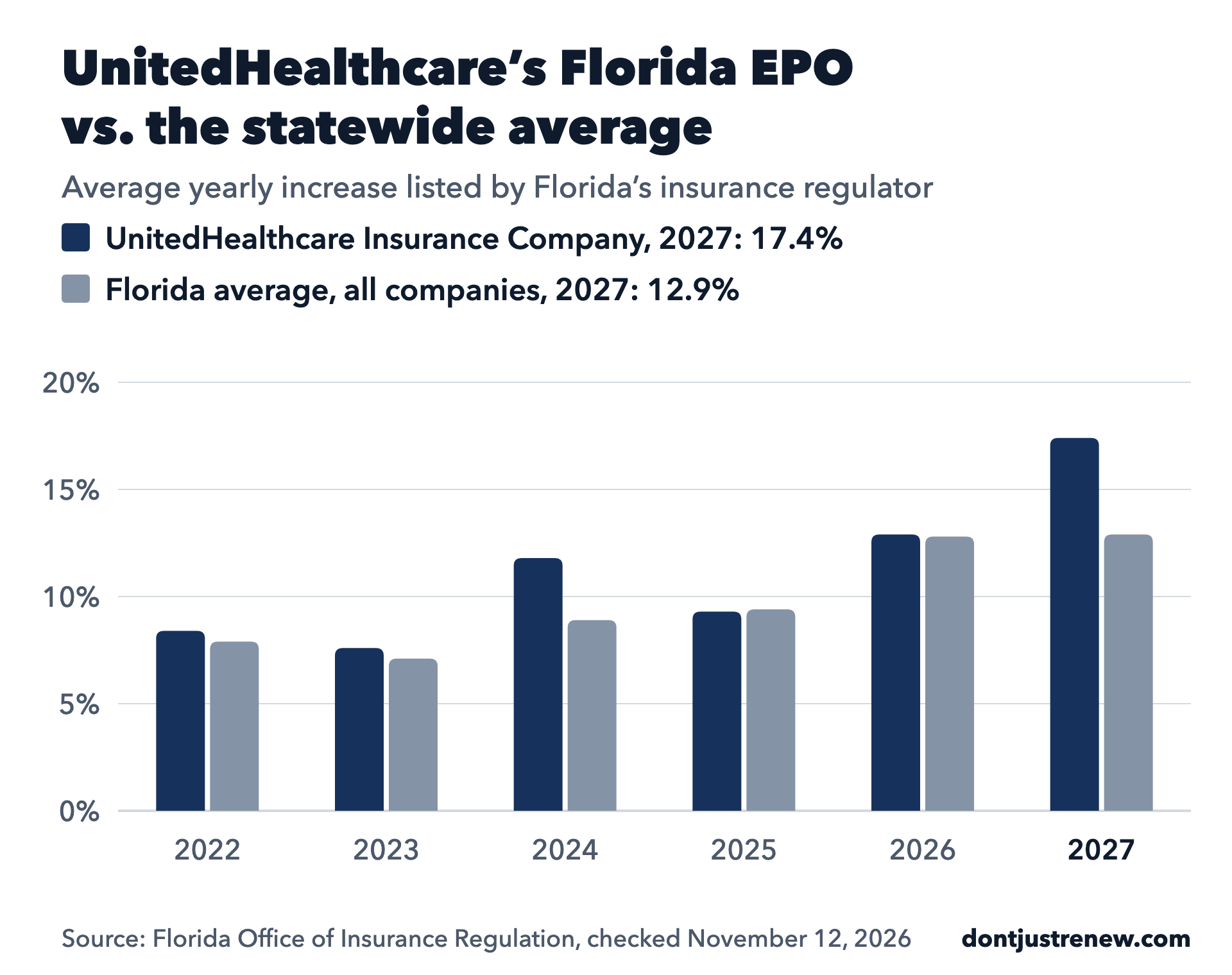
| Renewal year | UnitedHealthcare Insurance Company (EPO) | UnitedHealthcare of Florida (HMO) | Neighborhood Health Partnership (HMO) | Florida average |
|---|---|---|---|---|
| 2022 | 8.4% | 11.8% | 8.2% | 7.9% |
| 2023 | 7.6% | 7.9% | 10.8% | 7.1% |
| 2024 | 11.8% | 10.8% | 11.9% | 8.9% |
| 2025 | 9.3% | 8.4% | 9.9% | 9.4% |
| 2026 | 12.9% | 10.4% | 14.9% | 12.8% |
| 2027 | 17.4% | 16.8% | 16.7% | 12.9% |
Sources: Florida Office of Insurance Regulation small group premium tables for 2022, 2023, 2024, 2025, 2026, and 2027, checked November 12, 2026. The state bases each average on the company’s enrollment at the time, and the statewide figure gives more weight to bigger companies.
For 2024, all three UnitedHealthcare companies rose faster than the state as a whole. In 2025 they fell back to within a point of the average, and in 2026 UnitedHealthcare Insurance Company came in just 0.1 point above it. For 2027, all three are 3.8 to 4.5 points above it, while AvMed’s small business plans sit near the bottom of the list at 8.8%. By our math, the 2026 and 2027 increases together come to about 33% at UnitedHealthcare Insurance Company, 29% at UnitedHealthcare of Florida, and 34% at Neighborhood Health Partnership, against about 27% for the state.
The federal rate review site shows smaller averages for the same 2027 filings: 15.53% for UnitedHealthcare Insurance Company, 13.53% for UnitedHealthcare of Florida, and 14.76% for Neighborhood Health Partnership. Florida measures its averages against the people actually enrolled in 2026, and its table notes they aren’t the change for any single group. The gap here is 1.9 to 3.3 points, wider than at Florida Blue, where it’s under a point. Single plans spread even further in the federal filings: from 10.26% to 18.51% at UnitedHealthcare Insurance Company, 9.49% to 15.79% at UnitedHealthcare of Florida, and 10.57% to 20.90% at Neighborhood Health Partnership.
What UnitedHealthcare costs per person in 2027
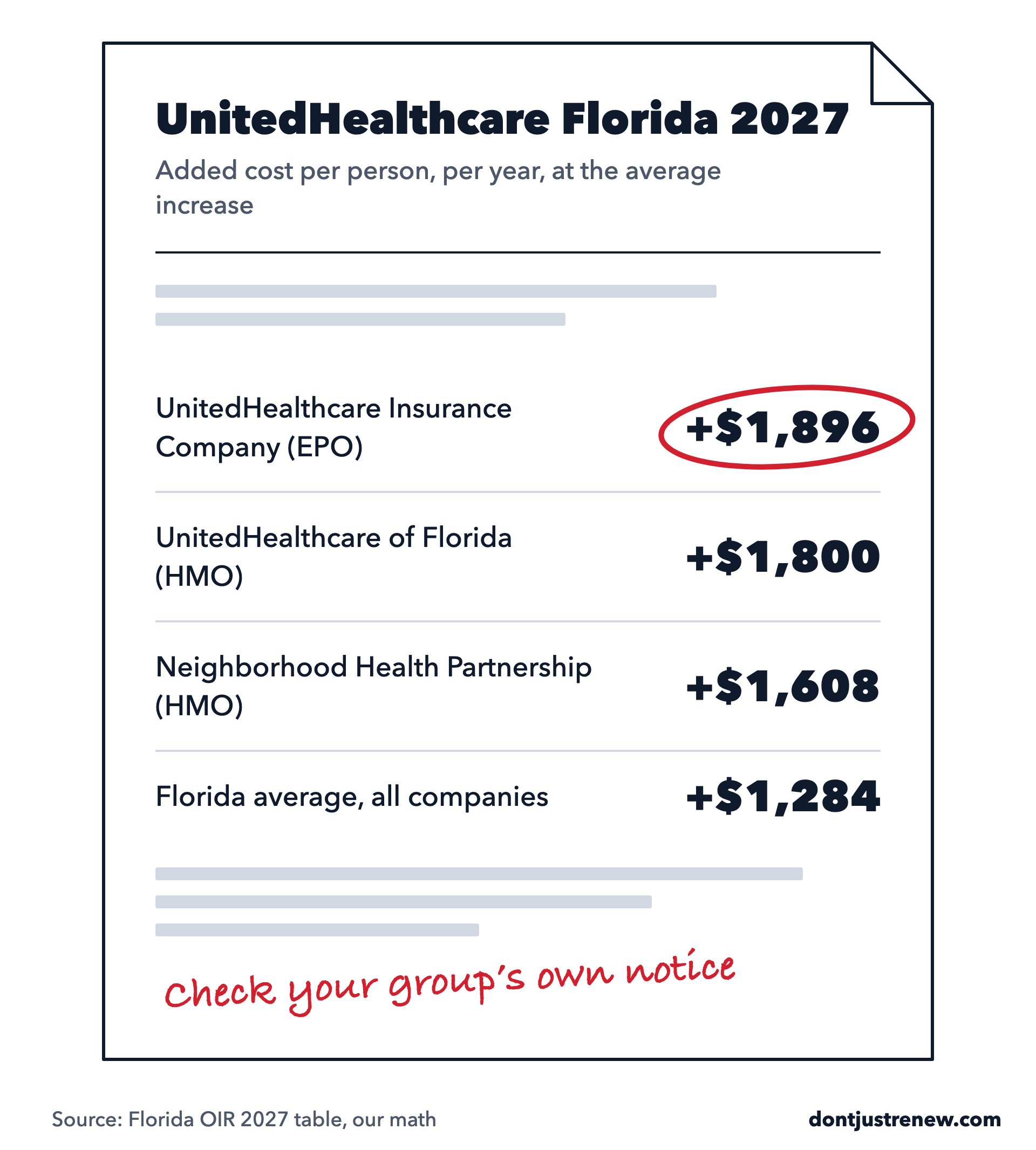
After renewal, the average premium is about $1,069 a month per person at UnitedHealthcare Insurance Company, $1,044 at UnitedHealthcare of Florida, and $933 at Neighborhood Health Partnership, according to the state’s 2027 table. The table also lists each company’s 2026 average for the same people. Compared with that, the 2027 increase adds $158, $150, and $134 a month per person, by our math.
| Company | Average monthly premium per person after renewal | More per month than 2026 | More per year |
|---|---|---|---|
| UnitedHealthcare Insurance Company | $1,069 | $158 | $1,896 |
| UnitedHealthcare of Florida | $1,044 | $150 | $1,800 |
| Neighborhood Health Partnership | $933 | $134 | $1,608 |
| Blue Cross and Blue Shield of Florida | $945 | $100 | $1,200 |
| Health Options (Florida Blue HMO) | $770 | $73 | $876 |
| Truli for Health (Florida Blue) | $565 | $45 | $540 |
| Florida average, all companies | $920 | $107 | $1,284 |
Premiums from the Florida Office of Insurance Regulation’s 2027 small group premium table, checked November 12, 2026. The changes compare each company’s 2026 and 2027 averages for its 2026 enrollment and are our calculation.
UnitedHealthcare Insurance Company has the highest average premium in the state’s 2027 table. Its lead over the state average was $93 a month per person in the 2022 table and is $149 now, by our math. Neighborhood Health Partnership has moved the other way: it averaged $68 less than the state in 2022 and averages $13 more for 2027. These averages depend on who’s enrolled at each company, like their ages, plans, and counties. Use them to compare companies. Your own group’s price is on its notice.
Why UnitedHealthcare says Florida costs are climbing
The plain-language justifications filed with the rates (UnitedHealthcare Insurance Company, UnitedHealthcare of Florida, Neighborhood Health Partnership) give the same five reasons:
- Higher payments to hospitals, doctors, and drug companies.
- More office visits and other care, and more intensive care like surgery.
- Deductibles and copays that stay the same while costs rise, so the plan pays a bigger share each year.
- Hospitals charging private plans more to make up for what Medicare and Medicaid don’t cover.
- New medical technology.
The filings don’t say how much each reason adds. The actuarial memos, the technical reports filed with the rates, are marked trade secret, and the cost growth assumptions and claims totals are left blank.
The justifications do say how much of each premium dollar went to medical claims in 2025: 82.5 cents at UnitedHealthcare Insurance Company, down from 87.0 cents in 2024, and 78.1 cents at Neighborhood Health Partnership, up from 72.8 cents. At UnitedHealthcare of Florida it was 86.4 cents. The rest pays for taxes, fees, administration, and profit. Your own group’s claims don’t set these rates. Each company’s whole Florida small business pool does, as our guide to claims and renewals explains.
UnitedHealth Group, UnitedHealthcare’s parent company, said on its October 13 earnings call that cost growth in its employer plans is running above the 11% it expected. It pointed to the billing dispute process under the No Surprises Act, which protects patients from surprise out-of-network bills, along with costlier care from clinicians and high-cost specialty drugs. The comment covered its employer business nationwide. In California, UnitedHealthcare’s small business plans are going up 21% to 23% for 2027.
Questions to ask about your UnitedHealthcare renewal
- Which company your plan is with. The company averages run from 16.7% to 17.4%, but single plans range from 9.49% to 20.90% in the federal filings.
- Whether an HMO from UnitedHealthcare of Florida or Neighborhood Health Partnership would fit your team. On average they cost $25 to $136 less a month per person than the EPO, by our math. Check that the network has the doctors your team uses.
- Whether your county’s price factor changed. UnitedHealthcare Insurance Company’s memo says it re-checked the factors for Florida’s 67 rating areas, one per county, when setting 2027 rates.
Don’t Just Renew is not associated with, endorsed by, or sponsored by UnitedHealthcare, UnitedHealth Group, or Neighborhood Health Partnership. These names are trademarks of their owners, and we use them only to report public rate data. This article is general information, not insurance advice. Figures are current as of November 12, 2026.