 Don’t just renew
Health Net is leaving California’s group market: how employers can plan around February 28, 2027
Health Net is closing all of its California small business and large group medical plans. It began notifying employers on September 1, 2026, and its group plans are expected to end February 28, 2027, 180 days later. If your company is on a Health Net plan, the work now is picking replacement coverage and choosing when to switch.
What’s changing
- Health Net is ending its California employer plans. Its Medi-Cal, Medicare, and individual Covered California plans aren’t affected.
- Group plans are expected to end February 28, 2027, unless a contract or regulation allows another date. Your notice from Health Net gives your group’s exact date.
- You can still renew before then, but the renewed plan also ends February 28.
- A group that can’t meet a new carrier’s participation or contribution rules has a window from November 15 to December 15 to enroll.
What Health Net is ending, and when
Health Net’s transition page, last updated September 22, 2026, says it’s discontinuing its commercial group health plans in California, including all small business and large group medical plans. Its FAQ on that page adds employer dental and vision plans and its Medicare plans for employers’ retirees. Health Net life insurance isn’t affected, and Health Net isn’t taking new employer groups.
The page says many group policies are expected to end February 28, 2027, “or as otherwise permitted” by the contract and regulations, and that each group got its own sunset date. So check your notice before you plan around February 28.
Many employers are moving at once. Health Net’s October 2026 small business filing with the Department of Managed Health Care (DMHC), the state agency that oversees health plans, listed 116,968 members. Its rate workbook for January 2027 counted about 11,700 small business groups.
Why February 28?
It’s 180 days after the notices started, and 180 days is the legal minimum. Federal rules (45 CFR 147.106 and 146.152) and California’s Health and Safety Code section 1365 let an insurer leave a market only after giving the state, each employer, and everyone covered at least 180 days’ written notice. California also bars canceling the plans during those 180 days. By our count, September 1, 2026, to February 28, 2027, is exactly 180 days.
The same rules generally keep an insurer that leaves a market from selling in it again for five years after its last coverage there ends.
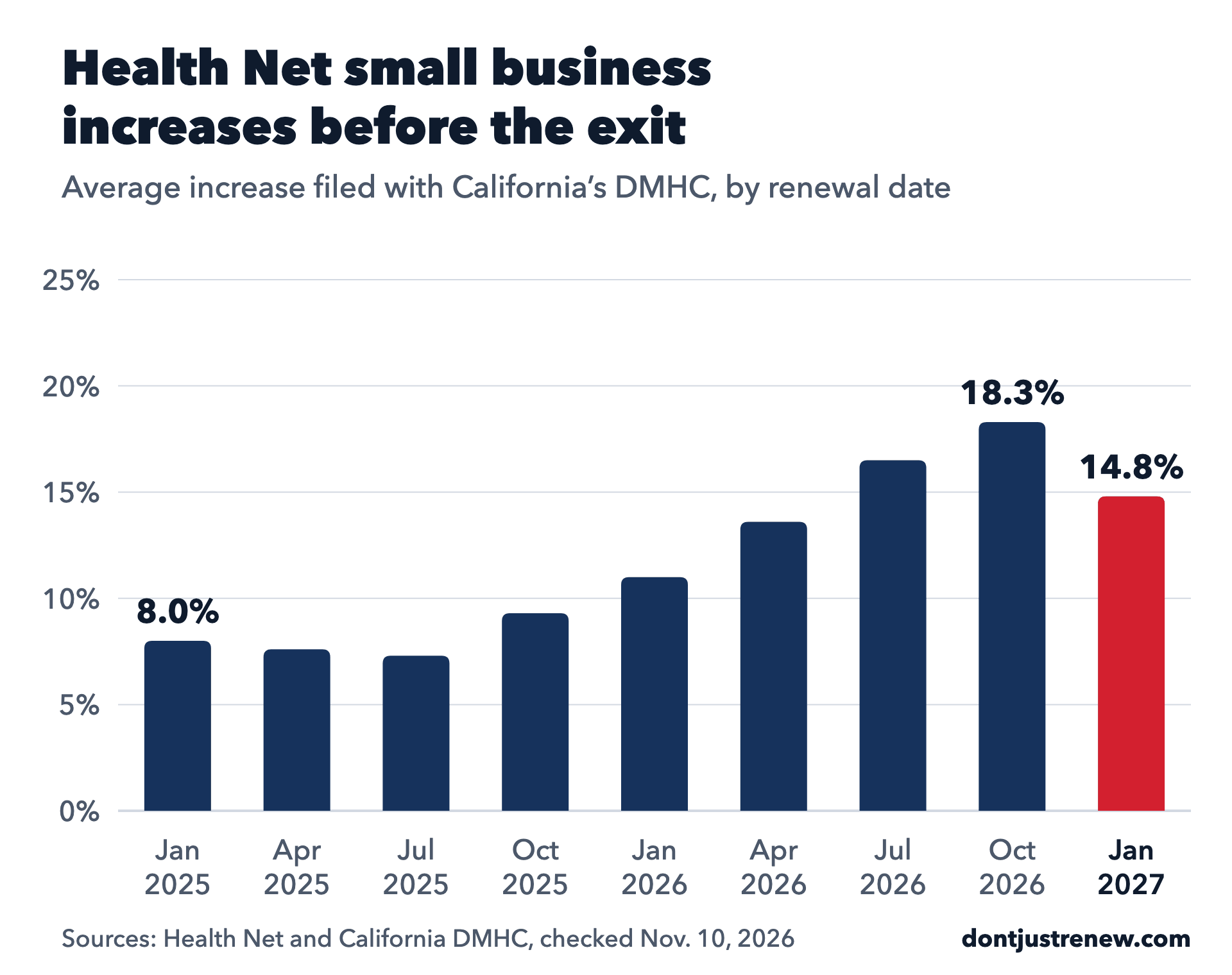
What Health Net groups were paying
| Renewal date | Health Net small business plans |
|---|---|
| January 2025 | 8.0% |
| April 2025 | 7.6% |
| July 2025 | 7.3% |
| October 2025 | 9.3% |
| January 2026 | 11.0% |
| April 2026 | 13.6% |
| July 2026 | 16.5% |
| October 2026 | 18.3% |
| January 2027 | 14.8% |
Source: DMHC rate filings for Health Net of California’s small business plans (not grandfathered), checked November 10, 2026. See the October 2026 filing and the January 2027 filing. The January 2027 figure is as filed. The federal rate review site lists it as 14.61% final. The earlier figures are final.
Through 2024, Health Net’s quarterly increases stayed between 7.1% and 7.9%. They then climbed each quarter from July 2025 to 18.3% for October 2026. The January 2027 filing went to DMHC on July 15, 2026, before the exit notices, and averages 14.8%: 12.1% on HMO plans and 20.1% on PPO plans, according to its rate workbook.
After that increase, the average premium would be about $723 a month per person on an HMO and $1,007 on a PPO. That’s about $78 and $169 more a month per person than before the renewal, by our math. Our HMO vs PPO guide explains why the two plan types are priced so differently.
If you renew in December or January
You can still renew, but Health Net says the renewed plan ends February 28 too. That matters for a lot of groups. Health Net’s January 2027 workbook lists about 32% of its small business groups renewing in December and 16% in January, so close to half face this choice, by our math.
Renewing buys two or three more months on the same plan, at the new rate. On an average PPO, that’s about $169 more a month per person for coverage that ends soon after. Moving on your renewal date instead means one switch, not two. Health Net warns that deductibles and out-of-pocket totals may not carry over to a new carrier, so a calendar-year plan that renews January 1 and moves March 1 could start employees’ deductibles over twice in two months. Health Net also lets groups end early, with notice under their agreement.
Dates to work back from
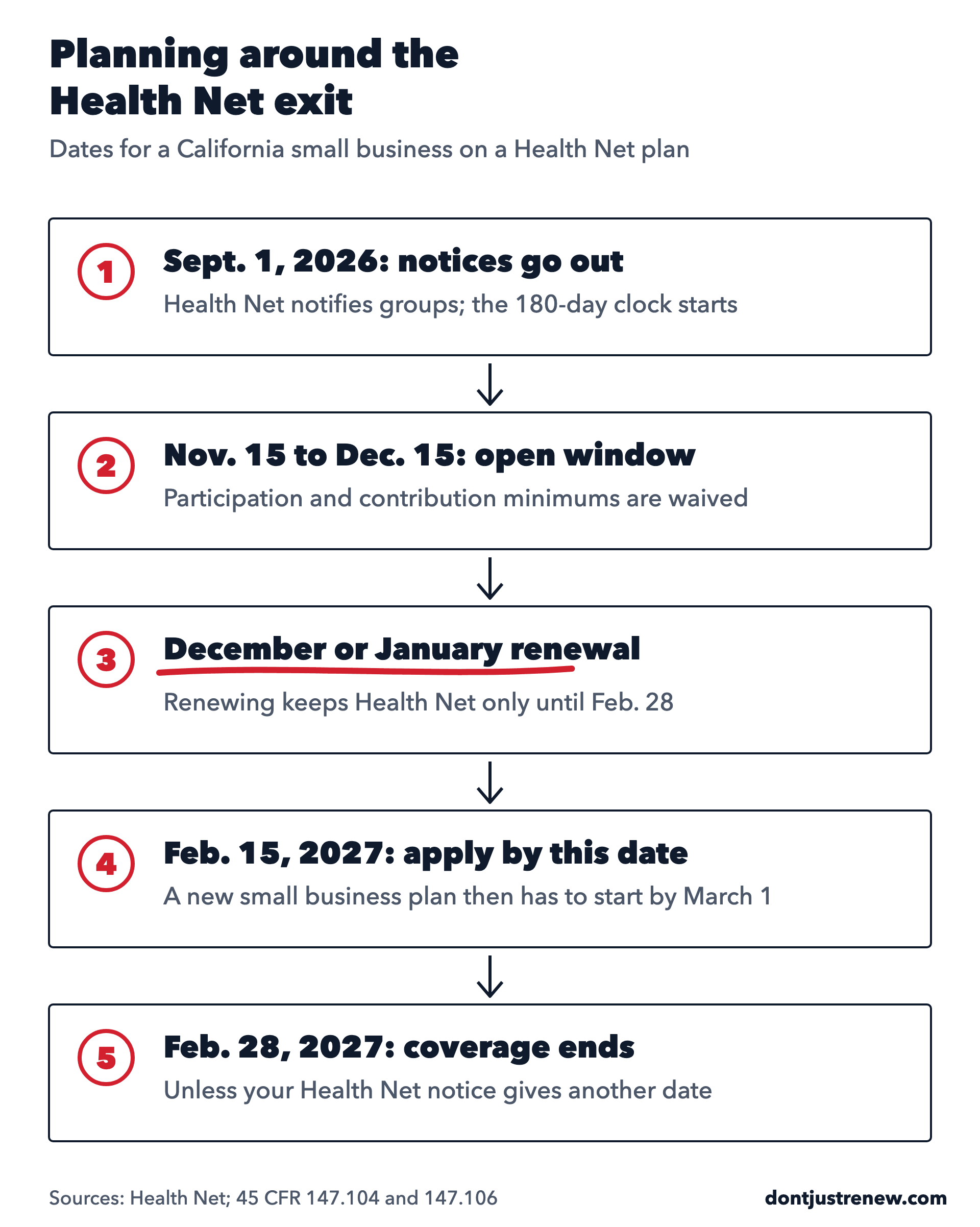
Small businesses can buy a plan in any month. Under 45 CFR 147.104, a carrier that gets your application by the 15th has to start coverage by the first of the next month. An application that arrives later in the month can start as late as the first of the month after that. By our reading, that makes February 15 the last day to apply and still be sure of a March 1 start.
Some groups have less time. Carriers can turn down a small business that doesn’t meet their participation rules (how many employees enroll) or contribution rules (how much the employer pays) for most of the year. The same federal rule lets those groups enroll anyway from November 15 to December 15. The next window opens November 15, 2027, well after Health Net coverage ends, so a group in that spot should plan on this year’s window.
Keeping employees’ care on track
Employees in the middle of treatment may be able to keep their doctor, medical group, or hospital for a while even if your new plan doesn’t include them. DMHC calls this “new health plan member” continuity of care, and it applies when an employer stops offering a plan. It covers conditions like pregnancy, a serious chronic condition (up to 12 months), care for a child under 3 (up to 12 months), and surgery scheduled within 180 days. The employee asks the new plan, and the doctor has to agree.
Health Net’s FAQ adds a few warnings. Its prior authorizations may not transfer, so employees should keep copies. People on regular prescriptions should check the new plan’s drug list and ask about refilling before coverage ends. COBRA and Cal-COBRA members are generally offered continuation through your replacement plan.
Where Health Net groups can look
We’ve written up the 2027 small business rates of the other California carriers: Anthem Blue Cross, Blue Shield of California, Kaiser Permanente, UnitedHealthcare, Aetna, Sharp Health Plan, Western Health Advantage, Sutter Health Plan, Chinese Community Health Plan, and Community Care Health. Several of them sell only in certain regions, so start with the ones that cover where your employees live. Those posts track increases for groups already with each carrier. A group switching in pays that carrier’s current rates for its plans, ages, and region.
Some employers also look outside the ACA small business market, at level-funded plans or a PEO such as Insperity.
Four things to settle this month
- Your group’s sunset date on the Health Net notice, and how much notice your agreement needs if you end early.
- Which of your employees’ doctors and hospitals are in each replacement plan’s network.
- Whether the new carrier will credit deductibles and out-of-pocket costs your employees already paid this plan year.
- Who’s in treatment, on COBRA, or on a regular prescription, so they hear about continuity of care and refills before February.
Don’t Just Renew is not associated with, endorsed by, or sponsored by Health Net or Centene. Health Net is a trademark of its owner, and we use the name only to report public information. This article is general information, not insurance, tax, or legal advice. Figures are current as of November 10, 2026.