 Don’t just renew
Western Health Advantage small business plans: 9.5% for 2027, its third smaller increase in a row
Western Health Advantage’s small business increases are coming down. After 20.6% for July 2025, its filings dropped to 15.3%, then 14.7%, and now 9.5% for January 2027. The pressure that’s left is mostly prescription drugs, which WHA expects to grow 13% a year.
Key numbers
- 9.5% is the average increase for groups renewing January through March 2027. Individual plans range from a 0.3% drop to a 13.3% increase.
- The average premium after renewal is about $803 a month per person, roughly $70 more than before, by our estimate.
- Drugs were about a fifth of WHA’s small business costs in 2025, and they’re growing more than twice as fast as medical care.
- New for 2027: WHA plans are coming to Covered California for Small Business in 10 Northern California counties.
Three smaller increases in a row
Western Health Advantage (WHA) is a not-for-profit health plan in Northern California that sells only HMOs. It files with the Department of Managed Health Care (DMHC), the state agency that oversees health plans, for companies with 1 to 100 employees. It had 19,662 people on its small business plans at the end of 2025, according to its filing.
In 2025 and 2026, WHA filed new rates twice a year, for January and July. The January 2027 filing covers groups renewing January through March: about 1,290 companies and 5,540 people. DMHC lists the increase as 9.5%, and the federal rate review site lists 9.53%.
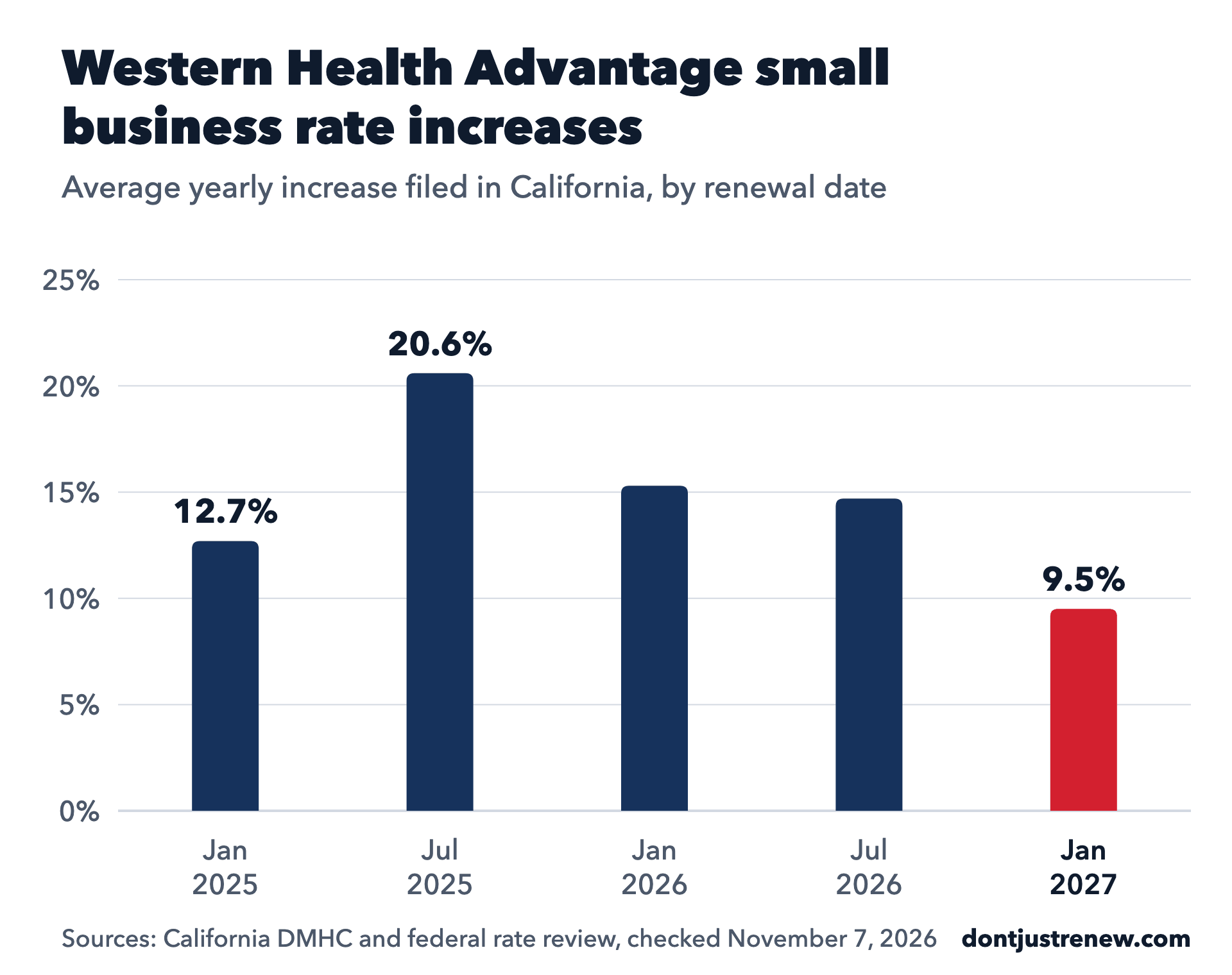
| Renewal date | Western Health Advantage |
|---|---|
| January 2025 | 12.7% |
| July 2025 | 20.6% |
| January 2026 | 15.3% |
| July 2026 | 14.7% |
| January 2027 | 9.5% |
Sources: DMHC rate filings for WHA’s small business plans, checked November 7, 2026, and the federal rate review site, which lists the same dates. See the January 2027 DMHC filing and WHA’s actuarial memo.
Smaller isn’t the same as small. A group that renewed each January at the average rate, 12.7%, 15.3%, and now 9.5%, pays about 42% more in 2027 than it did in 2024, by our math. The 2027 increase works out to roughly $70 more a month per person on the filing’s $803 average premium.
Where the 9.5% comes from
The filing splits the increase into parts. Higher prices and more use of care add about 7.0 points. Higher payments to doctors and hospitals add 3.2. Claims that came in higher than planned add 1.1, risk adjustment adds 0.2, and technical adjustments add about 1 point more. Risk adjustment is a federal program that moves money between insurers based on how healthy their members are.
Three things pull the other way. Savings from WHA’s pharmacy benefit manager, the company that runs its drug coverage, take 1.4 points off. Plan design changes take off 1.0, and lower administrative costs and margin take off 0.6. The parts multiply together, so they don’t add up exactly.
WHA pays most of its medical groups and hospitals a set amount per member each month instead of a fee for each visit. Those payments were about 95% of its medical costs in 2025. That year, care for members cost about 87% of the premium WHA collected from these plans, before risk adjustment.
Why drugs are the pressure point
The filing expects WHA’s overall costs to rise 7.0% a year. Medical care is at 5.3%. Prescription drugs are at 13.0%, and the filing puts about 9 points of that on higher prices and about 3 on people using more.
Drugs were about $116 of the $567 a month WHA’s small business members cost in 2025, about a fifth. When the smaller piece grows more than twice as fast as the bigger one, it takes a bigger share every year. It’s also the one place where WHA found savings this year, through its pharmacy benefit manager.
WHA next to the other Sacramento-area HMOs
Three plans we’ve covered sell HMOs in the Sacramento area, and they got to 2027 in very different ways.
| Plan | Increase for January 2027 | Average monthly premium per person after renewal | Expected yearly cost growth | How often it files |
|---|---|---|---|---|
| Western Health Advantage | 9.5% | $803 | 7.0% | Twice a year |
| Sutter Health Plan | 1.2% (3.1% for January renewals) | $817 | 16.7% | Twice a year |
| Kaiser Permanente | 5.6% | $696 | 6.7% | Once a year |
Sources: each plan’s 2027 small business filing with DMHC and its rate filing workbook, checked November 3 to 7, 2026. Kaiser’s premium is a statewide average for all of 2027. Sutter’s covers every month in its filing. Averages reflect each plan’s own members and regions.
Kaiser has been steady, with one rate a year. Sutter swung from 26.7% in January 2026 to almost nothing now. WHA is coming down from a 2025 peak. Over the last two Januaries, WHA’s increases add up to about 26%, close to Sutter’s 28% and well above Kaiser’s 13%.
New for 2027: WHA through Covered California for Small Business
WHA is joining Covered California for Small Business, the state’s marketplace for employers, with HMO plans in 10 Northern California counties. The marketplace says its rates for 2027 are going up 8.6% on average across all its carriers. Plans there are priced separately from WHA’s direct small business plans, so check which channel each quote comes from.
WHA’s filing shows costs in three of California’s 19 pricing regions: the Sacramento area, the North Bay counties of Marin, Napa, Solano, and Sonoma, and the region that takes in the rural northern counties. As an HMO, it generally doesn’t pay for care outside its network except in an emergency.
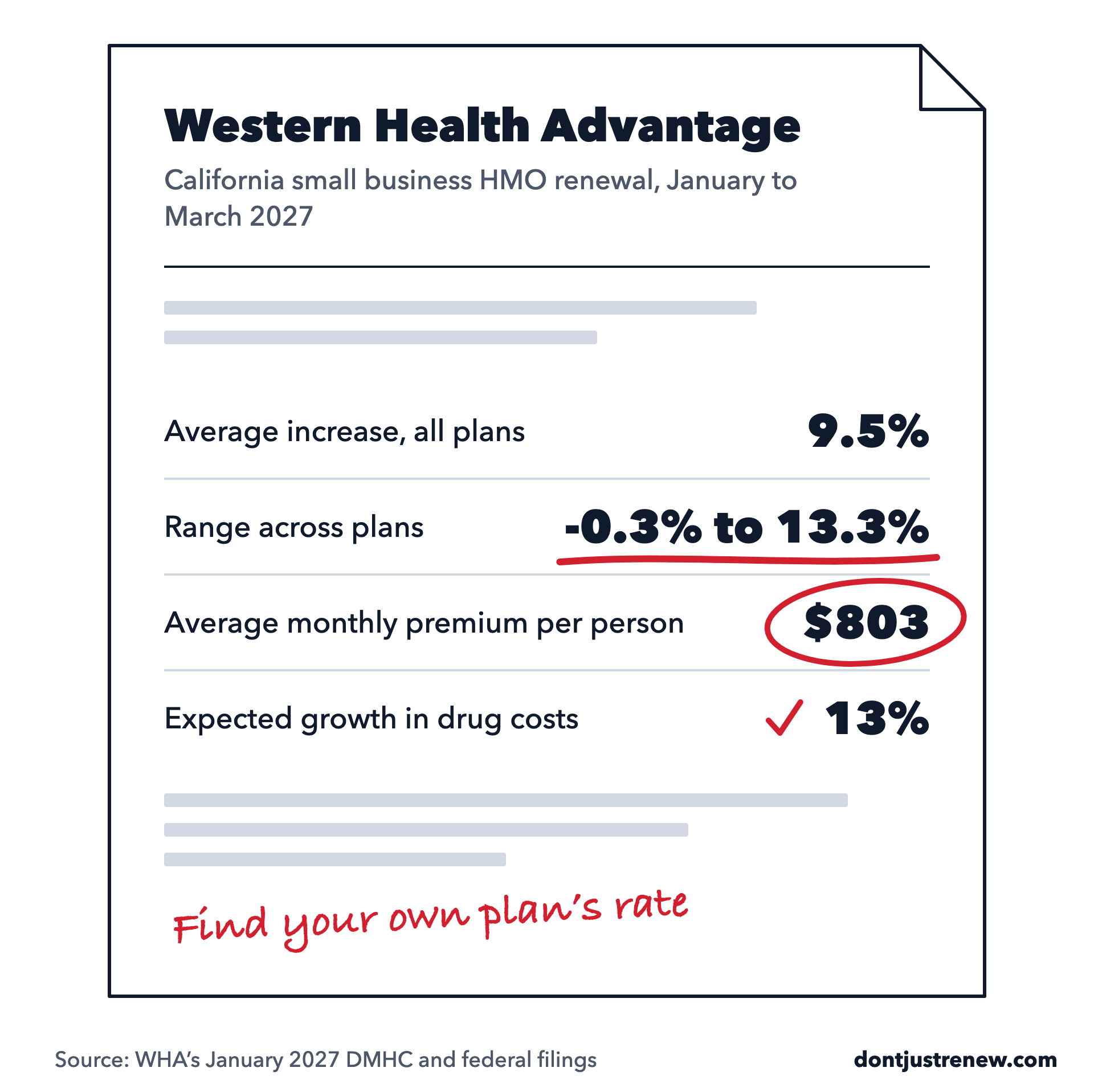
Across California’s January filings, WHA’s 9.5% is on the lower side, below Anthem Blue Cross at 10.9% and Blue Shield of California at 13.9%.
What to check on a WHA renewal
- Your own plan’s rate. WHA’s plans range from a 0.3% drop to a 13.3% increase.
- How your plan covers the prescriptions your employees fill most often, since drug costs are growing fastest.
- Your renewal month. These rates cover January through March, and in 2025 and 2026, July renewals had their own filing.
- Whether your employees’ medical groups are in WHA’s network, especially anyone outside the counties it covers.
Don’t Just Renew is not associated with, endorsed by, or sponsored by Western Health Advantage. Western Health Advantage is a trademark of its owner, and we use the name only to report public rate data. This article is general information, not insurance advice. Figures are current as of November 7, 2026.