 Don’t just renew
Aetna Funding Advantage, Cigna, and UnitedHealthcare level-funded plans: what comes back at renewal
Aetna, Cigna, and UnitedHealthcare all sell level-funded plans that can give money back when a group’s claims come in under budget. At all three, that money is tied to renewing. Aetna says it returns half of any surplus, Cigna says 50% or 67%, and UnitedHealthcare’s employer page doesn’t give a share. They also describe different rules for that money when a company leaves.
At a glance
- Aetna Funding Advantage returns 50% of any year-end surplus when you renew. If the plan ends, Aetna keeps the reserve to pay claims that arrive late.
- Cigna Level Funding gives renewing groups 50% or more of a surplus as a credit on its administrative fees. It’s for employers with 25 to 999 eligible employees.
- UnitedHealthcare says a surplus refund comes after you renew, only where state law allows. Its employer page doesn’t say how much.
- None of the three bills you extra after a year of high claims. Stop-loss insurance pays the overage.
What is Aetna Funding Advantage?
It’s Aetna’s level-funded plan for small and midsize employers. Your company is self-insured, Aetna Life Insurance Company administers the plan, and the same Aetna company sells the stop-loss insurance that pays when claims run past a set limit, according to its Aetna Funding Advantage page. If level funding is new to you, our guide to level-funded health plans covers how it compares with a regular small business plan.
You make one payment a month. Aetna says it covers claims, a terminal reserve (money set aside for claims that arrive after the plan year), stop-loss insurance, and plan administration. When you renew, Aetna returns 50% of any surplus. An Aetna small group flyer from 2023 shows what happens if the plan ends instead: all of the reserve stays with Aetna to pay claims submitted after the plan year is over.
The same flyer says monthly payments are based on your employees’ expected health costs, not a community pool. An earlier version from 2022 was labeled for small groups of 2 to 100. Aetna’s current page doesn’t give a size range.
How does level funding work with Cigna?
Cigna Level Funding rolls claims funding, the stop-loss premium, and administrative fees into one set payment a month, which changes only when enrollment does, according to Cigna’s Level Funding page. Part of what you pay in the first year is terminal funding. If you leave, that money pays for claims from before you left that are submitted afterward.
At the end of each year, Cigna does a settlement. If claims came in lower than expected, renewing clients can get 50% or more of the savings back as a credit on Cigna’s administrative fees. Its feature table puts the share at “50% and 67% with renewal,” and the page doesn’t say which groups get which. When claims run higher than expected, you don’t pay more, and Cigna says deficits aren’t carried into future years.
Cigna lists the plan for employers with 25 to 999 eligible employees, so a company with fewer than 25 can’t use it. Stop-loss coverage is built in.
What UnitedHealthcare’s level-funded products include
UnitedHealthcare sells its Level Funded plans in two versions, one for groups of 2 to 50 and one for 51 and up, according to its Level Funded page, whose web address also carries the name All Savers Alternate Funding. Your monthly payment goes to three things: a fund that pays your employees’ claims, administrative services, and stop-loss insurance with both an individual and a group-wide limit.
If more money goes into the claims fund than comes out, UnitedHealthcare says your plan may get a surplus refund after you renew. Its video on the page calls it a surplus share that you can apply to the following year’s plan. The page adds that refunds are available only where the law allows and tells employers to check with a tax or legal advisor about any restrictions. It doesn’t give a percentage.
UnitedHealthcare also says the plans come with up-to-date reports on your group’s claims costs. Its stop-loss insurance is written by UnitedHealthcare Insurance Company or an affiliate, with different affiliates in New Jersey and New York.
If you renew, and if you leave
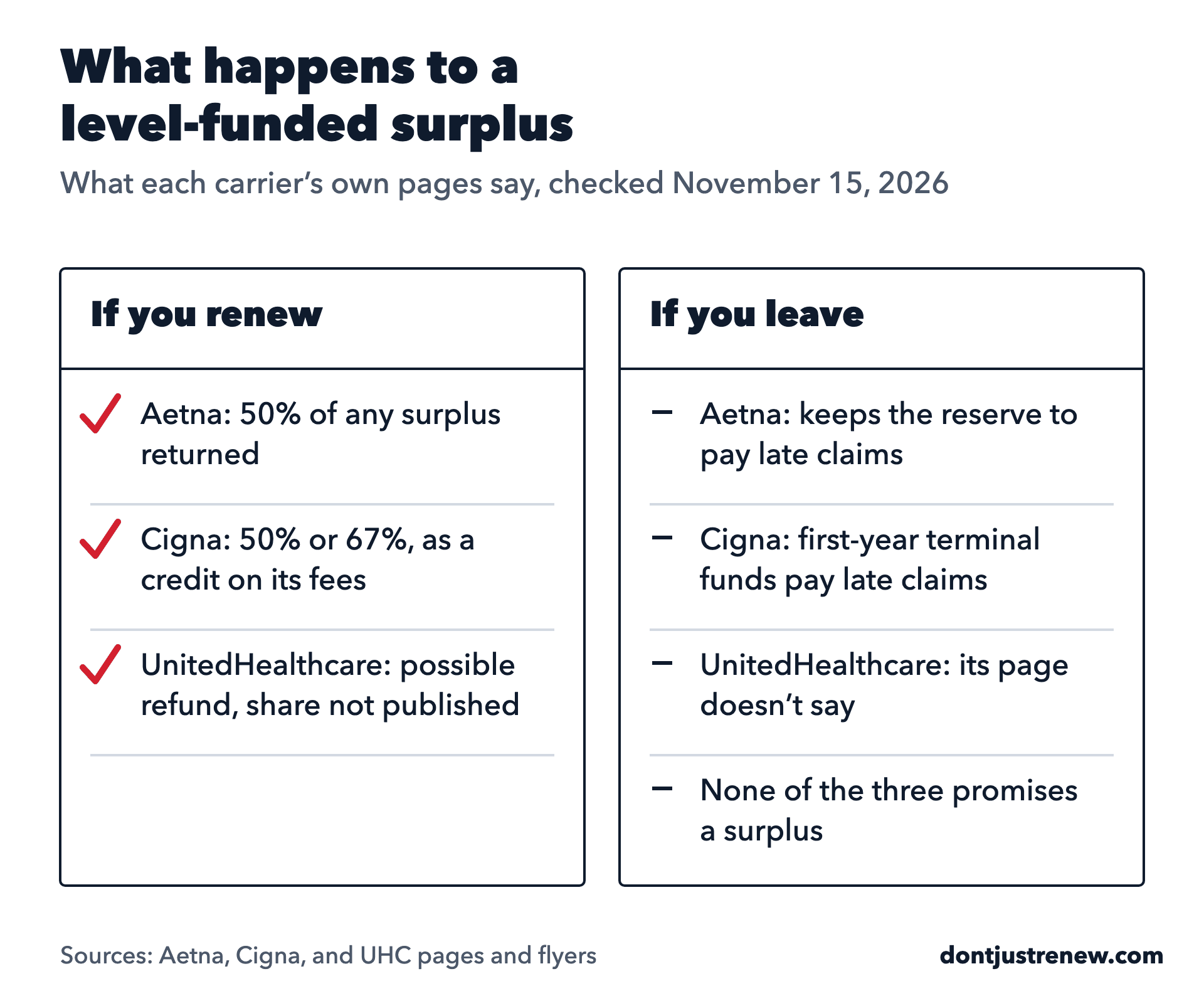
Aetna and UnitedHealthcare say they price a group on its own expected claims, and all three settle any leftover claims money after the plan year. They differ on what happens to that money, mostly when a company doesn’t renew.
| Carrier | Group size | Surplus at renewal |
|---|---|---|
| Aetna | Small and midsize (2 to 100 in a 2022 flyer) | 50%, returned to you |
| Cigna | 25 to 999 eligible employees | 50% or 67%, as a fee credit |
| UnitedHealthcare | 2 to 50, or 51 and up | Refund or share toward next year; percentage not published |
Sources: Aetna’s Aetna Funding Advantage page and its 2023 and 2022 small group flyers, Cigna’s Level Funding page, and UnitedHealthcare’s Level Funded page, checked November 15, 2026. Your contract’s terms can differ.
Cigna’s credit lowers next year’s administrative fees, so it only helps if you stay, and UnitedHealthcare describes its surplus share as something to apply to the following year’s plan. When you compare a level-funded renewal with other options, look at the price before any credit, then count the credit separately.
How much do level-funded groups get back?
Aetna is the only one of the three that publishes recent results on these pages. In 2024, it says, 44% of eligible groups earned a surplus, and the average paid was $7,152 per group and $753 per subscriber (the employee who holds the coverage).
| Plan year | Groups that earned a surplus | Average per group | Average per subscriber |
|---|---|---|---|
| 2021 | 53% | Over $9,450 | $796 |
| 2022 | Not given | $8,280 | Not given |
| 2024 | 44% | $7,152 | $753 |
Sources: Aetna’s 2022 flyer (2021 results), 2023 flyer (2022 results), and current Aetna Funding Advantage page (2024 results), checked November 15, 2026. Aetna counted all of its Aetna Funding Advantage employers for 2021 and its eligible groups for 2024, and says results vary by location and past claims. We found no 2023 figures.
By our math, that means 56% of eligible groups got nothing back in 2024. Dividing the per-group average by the per-subscriber average works out to about 9 or 10 subscribers in each group that got a payment. And if each payment was Aetna’s standard half, a $7,152 payment means a surplus of about $14,300, with Aetna keeping the other half. Cigna and UnitedHealthcare don’t publish comparable figures on their pages.
What changes at a level-funded renewal?
On a level-funded plan, next year’s price follows your group’s own claims, so it can move a lot in either direction. Our post on experience rating explains why a small group’s own claims swing its price, while an ACA small business plan is priced on the insurer’s whole pool. Cigna settles the surplus at the end of each year, and UnitedHealthcare says its refund comes after you renew, so the credit and the new price can reach you at different times.
The plan is still self-funded underneath, so some filings and fees fall to your company. Our post on self-funded health plan reporting requirements lists them.
Questions to ask before a level-funded renewal
- What share of a surplus comes back, in what form (a check, a premium credit, or a fee credit), and when it’s paid.
- What happens to the reserve and to late claims if you don’t renew.
- What next year’s price is before any surplus credit is applied.
- Whether a refund comes with tax or legal strings for your company, since UnitedHealthcare tells employers to check.
Don’t Just Renew is not associated with, endorsed by, or sponsored by Aetna, Cigna, or UnitedHealthcare. Their names are trademarks of their owners, and we use them only to describe public information. This article is general information, not insurance, tax, or legal advice. Figures are current as of November 15, 2026.