 Don’t just renew
Curative health plan renewals: Zero Always, Zero First, and the yearly Baseline Visit
Curative sells employer health plans with $0 in-network care, as long as every adult on the plan completes a Baseline Visit within 120 days of each plan year’s start. For plan years starting December 1, 2026 or later, level-funded groups can also pick Zero First, a design Curative prices lower, where members pay a share after a set amount of care. In Texas, only companies with 25 or more employees can buy it.
The basics
- Curative’s plans are either fully insured by its subsidiary, Curative Insurance Company, or level-funded, where the employer’s plan pays claims with stop-loss coverage behind it.
- In Texas, level-funded plans need 25 or more employees, and fully insured plans need 51 or more at companies in 38 counties.
- Every adult has to complete a Baseline Visit each plan year to keep $0 care. Without it, Curative’s 2026 plans carry a $5,000 deductible per person.
- At renewal, level-funded groups can stay on Zero Always or move to Zero First: $0 up to $2,500 or $5,000 of care a person, then 30% or 25% of each bill.
Is Curative an insurance company?
Yes, through a subsidiary. Curative started in 2020, according to its About page, and ran COVID-19 testing before launching its no-copay, no-deductible employer plan in 2022, its news page shows. Its fully insured plans come from Curative Insurance Company, the insurance subsidiary named on its employer page.
Its level-funded plans work differently. The employer’s plan is self-funded under ERISA, the federal law that governs employer plans, with stop-loss insurance that caps large claims, according to Curative’s Zero First page. Curative administers both kinds. Our level-funded plans post explains level funding in general.
Is Curative part of Cigna?
No. Curative’s employer FAQ says Cigna Healthcare is an independent company. Since January 1, 2026, employers have picked between two networks for care outside Texas, Florida, and Georgia. One is the Cigna Healthcare PPO network, available through a contract between the two companies. The other is Curative’s own wrap network of direct contracts, the Curative Cash Card, and the HealthSmart Preferred Network. Both replaced the First Health network Curative used before.
Who can buy a Curative plan?
Companies headquartered in Florida, Georgia, Indiana, Maryland, Texas, or Washington, D.C., according to the same FAQ, and their employees can live anywhere in the country. What’s offered and the minimum size vary by state. In Indiana and Maryland it’s level-funded plans and self-funded plans that Curative administers. Here’s how it works in what Curative calls its core states: Texas, Florida, and Georgia.
| Fully insured | Level-funded | |
|---|---|---|
| Where the company is based | 38 Texas counties, Florida, Georgia | Texas, Florida, Georgia |
| Minimum size | 51 employees | 25 employees in Texas; 50 employees and 25 enrolled in Florida and Georgia |
| Stop-loss insurance | Not needed | Included |
| Money back after the year | None | 50% of what’s left in the claims fund |
Source: Curative’s plan options and funding types page, checked November 20, 2026.
That leaves out the smallest companies. A Texas company with fewer than 25 employees can’t buy Curative, and none of the 2027 Texas small business filings on the federal rate review site are from Curative. Between 25 and 50 employees in Texas, level funding is the only way in.
That changes how your price is set. ACA small business plans price from the carrier’s whole pool, while level-funded and large group plans are priced for your own group, as our experience rating post explains. Curative’s Zero First page says its underwriting sets each group’s plan numbers.
How the Baseline Visit works, every plan year
The Baseline Visit keeps care at $0. Every member who’s 18 or older on the plan’s start date has to complete one within 120 days. A child keeps $0 care when the subscriber or spouse completes theirs, according to Curative’s Baseline FAQ. Most visits take 45 minutes to an hour, in person or by video, and include a walk through the plan with a care navigator. In-person visits also include quick lab tests, like blood sugar and cholesterol.
It starts over every plan year. Renewing members have to complete a new Baseline within 120 days of the renewal date. Members who did one last year keep $0 care from the first day while they book it. Members who skipped it last year get $0 care back once they complete it in that window.
Missing the window costs members money. On Curative’s 2026 EPO, PPO, and PPO Max plans, in-network care without a Baseline comes with a $5,000 deductible per person and $10,000 per family, its plan options page shows. Curative says the visit doesn’t affect premiums and the results aren’t shared with the employer.
Zero Always or Zero First: the new choice at renewal
Curative calls its all-$0 plans Zero Always. Zero First is a second design, open to new and renewing level-funded groups with plan years starting December 1, 2026 or later, according to its Zero First page. Curative says groups can choose it for a lower premium. For fully insured groups it depends on state approval, though a fully insured group can switch to level funding at renewal to get it.
On Zero First, care is $0 until a person has used a set amount of in-network care in the plan year. After that, the member pays a flat share of each bill, up to an out-of-pocket max. Preventive care, primary care, outpatient mental health visits, and urgent care stay $0 all year, and their cost still counts toward the set amount. Prescriptions don’t change: $0 for preferred drugs, $50 for non-preferred, and $250 for non-preferred specialty drugs. Zero First can’t be paired with an HSA.
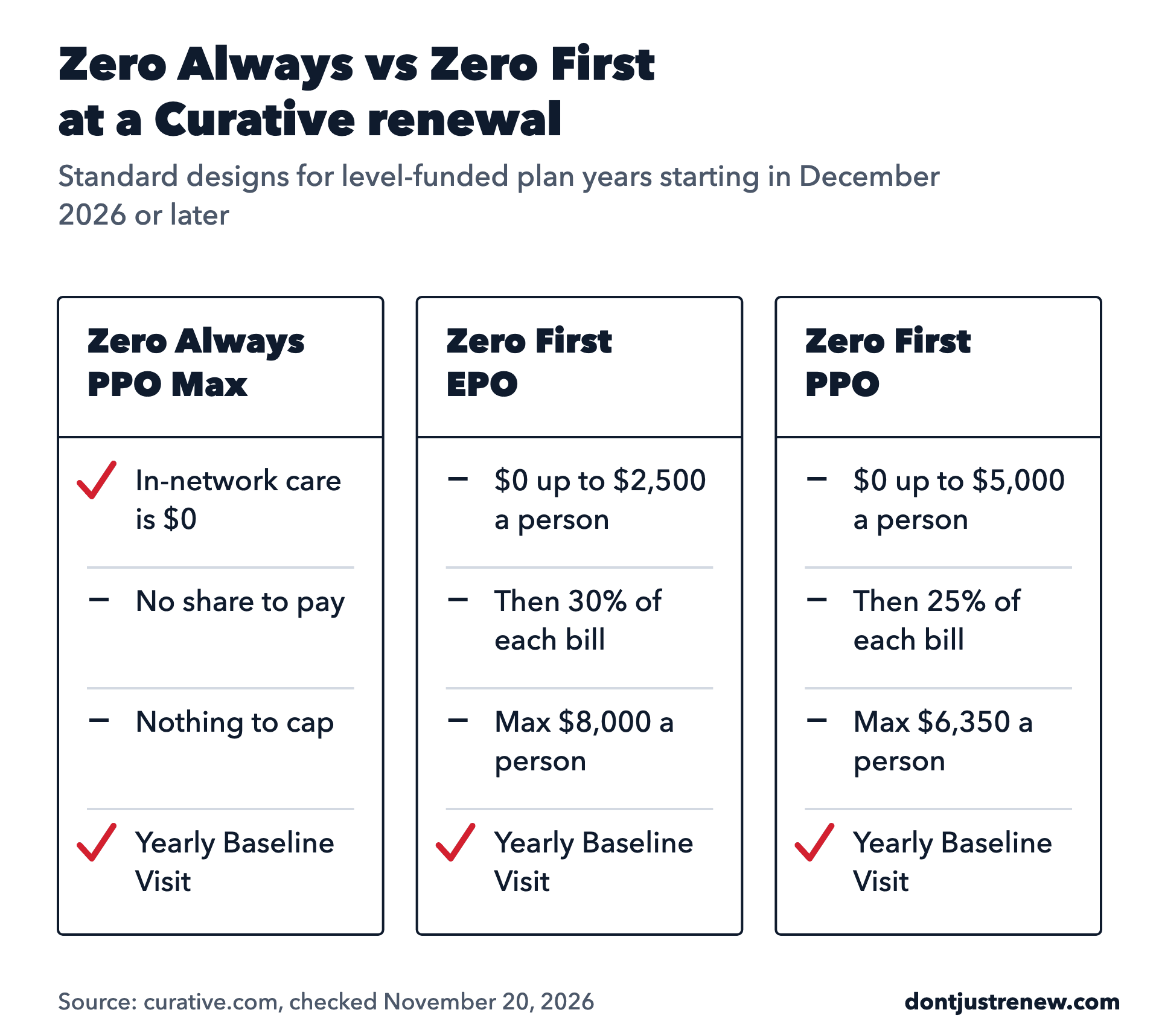
These are Curative’s standard designs. Underwriting can set different numbers for your group, and the quote shows them in the plan’s name, like “Zero First EPO 3000/30/8000.” Here’s what one person would pay on the standard designs at different levels of care.
| Care used in the year | Zero Always | Zero First EPO | Zero First PPO |
|---|---|---|---|
| $2,000 | $0 | $0 | $0 |
| $5,000 | $0 | $750 | $0 |
| $10,000 | $0 | $2,250 | $1,250 |
| $25,000 | $0 | $6,750 | $5,000 |
| $50,000 | $0 | $8,000 | $6,350 |
Source: our math from the standard designs on Curative’s Zero First page, checked November 20, 2026. Care used is what the plan pays providers. It assumes the Baseline Visit is done, leaves out prescriptions, and treats all care above the set amount as the kind that takes the share, like specialist visits, imaging, and hospital stays.
On the standard designs, a Zero First PPO member never pays more than a Zero First EPO member for the same in-network care, by our math, because the PPO’s set amount is higher and its share and max are lower. Curative doesn’t publish premiums, so the price difference between the designs only shows up on a quote. Curative also says about 2 in 3 of its 2025 members would have paid nothing for medical care on the Zero First EPO, and about 3 in 4 on the PPO, based on its own modeling.
What else can change at a Curative renewal?
For level-funded groups, there’s the leftover claims money. Curative’s plan options page lists the refund as 50% of what’s left in the claims fund. Our post on level-funded renewals at Aetna, Cigna, and UnitedHealthcare shows how other carriers handle that money.
Then there’s the network cost for employees outside Texas, Florida, and Georgia. Groups with employees there got the Cigna network at no charge for the 2026 plan year, and Curative’s FAQ says “there may be additional costs in the next renewal cycle” for it.
Who Curative tends to fit
Going by its rules, Curative fits companies headquartered in its states that meet the size minimums, with most employees living in Texas, Florida, or Georgia, where its direct contracts are. It also takes a company willing to get every adult through a Baseline Visit each year. A company that wants to offer an HSA would need a separate high-deductible plan next to Zero First.
A Texas company with fewer than 25 employees is choosing among ACA small business plans and level-funded plans from other carriers.
What to check on a Curative renewal quote
- Which design it quotes, Zero Always or Zero First, and the set amount, share, and out-of-pocket max in the plan’s name.
- How many of your adult members completed last year’s Baseline Visit, and how the rest will book one within 120 days of the renewal date.
- On a level-funded plan, the claims fund balance, when the 50% refund is paid, and any conditions on it in the contract.
- For employees outside Texas, Florida, and Georgia, which wrap network they’re on and whether its cost changed.
Don’t Just Renew is not associated with, endorsed by, or sponsored by Curative, Curative Insurance Company, Cigna Healthcare, or HealthSmart. These names are trademarks of their owners, and we use them only to describe public information. This article is general information, not insurance, tax, or legal advice. Figures are current as of November 20, 2026.