 Don’t just renew
What is an employee assistance program, and does your health plan include one?
An employee assistance program, or EAP, gives employees and usually their families a few free, confidential counseling sessions and referrals for things like stress, grief, money trouble, legal questions, or substance use. Some carriers build one into their small business health plans at no extra charge. Even so, workers at small workplaces are far less likely to have one than workers at big ones.
At a glance
- An EAP covers short-term help with personal, family, money, and work problems, then refers people elsewhere for anything longer.
- In March 2026, 38% of private industry workers at workplaces with fewer than 50 people could use an EAP, against 88% at workplaces with 500 or more.
- Federal rules keep an EAP outside the health insurance rules only if it’s free to employees, has no copays, doesn’t stand between employees and the health plan, and doesn’t provide significant medical care.
- Your medical plan may already include one, so check your plan documents before you shop for one on its own.
What does an EAP cover?
The Bureau of Labor Statistics defines EAPs as programs for more serious personal problems than wellness programs handle. They offer referrals, or referrals plus counseling, and the help can come from company staff, an outside company under contract, or both.
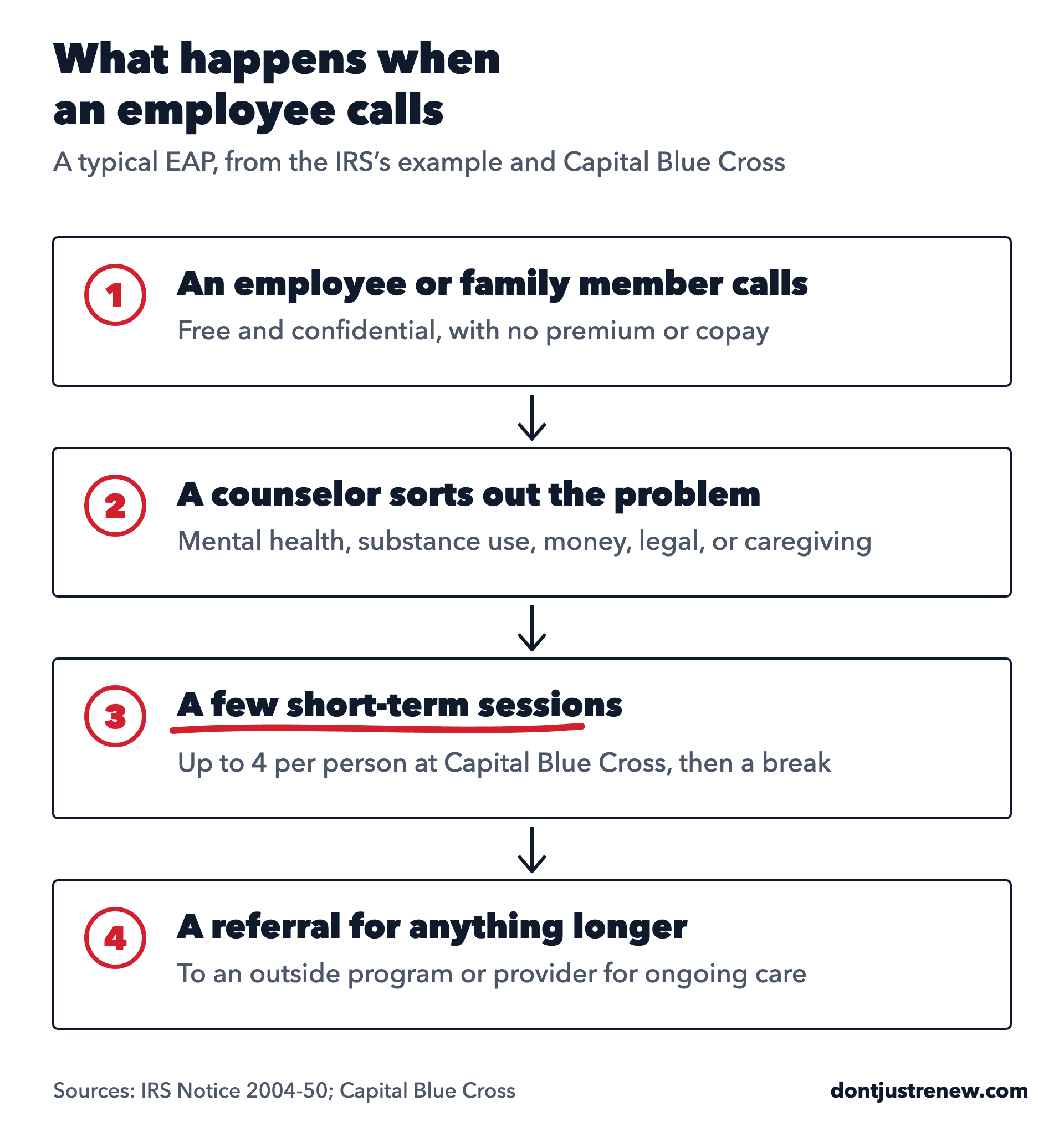
The IRS describes a typical one in Notice 2004-50, its guidance on health savings accounts: free or low-cost, confidential, short-term counseling to figure out what’s affecting an employee’s work, then a referral to an outside program when it’s needed. Its list of issues includes substance use, mental health, money or legal trouble, and caring for children or parents.
Some EAPs reach past the employee. Regence’s is open to anyone in an employee’s household, whether or not they’re on the health plan. Capital Blue Cross’s covers each employee and dependent on its plans.
How many small businesses offer an EAP?
Well under half of workers at small workplaces have one. In March 2026, 38% of private industry workers at workplaces with fewer than 50 people could use an EAP, according to the BLS benefits survey. At workplaces with 500 or more, it was 88%. BLS sorts workers by the size of their work location, usually a single site, not by the size of the whole company.
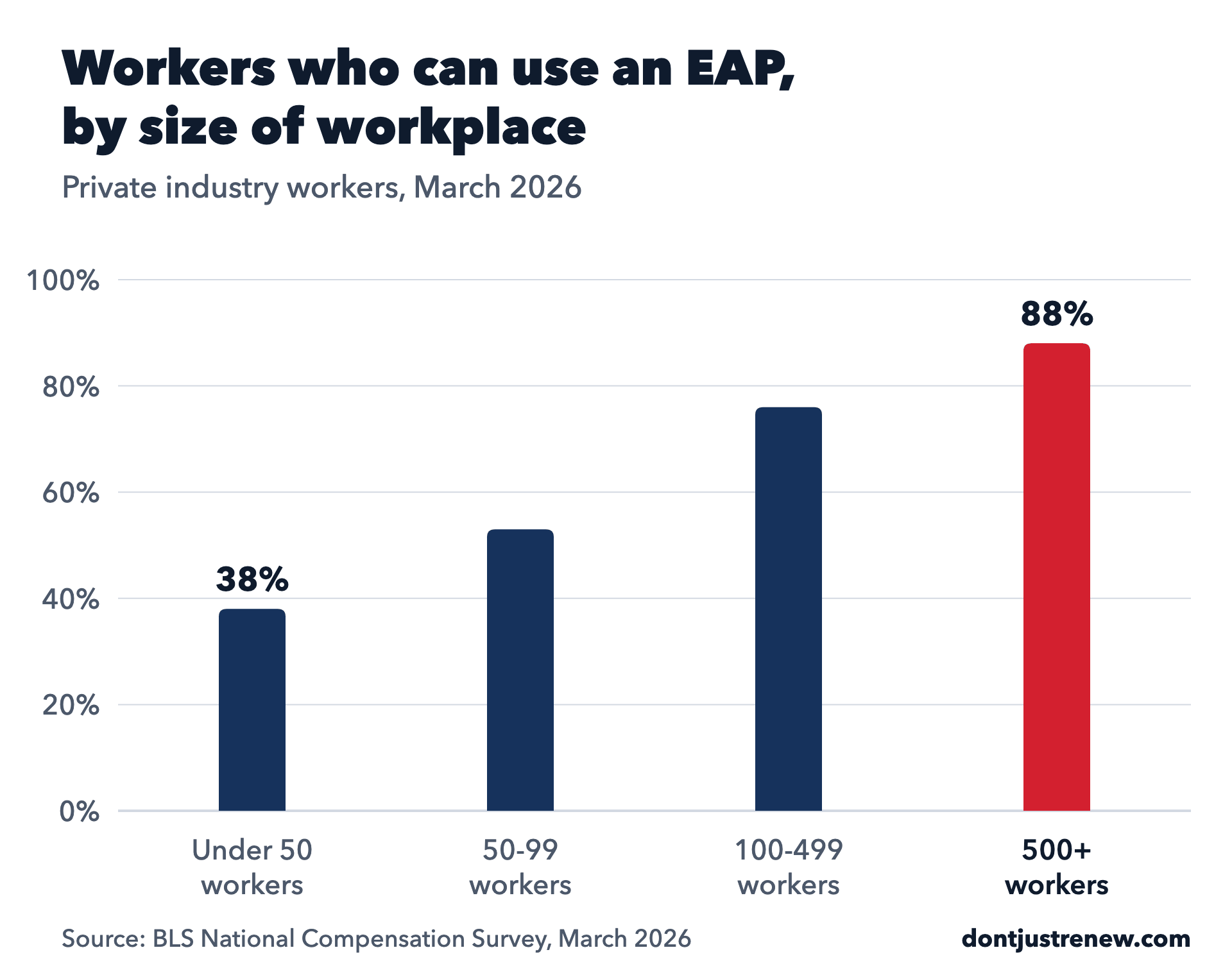
Health coverage thins out at small workplaces too, but EAPs thin out faster. Under 50 workers, 55% could get medical coverage through work and 38% could use an EAP, a gap of 17 points by our math. At 500 or more, it was 90% and 88%, a gap of 2 points. The gap is 20 points at 50 to 99 workers and 7 points at 100 to 499.
Mental health networks also tend to be narrower than the rest of a small company’s plan. In KFF’s 2026 employer survey, 21% of small firms with health benefits (10 to 199 employees) called the network in their main plan very broad for mental health and substance use care, against 50% for care overall. Capital Blue Cross’s EAP, for one, has its own network of therapists, separate from the health plan’s.
Is an EAP included in your group health insurance?
Sometimes. Some carriers put an EAP in their small business plans at no extra charge and charge bigger groups to add one. Two Blue Cross Blue Shield companies outside California, Texas, and Florida show how that can look: Regence, in Idaho, Oregon, Utah, and parts of Washington, and Capital Blue Cross, in central Pennsylvania and the Lehigh Valley.
| Regence | Capital Blue Cross | |
|---|---|---|
| Small business plans | Built in for groups of 1 to 50 | Included for small group ACA plans |
| Bigger groups | A low-cost add-on for 51 or more | Included for its mid-market groups |
| Counseling sessions | Up to four, six, or eight | Up to four per person, renewing after a two-month break, up to 12 a year |
| Who can use it | Employees on the medical plan, their dependents, and anyone in their household | Each employee and covered dependent |
| Run by | ComPsych, a separate company | M & S EAP Services, a separate company |
Sources: Regence and Capital Blue Cross employer EAP pages, checked November 18, 2026.
At Regence, groups of 51 to 100 that add the EAP get four sessions per issue, and groups over 100 pick four, six, or eight. Capital Blue Cross gives the example of a household of three getting up to 36 sessions a year at no extra cost. Your carrier may do it differently or not include one at all, so your plan documents and your carrier’s employer site are where to look.
What rules does an EAP have to follow?
Federal rules treat an EAP as an “excepted benefit,” which means the federal group health plan rules, including the ACA’s coverage requirements, don’t apply to it. It only qualifies if it meets four conditions in 29 CFR 2590.732 (the same text is in the HHS version, 45 CFR 146.145):
- It doesn’t provide significant medical care, judged by the amount, scope, and length of its services.
- Employees don’t have to use up the EAP before the health plan will pay, and they don’t have to be on the health plan to use the EAP.
- Employees pay no premium or contribution to join.
- There’s no cost sharing, like copays or deductibles.
If you offer a high-deductible plan with a health savings account, an EAP like this doesn’t cost employees their HSA eligibility. Notice 2004-50 says an EAP that doesn’t provide significant medical care or treatment isn’t a “health plan” for that purpose.
States can add their own rules. In California, an EAP needs a license from the Department of Managed Health Care, or a filing if the company is already a licensed health plan, unless it qualifies for an exemption. The exemption is for EAPs that only spot problems and refer people out, with no counseling or therapy, no charge to employees, and no more than three sessions per person in six months.
What are the disadvantages of an employee assistance program?
An EAP is built for short-term help. It has a set number of sessions per person or per issue, and longer treatment means a referral to other care, which the health plan may cover.
It’s also a separate service. In both examples above, an outside company runs the EAP, with its own phone line, website, and counselors. Employees at Regence groups, for example, need an access code unique to their employer to use the EAP’s website.
And it only helps if people know it’s there. Capital Blue Cross’s employer page suggests mentioning the EAP in staff meetings and emails and offers flyers to post and a webinar to share.
What happens to your EAP at renewal?
If your EAP comes with your medical plan, it renews with it. That also means a change of carrier can change the EAP: a different company running it, a different session limit, and a new phone number or access code for your employees.
Growing can change it too. At Regence, the EAP is built in for groups up to 50 and becomes a paid add-on at 51. The weeks between your renewal notice and your renewal date, laid out in our renewal timeline, are a good time to find the EAP in the new benefit materials and see what changed.
How to set up an EAP, or check the one you have
- Look for the EAP in your plan documents or on your carrier’s employer site: who runs it, the phone number or access code, and how many sessions each person gets.
- Check who can use it: only employees on the health plan, their dependents, or anyone in the household.
- If you buy one on its own, confirm it’s free to employees with no copays and doesn’t have to be used before the health plan, and get the price per employee per month so quotes line up.
- If you’re changing carriers or growing past 50 employees, ask what happens to the EAP and whether anyone partway through their sessions can finish them.
Don’t Just Renew is not associated with, endorsed by, or sponsored by Regence or Capital Blue Cross. Their names are trademarks of their owners, and we use them only to describe public information. This article is general information, not insurance, tax, or legal advice. Figures are current as of November 18, 2026.