 Don’t just renew
PEPM vs PMPM: how health plan costs are counted, and how much goes to broker commissions
PMPM means per member per month: a cost divided by everyone the plan covers, spouses and kids included. PEPM means per employee per month: the same cost divided by enrolled employees only. In 2024, small business health plans averaged about $630 per member per month, or roughly $1,050 per employee, by our math from federal data. About $26 of that per member, or $44 per employee, went to broker commissions.
In brief
- PMPM counts every covered person. PEPM counts enrolled employees. On small business plans, each enrolled employee brings about 1.67 covered people, so a cost stated PEPM is about two-thirds higher than the same cost stated PMPM.
- Of every $100 of small business premium in 2024, about $85 paid medical claims, $7.50 went to the insurer’s administration, $4.20 to broker commissions, and $2.20 to taxes and fees.
- Commissions averaged 4.2% of premium on small business plans, about $530 a year per enrolled employee, and 1.2% on large group plans.
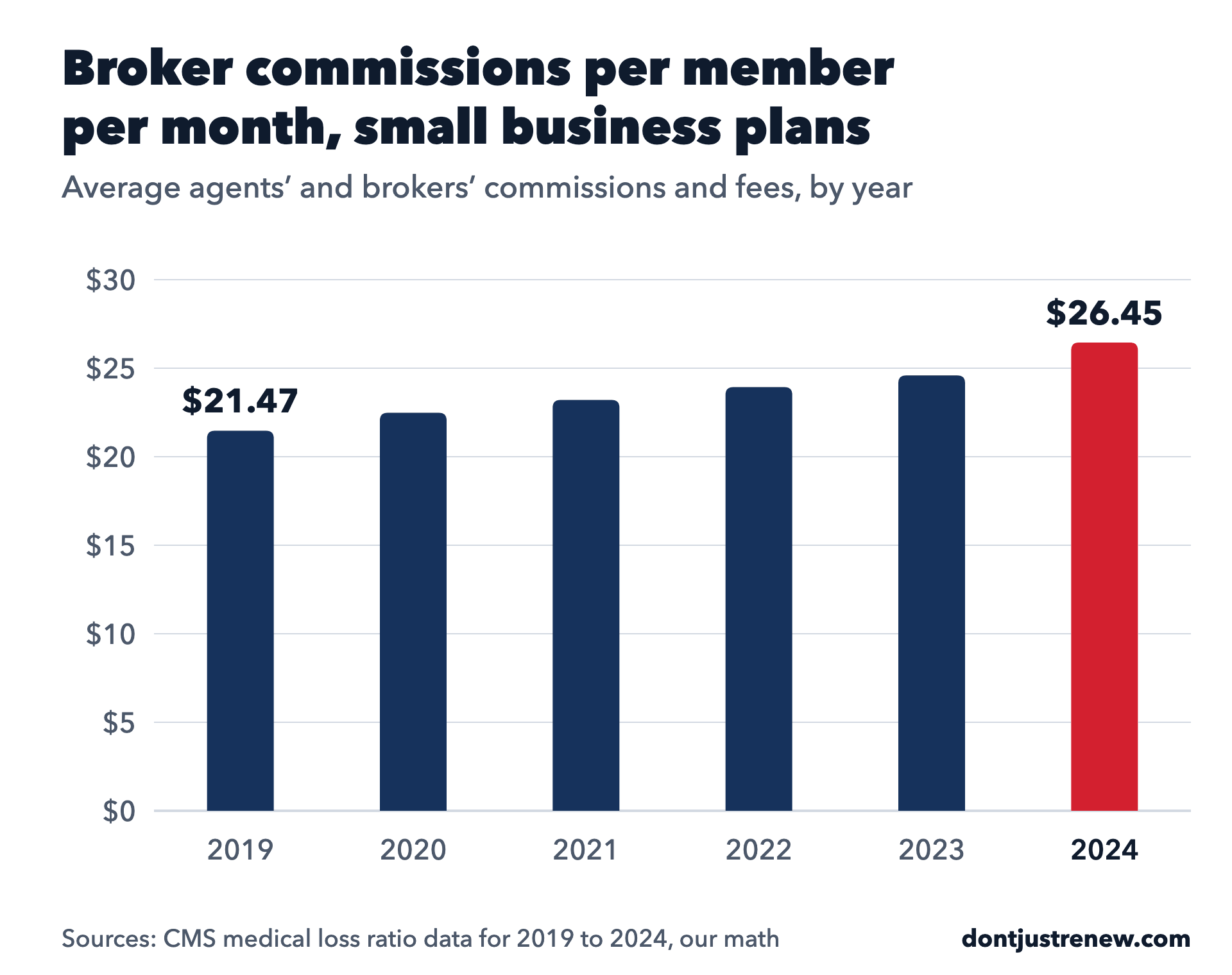
- From 2019 to 2024, the small business premium rose $133.50 a month per member. Claims rose $136. Commissions rose $5.
What do PEPM and PMPM stand for?
PMPM stands for per member per month. A member is anyone the plan covers: the employee, a spouse, each child. Insurers price this way because every covered person can have claims. It’s the unit they use when they file their prices with regulators and report their results to the federal government.
PEPM stands for per employee per month, and it counts only the employees enrolled in the plan. Employers budget this way, since payroll runs by employee. Fees charged to an employer are usually quoted PEPM, like some broker commissions and the administration fee on a self-funded plan, where the employer pays the claims itself.
You may also see PSPM, per subscriber per month. A subscriber is the employee who enrolls, as one of Kaiser Permanente’s commission schedules defines it, so on an employer plan it’s the same count as PEPM.
How to calculate PMPM, and how to turn it into PEPM
Divide the cost by member months: the number of people covered in each month, added up. A plan that covers 20 people all year has 240 member months. If its premiums for the year were $150,000, that’s $625 PMPM.
For PEPM, divide by enrolled employees instead. If those 20 people are 12 employees and 8 family members, the same $150,000 is about $1,042 PEPM. The shortcut is to multiply PMPM by the number of members per employee, here 1.67.
What’s the typical number of members per employee? It’s about 1.67 on small business plans, 1.87 on large group plans, and 1.96 on self-funded plans that insurers administer. That’s our math from the 2024 reports insurers filed with the Centers for Medicare & Medicaid Services (CMS), which count covered people and enrolled employees at year end. So PEPM is always the bigger number for the same cost, by two-thirds or more.
| Insured plans | PMPM | Members per employee | PEPM |
|---|---|---|---|
| Small business | $629.85 | 1.67 | $1,051 |
| Large group | $588.97 | 1.87 | $1,101 |
Source: CMS medical loss ratio public use file for 2024, checked November 16, 2026. Premium earned divided by member months, across all insurers’ reports, is our math. Small business means employers with up to 50 employees, or up to 100 in states that set the line there, as California does.
KFF’s 2026 survey of employers gives another view. The average premium was $9,804 a year for single coverage and $28,303 for family coverage, which is about $817 and $2,359 a month by our math. A per-employee average lands between those two, because it blends employees who cover only themselves with employees who cover a family.
Where does each premium dollar go?
Most of it pays for medical care. Federal rules make insurers spend at least 80% of small business premiums and 85% of large group premiums on medical claims and on programs that improve care, measured after taxes and fees. An insurer that falls short owes rebates. Everything else has to fit in what’s left, and the rules count agents’ and brokers’ commissions as an administrative cost, next to the insurer’s own overhead.
Here’s how the 2024 small business premium split across the country:
| Where it went | Per $100 | PMPM |
|---|---|---|
| Medical claims | $85.45 | $538.21 |
| Insurer’s administration | $7.51 | $47.28 |
| Broker commissions and fees | $4.20 | $26.45 |
| Taxes and regulatory fees | $2.24 | $14.08 |
| Left over | $0.61 | $3.83 |
Source: CMS medical loss ratio public use file for 2024, checked November 16, 2026. Our math from every insurer’s small group report: $76.2 billion in premium covering about 10.1 million people. Insurer’s administration combines claims handling, cost control, quality programs, the insurer’s own sales staff, and general overhead. Left over is premium minus those reported costs, before investment income. Rounded, so the first column adds to $100.01.
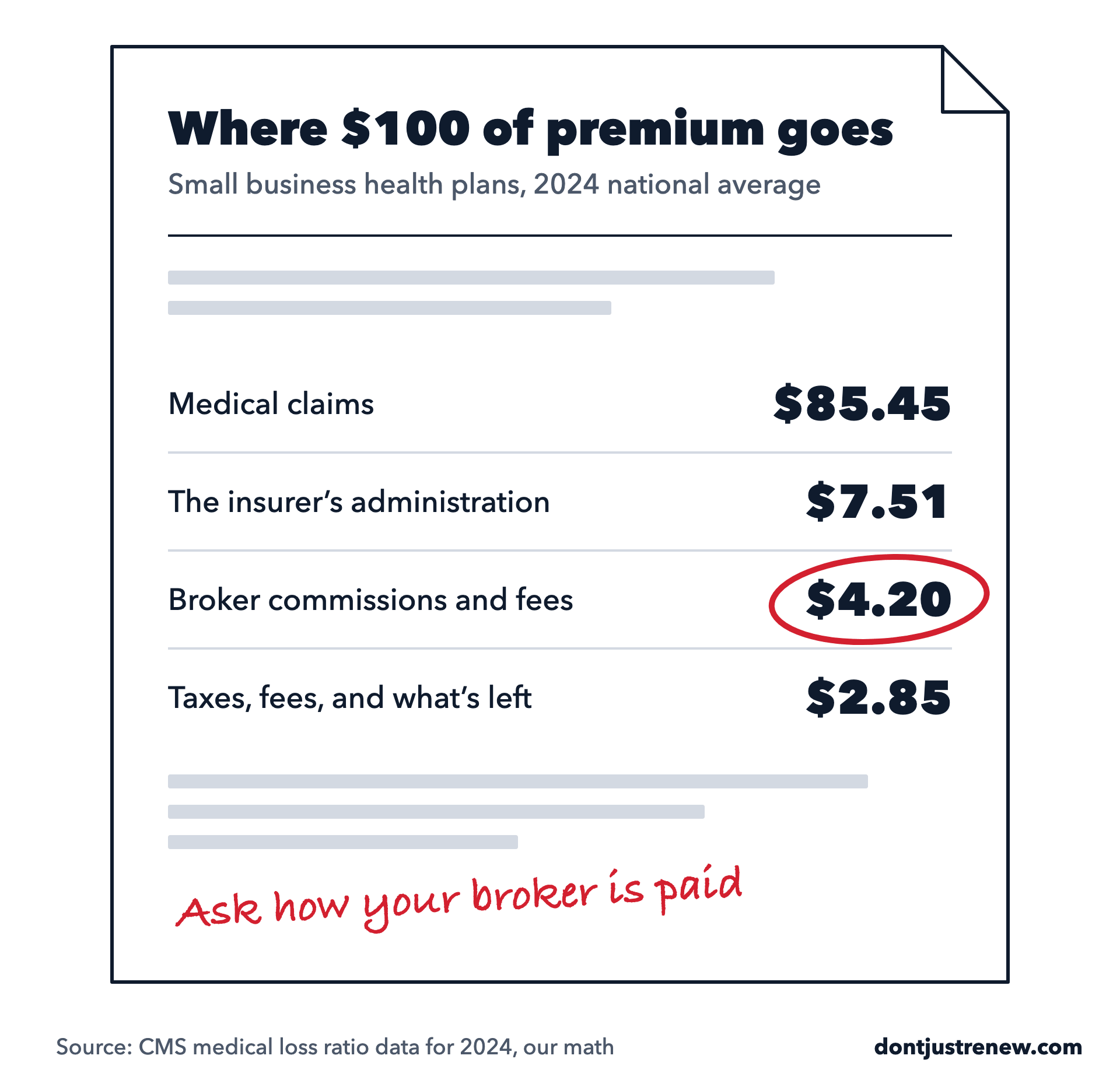
2024 was a thin year for insurers. In 2019, claims took $81 of every $100 and about $4 was left over. Large group plans spend even more of the premium on care: in 2024, $89.40 of every $100 went to claims and $1.24 to commissions.
How do health insurance brokers get paid?
Mostly by the insurance company, out of the premium. Brokers (this site calls them employee benefits advisors) “often get payments (‘commissions’) from insurance companies for selling plans,” HealthCare.gov says, and you won’t pay anything additional for enrolling with one. On an ACA small business plan, the price can vary only by family size, location, age, and tobacco use, as our community rating post explains. Whether you use a broker isn’t on that list, so the commission sits inside the rate.
Insurers publish commission schedules for brokers, and they use two main formulas. One is a percentage of premium. The other is a flat dollar amount per enrolled employee per month.
| Schedule | Employees | Commission |
|---|---|---|
| Covered California for Small Business | 1 to 100 | 5% of premium |
| Kaiser Permanente, Georgia | 2 to 50 | 6% of premium |
| Kaiser Permanente, Georgia | 51 to 249 | 5% of premium |
| Kaiser Permanente, Mid-Atlantic | 1 to 50 | $35 PEPM, then $30 at renewal |
Sources: Covered California’s schedule of commissions (revised May 2026; 5% applies to groups that enrolled in 2018 or later), Kaiser Foundation Health Plan of Georgia’s 2026 broker commissions, and Kaiser Foundation Health Plan of the Mid-Atlantic States’ 2026 group broker commission schedule, checked November 16, 2026. Covered California for Small Business is the state’s insurance marketplace for small employers.
For bigger groups, pay is often negotiated. Kaiser’s Georgia schedule lists groups of 250 or more as negotiable. Its Mid-Atlantic schedule makes commissions negotiable above 50 employees, and says a negotiated commission is paid when it appears on the group’s rate proposal as a separate line item.
Bonuses can come on top. For new groups starting between July 2026 and January 2027, an agency that enrolls at least three with Covered California gets $500 to $9,000 per group on top of the 5%, depending on each group’s size and how many groups it enrolls.
What does the pay cover? Federal law’s list of the services brokers and consultants provide to health plans includes help choosing insurance, benefits administration, the companies that manage a plan’s drug coverage, wellness programs, and compliance.
Health insurance broker commission rates: the national averages
Insurers report what they pay outside agents and brokers to the federal government every year. On small business plans in 2024, it came to $3.2 billion on $76.2 billion in premium. That’s 4.2%, or $26.45 per member per month. By our math it’s about $44 per enrolled employee per month, or $530 a year. The average small group had about five enrolled employees and generated about $2,900 a year in commissions.
The figure covers everything an insurer pays licensed agents and brokers who aren’t its employees for selling its policies. Pay for the insurer’s own salespeople is reported separately and added another $3.28 per member per month.
| Insured plans | Share of premium | PMPM | PEPM |
|---|---|---|---|
| Small business, U.S. | 4.2% | $26.45 | $44 |
| California | 6.8% | $42.01 | $66 |
| Texas | 4.8% | $32.52 | $54 |
| Florida | 3.4% | $22.80 | $36 |
| Large group, U.S. | 1.2% | $7.28 | $14 |
Source: CMS medical loss ratio public use file for 2024, checked November 16, 2026. Agents’ and brokers’ fees and commissions divided by premium and by member months is our math. PEPM uses each row’s own count of members per enrolled employee. The state rows are small business plans.
Insurers differ a lot. About half of small business members were with insurers whose commissions ran between 2.8% and 5.9% of premium. About a tenth were with insurers under 2%, and nearly a fifth with insurers above 6.5%. California’s 6.8% average sits above the 5% on Covered California’s schedule. Insurers set their own schedules for plans sold outside it, and the federal total also counts bonuses.
Large group plans paid 1.2% of premium, or about $14 per enrolled employee per month. The average large group in the data had about 89 enrolled employees and generated about $14,700 a year in commissions.
Do commissions push premiums up?
A little, mostly by riding along with the premium. From 2019 to 2024, the small business premium rose from $496.35 to $629.85 per member per month, up 27%. Claims rose from $402.08 to $538.21, up 34%. Commissions rose from $21.47 to $26.45, up 23%, about the same as consumer prices over those years.
In dollars, the monthly premium per member went up $133.50. Claims went up $136, more than the whole increase, so what insurers had left over shrank. Commissions went up about $5. If commissions per member had stayed at their 2019 level, the 2024 premium would have been about 0.8% lower, by our math.
How a broker is paid decides whether the commission moves with your renewal. A 5% commission on a $1,051 PEPM premium is about $53 per employee per month. After a 10% increase it’s about $58, with nothing else changed. Florida’s average small business increase for 2027 is 12.9%, so a percentage commission on an average Florida renewal rises 12.9% too. A flat $35 stays $35, and on Kaiser’s Mid-Atlantic schedule it drops to $30 at renewal.
The 80% and 85% rules work the same way. They cap administration, commissions, and profit as a share of premium. The dollar amount isn’t capped, so when claims rise, the dollars allowed for everything else rise with them.
What are typical ASO fees per employee per month?
About $49, going by what insurers reported for 2024. On a self-funded plan there’s no premium. The employer pays the claims and pays an insurer or administrator a fee to run the plan, an arrangement often called ASO, for administrative services only.
Insurers reported $32.1 billion in fees from the self-funded plans they administered in 2024, covering about 106 million people. That’s $25.20 per member per month, by our math. It’s the fee alone. Claims come on top, and so does stop-loss insurance, which covers unusually large claims.
| Insurer | PMPM | PEPM |
|---|---|---|
| All insurers reporting | $25.20 | $49 |
| Aetna Life Insurance Company | $28.40 | $56 |
| Cigna Health and Life Insurance Company | $21.92 | $42 |
Source: CMS medical loss ratio public use file for 2024, checked November 16, 2026. Income from fees on self-funded plans divided by member months, for the 192 insurer reports that included both, is our math. Fees can cover different services at different companies, and most of these members work for large employers, so these are averages, not quotes. UnitedHealthcare’s reports don’t include enough of its self-funded membership to calculate a figure.
Brokers are paid differently here too. Insurers paid agents and brokers about 61 cents per member per month on self-funded business, a fraction of the $26.45 on small business plans. That figure leaves out fees an employer pays a broker or consultant directly.
How to find out what your broker is paid
You can ask, and federal law backs you up. If your plan falls under ERISA, the law that covers most private employers’ benefit plans, a broker or consultant who expects $1,000 or more in pay tied to your plan has to disclose it in writing to the person responsible for the plan, reasonably in advance of when you sign or renew.
- Ask for the compensation disclosure. It can state pay as a dollar amount, a formula, or a charge per enrollee, and it has to include pay from insurers under incentive programs that aren’t tied to your plan alone.
- Ask whether the commission is a percentage of premium or a flat PEPM amount, and what it comes to in dollars a year at your current enrollment.
- On a larger group’s quote, look for the commission as its own line. On the schedules above, it becomes negotiable somewhere between 51 and 250 employees.
- If your plan files a Form 5500, the yearly report some plans owe the Department of Labor, look there too. Kaiser Permanente and Covered California both say the commissions and bonuses they pay get reported on Forms 1099 and 5500.
One note about us: Don’t Just Renew may accept compensation from companies that appear on this site, as our advertiser disclosure explains.
Don’t Just Renew is not associated with, endorsed by, or sponsored by Kaiser Permanente, Covered California, Aetna, Cigna, or UnitedHealthcare. Their names are trademarks of their owners, and we use them only to describe public information. This article is general information, not insurance, tax, or legal advice. Figures are current as of November 16, 2026.