 Don’t just renew
Fully insured or self-funded: who pays your employees’ claims, and which rules apply?
In a fully insured plan, your company pays a premium and the insurance company pays your employees’ claims. In a self-insured plan, also called self-funded, your company pays the claims itself, usually with an insurer or administrator doing the paperwork. Which one you have decides which laws cover the plan and what moves its cost from year to year.
Short answer
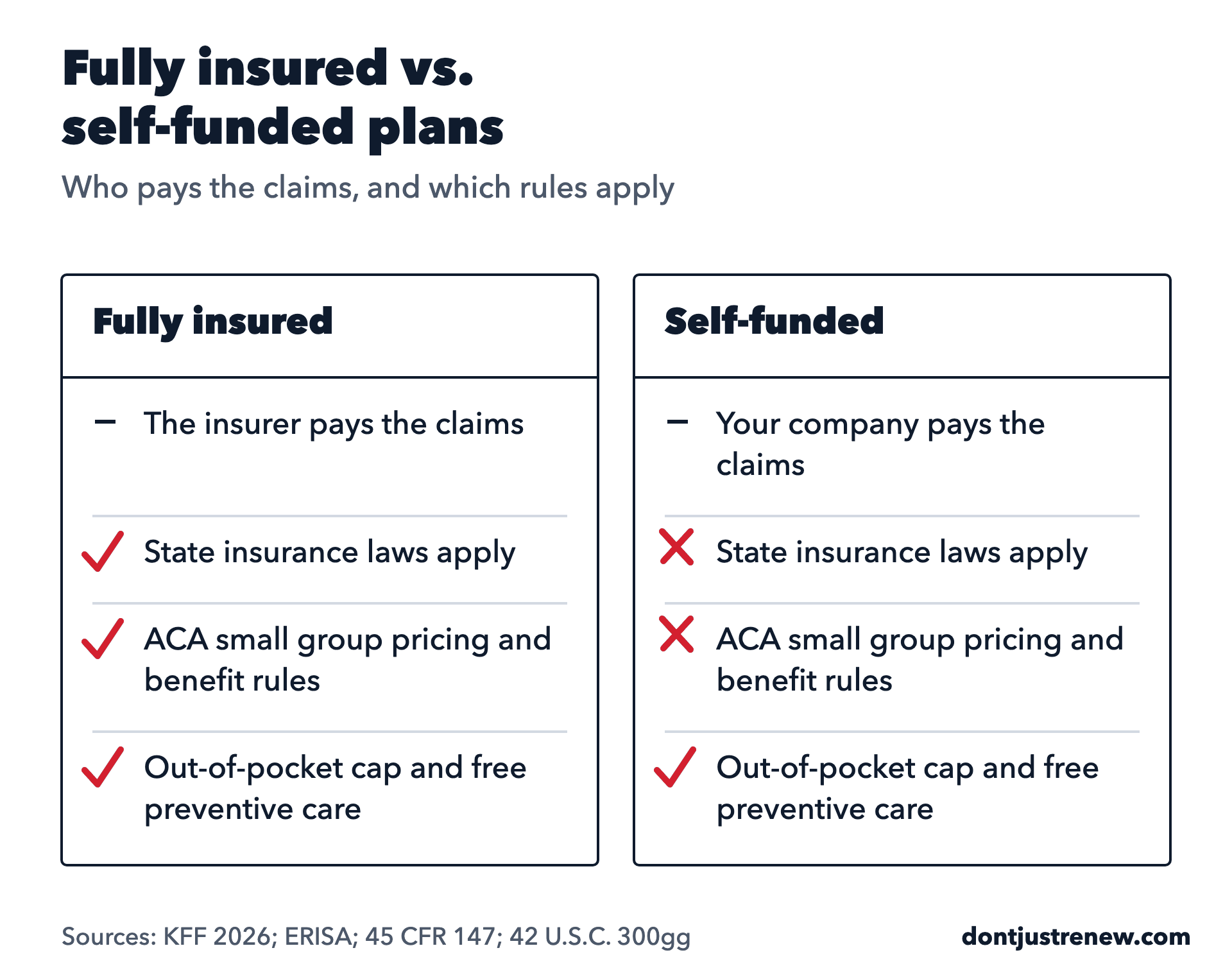
- With a fully insured plan, the insurer carries the risk of high claims. State insurance law applies, and plans sold to small businesses follow the ACA’s pricing and benefit rules.
- With a self-funded plan, your company pays claims as they come in, often with stop-loss insurance for the big ones. A private employer’s self-funded plan falls under federal law instead of most state insurance laws.
- Some ACA protections apply to both, including free preventive care and the yearly out-of-pocket cap.
- In 2026, 19% of covered workers at companies with 10 to 49 workers were in a self-funded plan, against 95% at companies with 5,000 or more, KFF found.
What’s the difference between fully insured and self-insured plans?
It comes down to who takes the risk that claims run high. KFF’s 2026 Employer Health Benefits Survey defines a fully insured plan as one where the employer contracts with a health plan that takes financial responsibility for enrollees’ medical claims. In a self-funded plan, the employer takes that responsibility on directly.
Self-insured and self-funded mean the same thing here. With a fully insured plan, your bill is the premium, and the insurer pays the claims however high they run. With a self-funded plan, your company pays the claims, and it typically hires an insurer or a third-party administrator to run the plan, KFF says.
Many self-funded employers buy stop-loss insurance to limit what they can owe. KFF describes two main kinds. Specific stop-loss pays what the plan owes above a set amount for any one person, and aggregate stop-loss caps the plan’s total claims for the year. Among covered workers in self-funded plans at companies with 200 or more workers, 75% are in plans with stop-loss coverage.
Is a self-funded health plan insurance?
Not under state insurance law. ERISA, the federal law that covers most private employers’ benefit plans, says an employee benefit plan isn’t deemed an insurance company for the purposes of state laws that regulate insurance. As a result, KFF notes, private employers’ self-funded plans are exempt from most state insurance laws, including reserve requirements, benefit mandates, premium taxes, and some consumer protections.
That exemption covers private employers only. Self-funded plans run by public employers, like cities and school districts, don’t get it, according to KFF. The stop-loss policy itself is insurance, though, since it’s coverage the employer buys from an insurer.
For a small business, this matters most for benefits: if your state requires insured plans to cover a treatment, a private employer’s self-funded plan doesn’t have to. The federal rules in the next section still apply.
Which ACA rules apply to a self-funded plan?
Some ACA rules apply to every group health plan, and some apply only to insurers selling to individuals and small businesses.
| Rule | Insured small business plan | Self-funded plan |
|---|---|---|
| Covers the ACA’s essential health benefits package | Yes | No |
| Price can vary only by age, location, tobacco use, and family coverage | Yes | No |
| Yearly out-of-pocket cap | Yes | Yes |
| Preventive care with no cost sharing | Yes | Yes |
| No lifetime or yearly dollar caps on essential benefits | Yes | Yes |
Sources: 45 CFR 147.150 and 147.102; 42 U.S.C. 300gg-6, 300gg-13, and 300gg-11; checked November 15, 2026.
The first two rows are written for insurers selling in the individual and small group markets. So they don’t reach a self-funded plan, or a fully insured plan sold to a large employer. The last three apply to group health plans in general, insured or not. A grandfathered plan, one that’s been in place since March 23, 2010 without big changes, may not include some ACA protections, according to HealthCare.gov.
How common is self-funding at small companies?
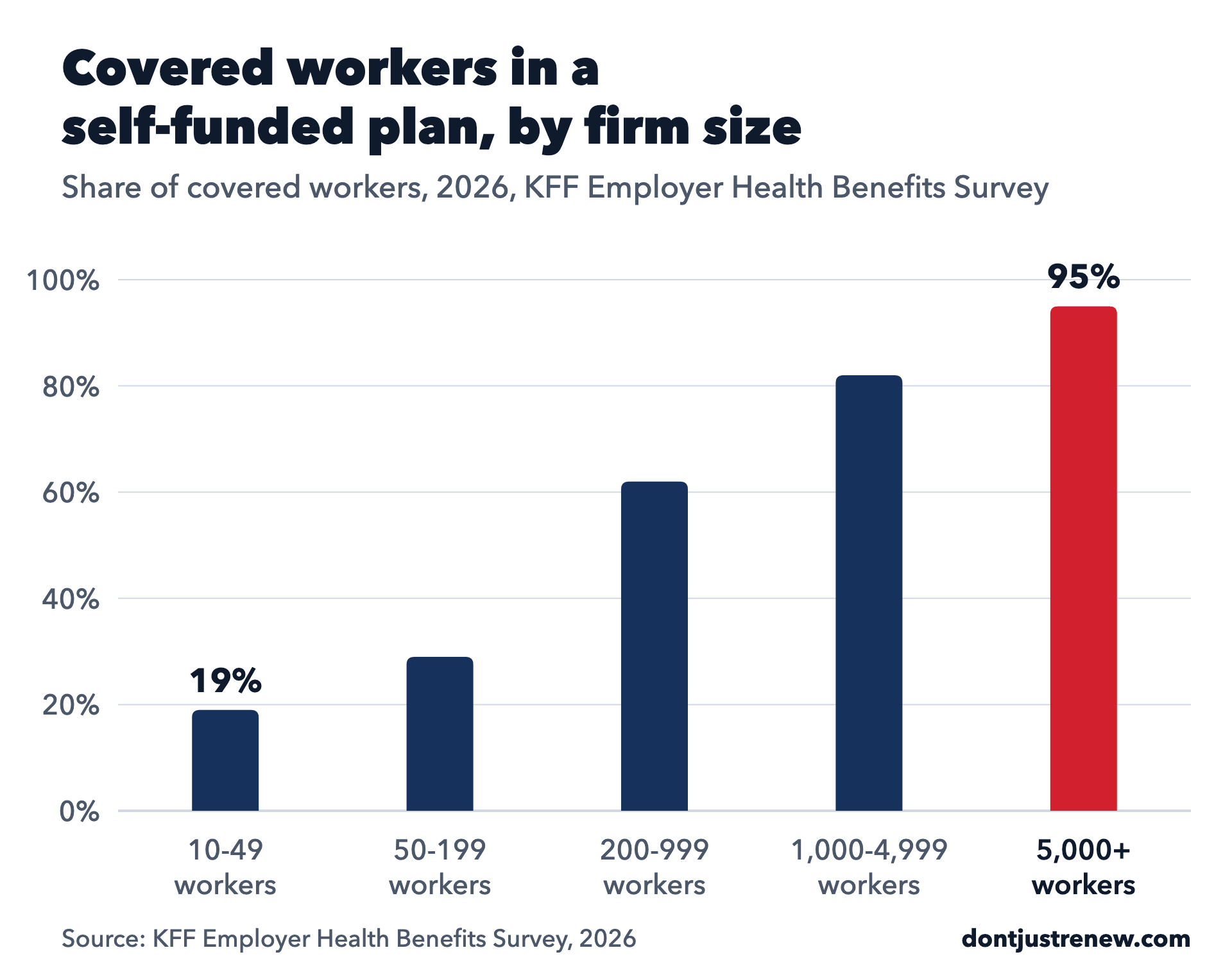
Self-funding climbs with company size. In KFF’s 2026 survey, 19% of covered workers at companies with 10 to 49 workers were in a self-funded plan. That rises to 29% at 50 to 199 workers, 62% at 200 to 999, 82% at 1,000 to 4,999, and 95% at 5,000 or more. By our math, a covered worker at the biggest companies is five times as likely to be in a self-funded plan as one at a company with 10 to 49 workers. Across all companies the share was 71%, up from 63% ten years earlier.
Level-funded plans add to the count at small companies. KFF tracks them separately and calls them nominally self-funded, since they pair a small self-funded plan with stop-loss coverage that takes on much of the risk. Counting them, half of covered workers at companies with 10 to 199 workers were in a level-funded or self-funded plan. Employers may not understand the self-funding underneath, the survey adds, because the set monthly payment looks like a premium. Our level-funded plans post covers how they work.
How to tell if your plan is fully insured or self-funded
Look in your summary plan description, the plain-language guide to the plan that ERISA requires. Federal rules say it has to name any insurer that finances or administers the plan. It also has to say whether, and how far, benefits are guaranteed under an insurance policy, and what administrative services, like paying claims, the insurer provides.
Don’t go by the name on the ID card. Since self-funded employers usually hire an insurer or administrator to run the plan, a self-funded plan can carry a big insurer’s name. If the insurer only handles administration and doesn’t guarantee the benefits, the plan is self-funded. Self-funded plans also owe filings a fully insured plan’s insurer would handle, which our post on self-funded reporting requirements lists.
What changes at renewal under each?
On a fully insured small business plan, the price follows the insurer’s whole small business pool. Your own group’s claims don’t set it, because ACA rules let the price vary only by the factors in the table above, as our post on experience rating explains. Your increase can still differ from the insurer’s average if your employees’ ages, your plan, or your location changes.
On a self-funded plan, the claims your company pays are the plan’s main cost, so your own claims history shapes what it costs going forward. The stop-loss policy has its own price on top. KFF notes that level-funded plans, unlike insured small business plans, may use health status in pricing and underwriting.
Questions to ask about how your plan is funded
- Who pays a claim that runs past the budget? On a self-funded plan it’s your company, up to the stop-loss limits, so ask for both the per-person and the total amounts.
- Which state rules apply? If the plan is self-funded, check the plan document for any benefit your employees count on that your state requires of insured plans.
- What does the summary plan description say about funding? It has to name the insurer and say whether it guarantees the benefits.
- On a level-funded plan, how will next year’s price be set, and can health status change it?
This article is general information, not insurance, tax, or legal advice. Figures are current as of November 15, 2026.