 Don’t just renew
What is stop-loss insurance, and how low can a small company’s limits go?
Stop-loss insurance repays a company that pays its own employees’ health claims once those claims pass a set limit. The limit can apply to one person’s claims, to everyone’s claims for the year, or both. For small employers, some states set a floor on how low those limits can go.
Key points
- Stop-loss protects the employer, not the employees. The company’s plan still owes each claim.
- Specific stop-loss caps what you pay for any one person. Aggregate stop-loss caps what you pay for everyone.
- California bars small employer policies with a per-person limit under $40,000. Florida treats a small employer policy with too low a total limit as regular health insurance.
- A stop-loss insurer doesn’t have to renew you after a year of big claims, according to the Texas Department of Insurance.
What is stop loss in health insurance?
It’s insurance for a self-funded health plan. In a self-funded plan, the company pays employees’ claims itself instead of paying an insurer a premium to take that risk, as our guide to fully insured vs self-insured plans explains. Stop-loss repays the company when claims pass the limits in its policy.
The Texas Department of Insurance’s guide to self-funding points out that stop-loss protects you, not your employees. If an employee thinks the plan wrongly denied a claim, they can sue the employer, but they generally can’t sue the stop-loss insurer.
Federal law exempts private employers’ self-funded plans from most state insurance laws, according to KFF’s 2026 employer survey. The stop-loss policy is different. It’s insurance the employer buys, so states can set rules for it, and some do.
Specific vs aggregate stop-loss
Most policies have two limits, called attachment points. KFF defines an attachment point as the amount at which the stop-loss insurer starts to pay.
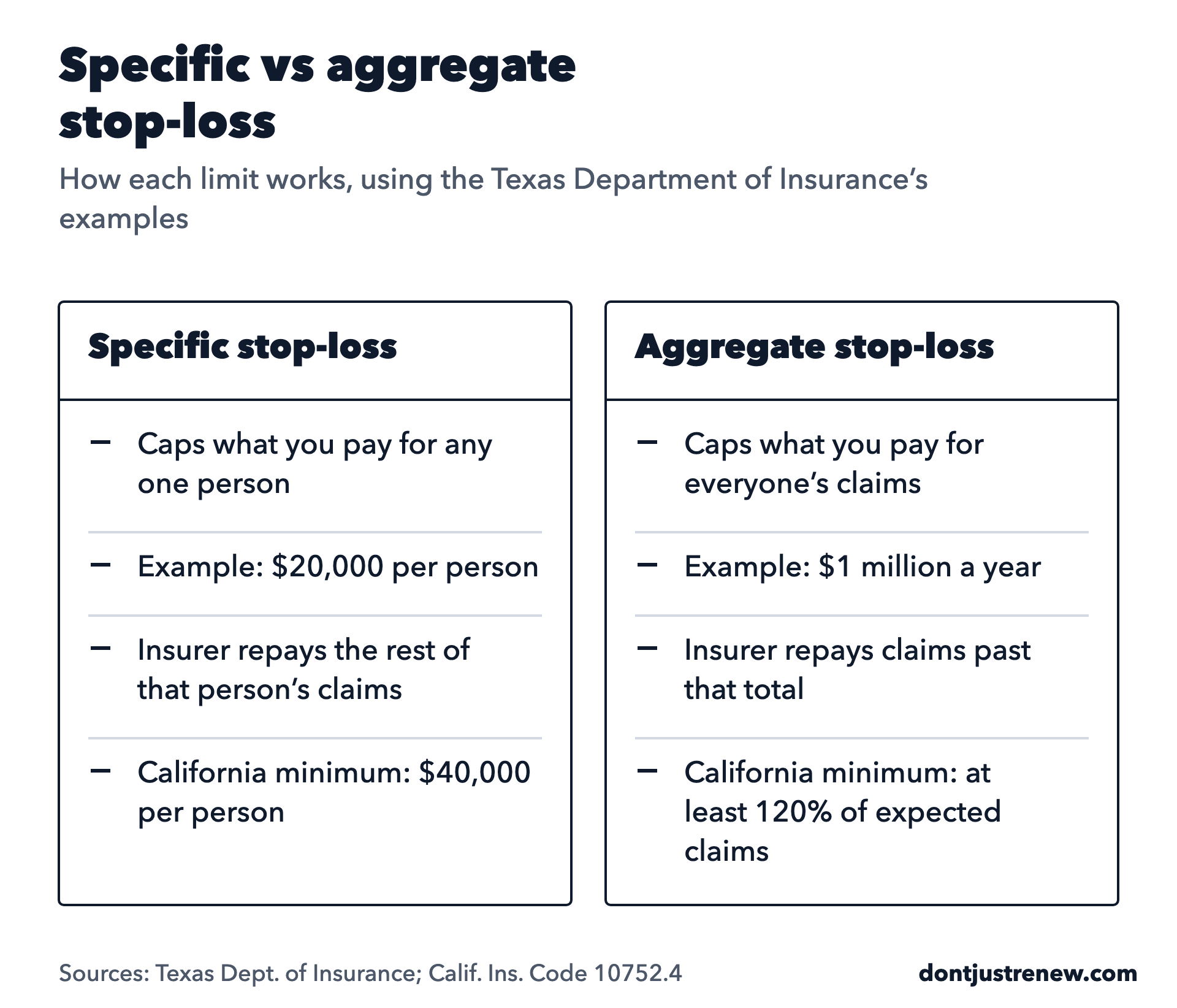
- Specific stop-loss caps what you pay for each person’s claims in the policy year. In the Texas guide’s example, with a $20,000 specific attachment point, you pay the first $20,000 of a very sick employee’s claims and the insurer repays the rest.
- Aggregate stop-loss caps what you pay for all claims combined. In the same guide, with a $1 million aggregate attachment point, the insurer repays what you pay past $1 million for the year.
KFF adds that some stop-loss covers only certain kinds of claims, like organ transplants, and that a company can have more than one type.
How low can a small company’s attachment point go?
That depends on the state. In California, under Insurance Code section 10752.4, a stop-loss policy issued or renewed to a small employer since January 1, 2016 can’t have a per-person attachment point under $40,000. Its aggregate attachment point can’t be under the greater of $5,000 times the number of group members, 120% of expected claims, or $40,000. The policy also can’t cover employees directly.
Florida doesn’t ban low limits outright. Under section 627.66997, a small employer’s stop-loss policy is treated as health insurance, subject to the state’s small group law, if its aggregate attachment point is below the greatest of $2,000 times the number of employees, 120% of expected claims, or $20,000. Once claims reach that point, the policy has to cover 100% of everything above it.
In Texas, the Department of Insurance’s checklist for group stop-loss filings says a policy’s attachment point must be at least $5,000.
| Group size | California ($5,000 per member) | Florida ($2,000 per employee) |
|---|---|---|
| 10 | $50,000 | $20,000 |
| 25 | $125,000 | $50,000 |
| 50 | $250,000 | $100,000 |
Our math from California Insurance Code section 10752.4 and Florida Statutes section 627.66997, checked November 19, 2026. In both states the floor rises to 120% of expected claims if that’s higher. California counts group members, and Florida counts employees.
The highest of the amounts sets the floor. So once a group’s expected claims for the year run well past those per-head figures, 120% of expected claims is the number that counts.
Where stop-loss fits in a level-funded plan
Many small companies get stop-loss as part of a level-funded plan. That’s a self-funded plan packaged with stop-loss, paid as one set amount a month. KFF says insurers sell these to small and mid-sized employers with stop-loss at “relatively low attachment points.” In 2026, 38% of covered workers at firms with 10 to 199 workers were in a level-funded plan.
Because they’re sold as self-funded plans, KFF notes, level-funded plans generally aren’t subject to state rules for insured plans. For employers with fewer than 50 employees, they also aren’t subject to the ACA’s rating and benefit rules for small businesses, so they can use health status in pricing. Our level-funded plans guide covers how they work, and our post on Aetna, Cigna, and UnitedHealthcare level-funded plans shows who writes the stop-loss at each.
What can change when stop-loss renews?
A stop-loss insurer can raise the price, set a higher limit for one person, or decline to renew, according to the Texas guide. It says stop-loss is less regulated than other insurance, and an insurer isn’t required to renew your policy after multiple claims. Premiums aren’t strictly regulated either, and the guide tells employers who’ve had a lot of claims to expect a rate increase at renewal.
The insurer can also “laser” one person, setting a higher attachment point for someone likely to have high claims. The guide’s example is a policy with a $60,000 specific attachment point where one dependent gets a $100,000 one. Your company pays that person’s claims up to $100,000 before the insurer repays anything.
The attachment points also start over when the policy renews, so a large claim from December that’s filed in January may fall into the new year. Some policies add run-out coverage for claims filed after the year ends, or run-in coverage for claims from before the policy started. In Texas, the department’s checklist says a policy has to state whether it’s renewable and give reasonable notice of renewal and rate increases.
What to check in a stop-loss policy
- Both attachment points, and whether anyone on your plan has a higher one than everyone else.
- Which claims count toward each limit, and how long any run-in or run-out period lasts.
- Whether the policy covers the same benefits as your plan, including prescription drugs, and whether the insurer is bound by the plan’s independent review decisions.
- The renewal and termination terms, including mid-year premium changes and whether switching plan administrators ends the policy.
This article is general information, not insurance, tax, or legal advice. Figures are current as of November 19, 2026.