 Don’t just renew
TriNet PEO health insurance: who carries the claims, and why prices went up
TriNet is a PEO, a company that becomes a co-employer of your staff so it can run payroll, HR, and benefits. On most of its health plans, TriNet pays part of the claims itself, so its prices follow its members’ claims. Those claims ran high in 2025, TriNet raised prices, and it says the increases cost it clients.
In brief
- TriNet’s PEO serves companies with 5 to 500 employees and gives them access to TriNet’s large group health plans.
- About 88% of TriNet’s group health costs in 2025 were on plans where it repays the insurer for claims up to a set amount per person.
- Insurance costs reached 91% of TriNet’s insurance revenue in 2025, up from 84% in 2023. After it repriced, its worksite employees fell 11% in a year.
- You can also use TriNet’s PEO with a health plan from your own broker, or use its HR Plus service with no co-employment at all.
Is TriNet a PEO, and whose plan do you get?
Yes. TriNet’s 2025 annual report (its 10-K filing with the SEC) describes a co-employment model. You and TriNet split the employer’s duties by contract, and your employees, which TriNet calls worksite employees, get access to TriNet-sponsored benefits. TriNet sponsors the group health, dental, vision, disability, and life plans itself, as the employer under federal benefits law, through a range of insurance carriers.
On its benefits page, TriNet lists its PEO for companies with 5 to 500 employees and says PEO clients get access to large group health plans. A small company buying on its own would usually get a small business plan instead. Whether a PEO’s plan counts as one employer’s plan or many is a question TriNet and the Department of Labor disagree on, as our guide to PEOs explains.
How TriNet pays for its health plans
TriNet buys insured policies from carriers, in two kinds. On a guaranteed-cost policy, the carrier sets the premium and TriNet owes nothing more. On a risk-based policy, TriNet repays the carrier for claims up to a set amount per person, called the deductible layer, with a cap on its total under each policy. The 10-K says about 88% of TriNet’s 2025 group health insurance costs came from risk-based plans.
So TriNet carries much of its members’ claims risk. Justworks is set up differently: its 2022 stock offering filing said its carriers set its medical premiums. TriNet sets its insurance fees in advance for each benefit period. If claims come in above its projections, TriNet absorbs the difference that year and can raise prices at the next renewal.
Why TriNet health insurance cost more
TriNet tracks an insurance cost ratio: its insurance costs divided by the insurance fees it collects. It ran 86% in 2021 and 84% in 2022 and 2023, according to TriNet’s 2023 10-K. Then it rose to 90% in 2024 and 91% in 2025. The 2025 10-K blames higher prices for outpatient care and doctors’ services, plus more use of costly drugs, including medications for diabetes and obesity.
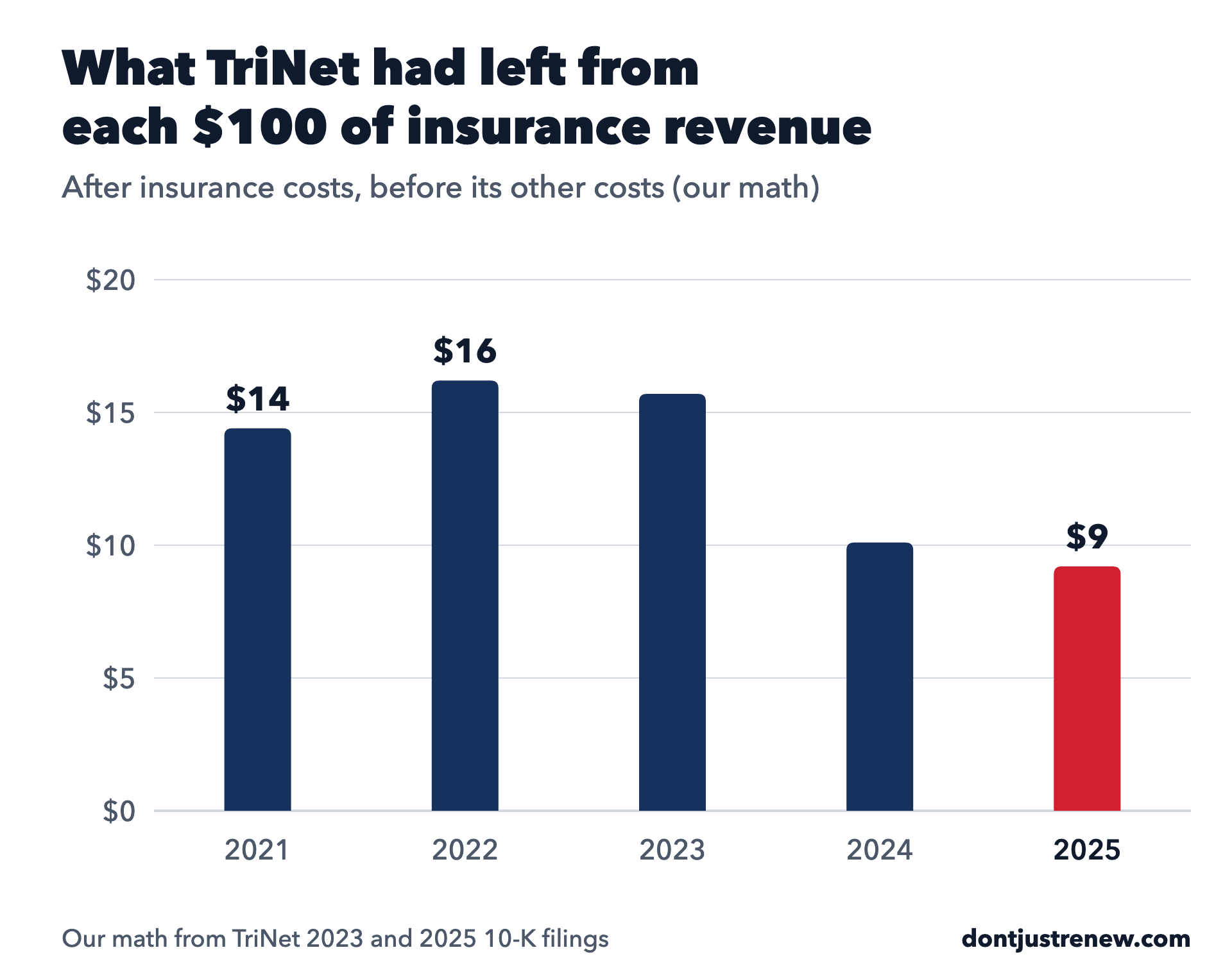
Put in dollars, TriNet had about $16 left from each $100 of insurance fees in 2023 to cover its other costs and profit, by our math. In 2025 it had about $9. TriNet collected $4.224 billion in insurance fees in both 2024 and 2025, while its insurance costs grew from $3.513 billion in 2023 to $3.835 billion.
Among its 2025 highlights, the 10-K lists a “significant repricing” of TriNet’s insurance rates, and it says total worksite employees fell 10% that year, partly because of that repricing. Its third quarter 2026 10-Q says client losses have run above TriNet’s usual rate for the past year, mainly because of the health price increases. Worksite employees fell 11%, to 295,494 at the end of September 2026. From the end of 2024, that’s down about 18%, by our math.
The ratio came down in 2026: 86% for the first nine months, against 90% a year earlier, which TriNet credits to fee increases outpacing cost increases and to claims coming in lower than expected. That figure also includes a one-time $21 million recovery of costs from earlier years. TriNet’s October 29 earnings release expects a full-year ratio between 88.5% and 89.5%.
Three ways to get benefits with TriNet
TriNet offers two other setups. Its 10-K describes an option it calls Open Market Solutions, where you keep TriNet’s PEO services but sponsor your own health plan through a broker. TriNet’s site labels HR Plus as its ASO service, and the 10-K says ASO clients don’t have co-employment or TriNet’s health plans.
| TriNet PEO plan | PEO with your own plan | HR Plus | |
|---|---|---|---|
| Company size | 5 to 500 employees | 5 to 500 employees | 1 to 500 employees |
| Co-employment | Yes | Yes | No |
| Who sponsors the medical plan | TriNet | Your company, through your broker | Your company |
| Who sets the medical price | TriNet, from its own plans’ costs | Your plan’s carrier | Your plan’s carrier |
Sources: TriNet 2025 10-K, benefits page, and broker benefits page, checked November 17, 2026. Company sizes are from TriNet’s benefits page; the PEO with your own plan is part of the PEO service.
With your own plan, your company holds the policy, so its renewal follows that carrier’s rates. For most companies under 50 employees, that means a small business plan priced from the carrier’s whole pool, like the ones in our Blue Cross and Blue Shield of Texas 2027 rates post. On TriNet’s plan, the price comes from TriNet’s own costs.
What changes at a TriNet renewal?
Your health fees are set for a benefit period, and TriNet’s open enrollment periods run at different times of the year for different clients. Most of TriNet’s contracts can be ended by either side with 30 days’ notice, the 10-K says. TriNet also warns that state rules can change its plans: New Mexico has moved to keep small employers’ workers out of PEO large group plans unless the PEO registers the plan under state law as a multiple employer arrangement.
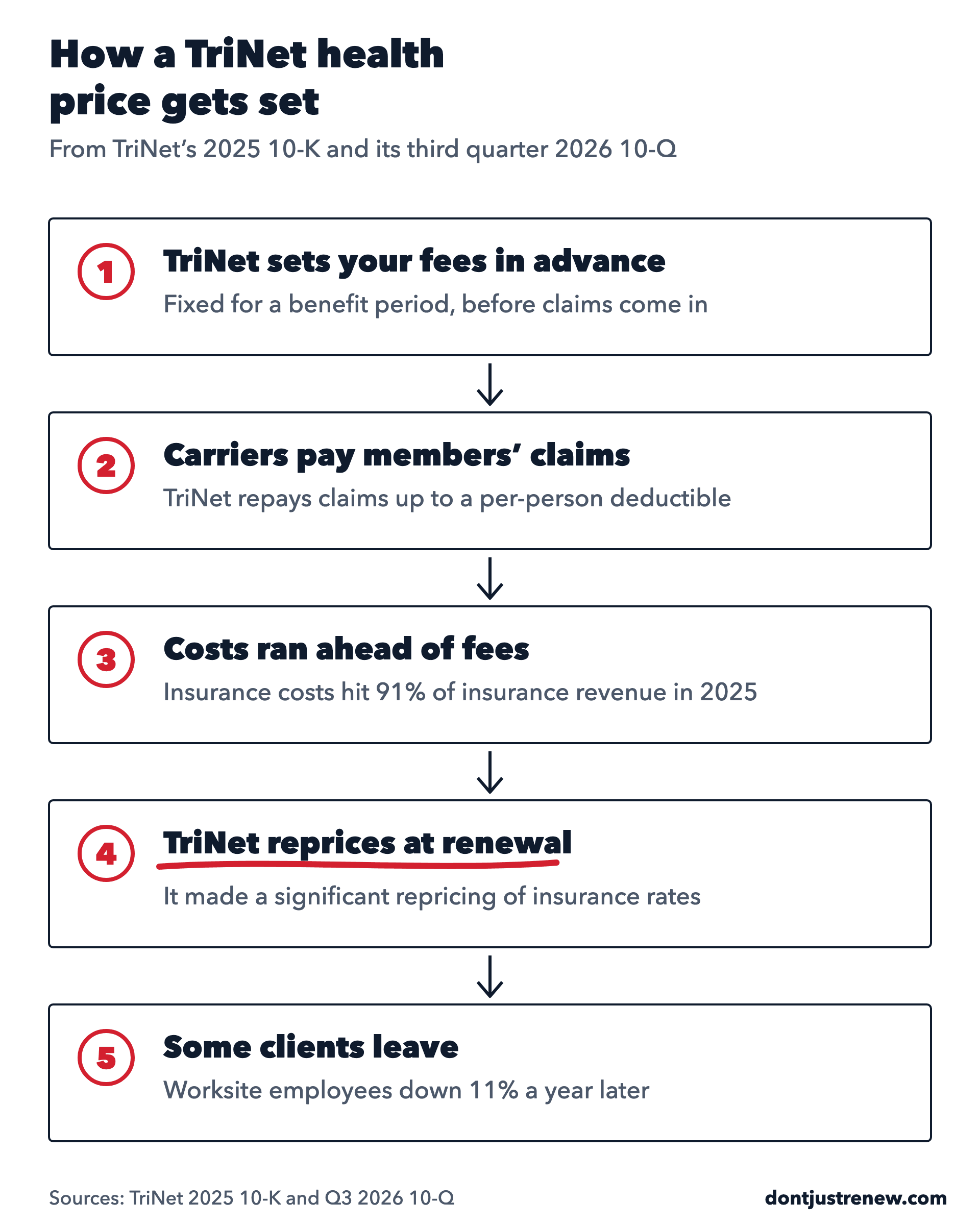
Since TriNet carries much of the claims risk, costs across its plans feed into the fees it sets. The 10-K doesn’t say how much weight your own group’s claims get in your price, so that’s worth asking when the new rates arrive.
Who tends to use TriNet?
TriNet aims its PEO at technology, financial services, life sciences, nonprofit, professional services, and main street businesses, the 10-K says. About 64% of its paid worksite employees in 2025 were in five states: California, New York, Florida, Texas, and Massachusetts. Those concentrations matter at renewal, since TriNet says heavy client numbers in one region or industry can make it harder to get competitive rates from carriers there.
Four questions to ask TriNet about its health plan
- What will each plan cost per employee for the next benefit period, and when does the new rate start?
- Which carrier insures each plan, and which doctors and hospitals are in its network where your employees live?
- Is Open Market Solutions available to your company, and what would that setup cost with a plan from your own broker?
- What does your contract say about leaving, and on what date would your employees’ health coverage end?
Don’t Just Renew is not associated with, endorsed by, or sponsored by TriNet. Its name is a trademark of its owner, and we use it only to describe public information. This article is general information, not insurance, tax, or legal advice. Figures are current as of November 17, 2026.