 Don’t just renew
Blue Cross and Blue Shield of Texas small business plans: 19.2% for 2027, as healthier groups leave
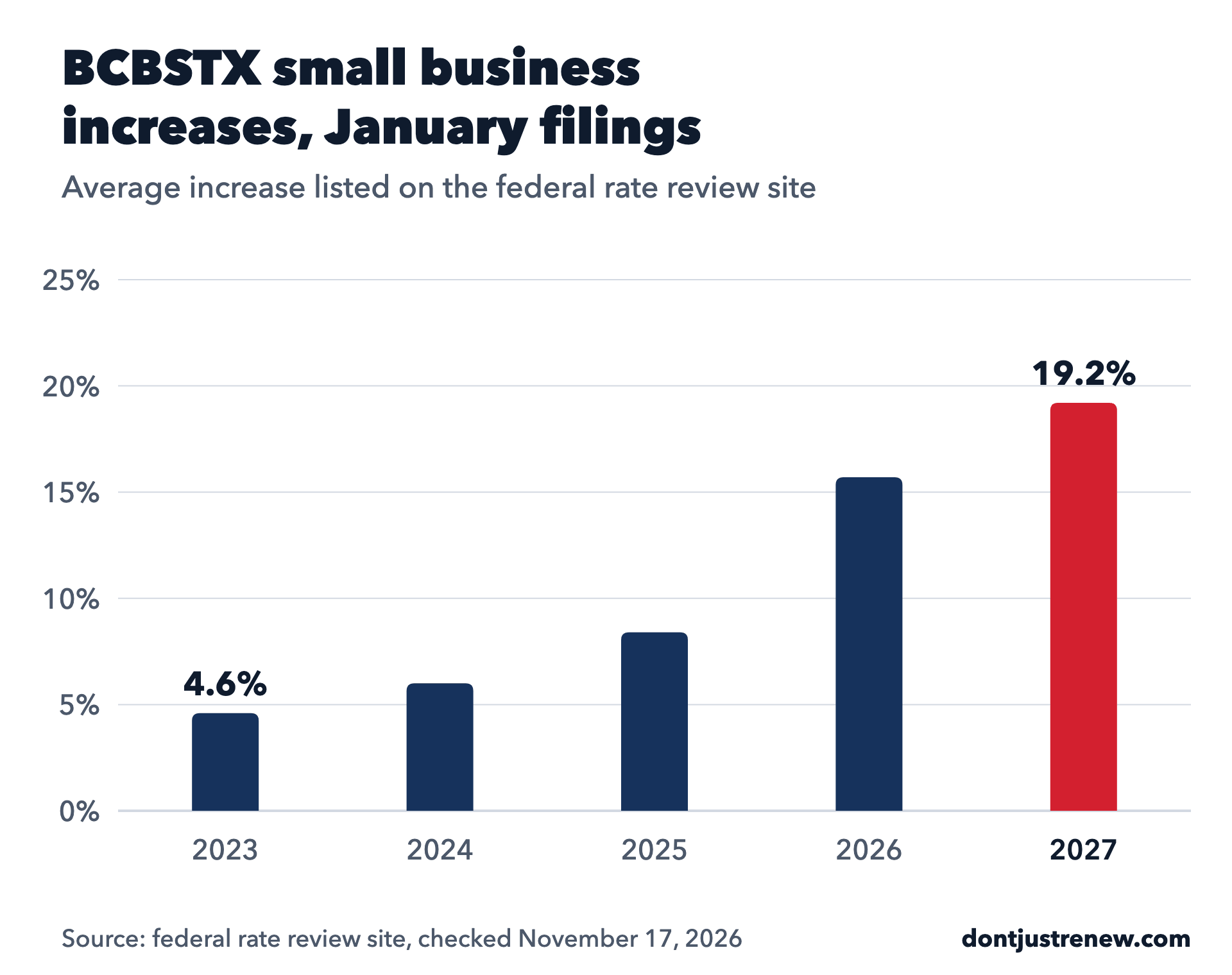
Blue Cross and Blue Shield of Texas, or BCBSTX, is raising its small business rates an average of 19.2% for 2027. That’s its largest January increase since at least 2023, and its filing says why in plain terms: lower-risk groups have been leaving for self-funded plans, so the people who stay cost more to cover. HMO plans take the bigger hit, at 24.9%.
Key numbers
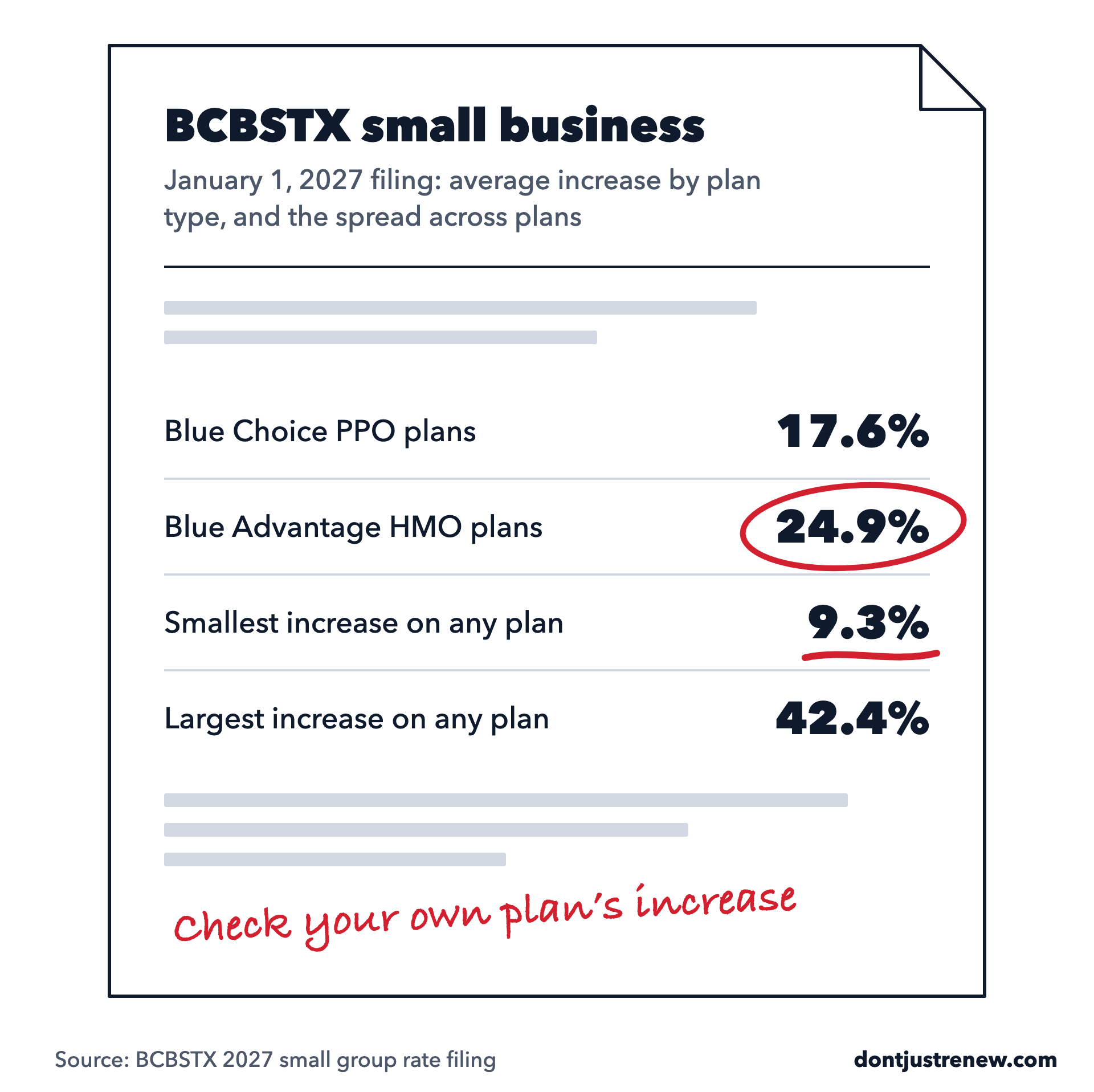
- The 2027 average is 19.2%, or 18.9% for groups renewing January through March. PPO plans average 17.6% and HMO plans 24.9%.
- Increases by plan run from 9.3% to 42.4%. In 2023, some plans went down.
- BCBSTX’s small business plans covered 399,954 people at its 2027 filing, about 17% fewer than a year earlier.
- By our math, a group renewing each January since 2025 pays about 52% more than it did in 2024.
Who’s leaving BCBSTX’s small business pool
BCBSTX is a division of Health Care Service Corporation and an independent licensee of the Blue Cross and Blue Shield Association, according to its 2027 actuarial memo, the technical report filed with its rates. It sells two kinds of small business plans, Blue Choice PPO and Blue Advantage HMO. Its plain-language justification counts 399,954 members on those plans, down from 480,296 in the 2026 filing. Premiums held flat at about $4.12 billion in both 2024 and 2025, even as rates rose.
The memo says the pool has shrunk because lower-risk groups are moving to self-insured products. In a self-funded or level-funded plan, the company pays its own employees’ claims, with insurance on top for large ones, as our guide to fully insured vs self-insured plans explains. A group with few claims can often pay less that way, and our post on level-funded plans shows how they work for small companies.
In a small business plan, every group’s rate comes from the whole pool’s claims, as our post on experience rating explains. When low-claim groups leave, the average cost of everyone left goes up, and so does every group’s rate. BCBSTX prices this in as “population morbidity,” a measure of how sick the pool is. It added 6.1% for it in the 2026 memo and 5.6% for 2027. Together, those two adjustments raise rates about 12%, by our math.
Each January filing has been bigger than the last
| Rates effective | Average increase | Range across plans |
|---|---|---|
| Jan 1, 2023 | 4.55% | -11.92% to 21.18% |
| Oct 1, 2023 | 4.99% | -11.47% to 21.62% |
| Jan 1, 2024 | 6.01% | -7.98% to 13.61% |
| Apr 1, 2024 | 7.30% | -6.86% to 14.98% |
| Jul 1, 2024 | 8.62% | -5.71% to 16.40% |
| Jan 1, 2025 | 8.40% | -3.01% to 12.84% |
| Apr 1, 2025 | 8.56% | -2.86% to 13.02% |
| Jul 1, 2025 | 9.18% | -2.30% to 13.66% |
| Oct 1, 2025 | 13.94% | 1.95% to 18.60% |
| Jan 1, 2026 | 15.68% | 6.60% to 20.70% |
| Apr 1, 2026 | 14.90% | 5.87% to 19.89% |
| Jan 1, 2027 | 19.19% | 9.31% to 42.45% |
Source: federal rate review site, Texas small group filings for 2023 to 2027, checked November 17, 2026. Each filing sets rates until the next one. All are final, and the 2027 figure is unchanged from what BCBSTX requested.
The low end of the range has climbed too. In 2023, BCBSTX’s cheapest renewals were price cuts of up to 11.92%. For 2027, no plan goes up less than 9.31%. The Texas Department of Insurance reviewed the 2027 filing, and the federal site lists its finding as “not unreasonable.”
The 19.2% is BCBSTX’s average across all four 2027 renewal quarters. Its memo puts groups renewing in January, February, or March at 18.9%, and the 2026 memo did the same, with 15.7% for the year and 18.1% for the first quarter. A group renewing every January took 8.4% in 2025, 18.1% in 2026, and 18.9% for 2027. By our math, that adds up to about 52% more than it paid in 2024, before any changes for its own plan, ages, or location.
BCBSTX also has the highest average of the five Texas small business filings for January 2027 on the federal site. Scott and White Health Plan filed 18.35%, UnitedHealthcare Insurance Company 16.44%, UnitedHealthcare of Texas 16.05%, and Baylor Scott & White Insurance Company 14.34%. None of those four tops 19.65% on any plan, against BCBSTX’s 42.45%.
What’s inside the 19.2%
Both of the last two memos break the increase into parts. Side by side, cost growth and the sicker pool add about what they did a year ago. The jump comes from plan design and from the line for taxes, fees, administration, and margin.
| Part of the increase | 2026 filing | 2027 filing |
|---|---|---|
| Updated claims from the year before | 1.3% | -0.6% |
| Cost growth (prices and use of care) | 8.5% | 8.1% |
| A sicker pool | 6.1% | 5.6% |
| Plan design and cost sharing | -0.4% | 2.1% |
| Taxes, fees, admin, and margin | -0.3% | 3.0% |
| Total | 15.7% | 19.2% |
Sources: BCBSTX 2026 and 2027 small group actuarial memos, checked November 17, 2026. Row names are ours; the 2026 plan design row also includes network changes. The parts multiply, so they don’t add up exactly to the total.
The memo assumes claims costs grow 7.9% a year, from higher prices paid to doctors and hospitals, more use of care, and new treatments. It adds 1.0% because large claims in 2025 came in well below past years, and BCBSTX expects them back in 2027. The plan design line includes what actuaries call leveraging: when costs rise and a deductible or copay stays the same dollar amount, the plan pays a bigger share of each bill.
The taxes, fees, admin, and margin line moved the most. BCBSTX’s target margin, which it calls its contribution to surplus, is 4.00% of premium for 2027, up from 2.07% in the 2026 filing. The memo also builds in commissions of $52.16 a month per member, which it lists as 5% of premium. Our post on PEPM, PMPM, and broker commissions explains how those are counted. BCBSTX projects spending 86.86% of premiums on care and quality programs under the federal formula, above the 80% minimum. In 2025, its claims were $3.68 billion against $4.12 billion of premiums, about 89%, by our math.
HMO plans go up more than PPO plans
BCBSTX’s HMO plans average 24.9% for 2027 and its PPO plans 17.6%. A year earlier the two were close, at 15.18% and 15.80%. An HMO covers care only from its own network except in emergencies, while a PPO also pays part of the bill outside its network, as our HMO vs PPO guide explains. The memo doesn’t give a reason for the gap beyond saying that what BCBSTX pays its networks isn’t changing evenly across products.
The memo prices one example. A 40-year-old on the Blue Choice Bronze PPO 833 plan in rating area 1, with a plan year starting in the first quarter of 2027, pays $790.81 a month. That area is Taylor County and 17 other counties nearby, according to CMS.
Across the whole pool, the commission figures point to an average premium of about $1,043 a month per member for 2027, by our math, since $52.16 is 5% of it. Each covered spouse or child counts as a member. Backing out the 19.2% average, the increase is about $168 a month per member, or about $2,000 a year.
The 2027 rates also step up 2.00% each quarter, so a group renewing in April pays about 2% more than the same group renewing in January, and an October renewal about 6% more.
Questions to ask about a BCBSTX renewal
- What’s the increase on your exact plan? BCBSTX’s 2027 increases run from 9.3% to 42.4% by plan, so the 19.2% average may not be yours.
- Are you on an HMO or a PPO, and do your employees’ doctors sit in that network? The HMO plans average 24.9% against 17.6% for the PPO plans.
- Did your deductible or copays change? The filing says BCBSTX changed cost sharing within its plans to keep each one at its metal level, like gold or silver.
- Is your plan the IVF version? Because of a Texas rule on in vitro fertilization coverage, BCBSTX sells an IVF twin of each plan, priced with a factor of 1.362, about 36% more than the same plan without it.
Don’t Just Renew is not associated with, endorsed by, or sponsored by Blue Cross and Blue Shield of Texas or Health Care Service Corporation. These names are trademarks of their owners, and we use them only to report public rate data. This article is general information, not insurance advice. Figures are current as of November 17, 2026.