 Don’t just renew
UnitedHealthcare small business plans in Texas: 16.4% for 2027, down from April’s 19.8%
UnitedHealthcare’s Texas small business plans go up an average of 16.4% for 2027. That’s a step back from the 19.8% it filed for groups renewing from April 2026 on, and still about triple what it filed for January 2025. Its Texas pool also runs healthier than average: UnitedHealthcare paid into the state’s risk adjustment program for 2025 instead of drawing from it.
In brief
- UnitedHealthcare Insurance Company’s PPO and EPO plans average 16.4% for 2027. UnitedHealthcare of Texas’s HMO plans average 16.1%.
- Increases by plan run from 10.6% to 19.7%, a much tighter spread than the April 2026 filing’s 10.0% to 27.5%.
- The two companies cover about 34,100 people on these plans, less than a tenth of Blue Cross and Blue Shield of Texas’s 399,954.
- By our math, the 16.4% adds about $160 a month per covered person.
PPO, EPO, or HMO: UnitedHealthcare’s three Texas plan lines
UnitedHealthcare sells its Texas small business plans through two companies. UnitedHealthcare Insurance Company sells Choice Plus Essential plans, which are PPOs, and Choice Essential plans, which are EPOs. UnitedHealthcare of Texas sells Choice Essential HMO plans. That’s according to the plan-level rate data CMS publishes in its rate review public use file for 2027.
A PPO pays part of the bill outside its network. An EPO or HMO generally pays only inside it, except in emergencies. Our HMO vs PPO guide covers the differences. About four in five of UnitedHealthcare’s Texas small business enrollees are on the PPO plans, by our math from the same file.
The 2027 increases barely differ by plan line: 16.44% for the PPO plans, 16.42% for the EPO plans, and 16.05% for the HMO plans. Your own plan can land anywhere from 12.65% to 18.41% at UnitedHealthcare Insurance Company, or 10.60% to 19.65% at UnitedHealthcare of Texas. UnitedHealthcare is also closing 22 plans and adding 18 for 2027, according to the CMS file.
The pool is small: UnitedHealthcare Insurance Company’s 2027 justification puts the increase on 33,057 people, and UnitedHealthcare of Texas’s justification on 1,043. A year earlier, their January 2026 filings counted 35,835 and 1,231, so the total is down about 8%.
From 5.7% to 19.8%, then 16.4%
UnitedHealthcare files new Texas small business rates more than once a year, and each filing sets rates for groups renewing until the next one. From 2023 through 2025, its filings averaged about 6% to 12%. Then they jumped: 15.4% for January 2026 and 19.8% for April 2026 at UnitedHealthcare Insurance Company, with UnitedHealthcare of Texas close behind.
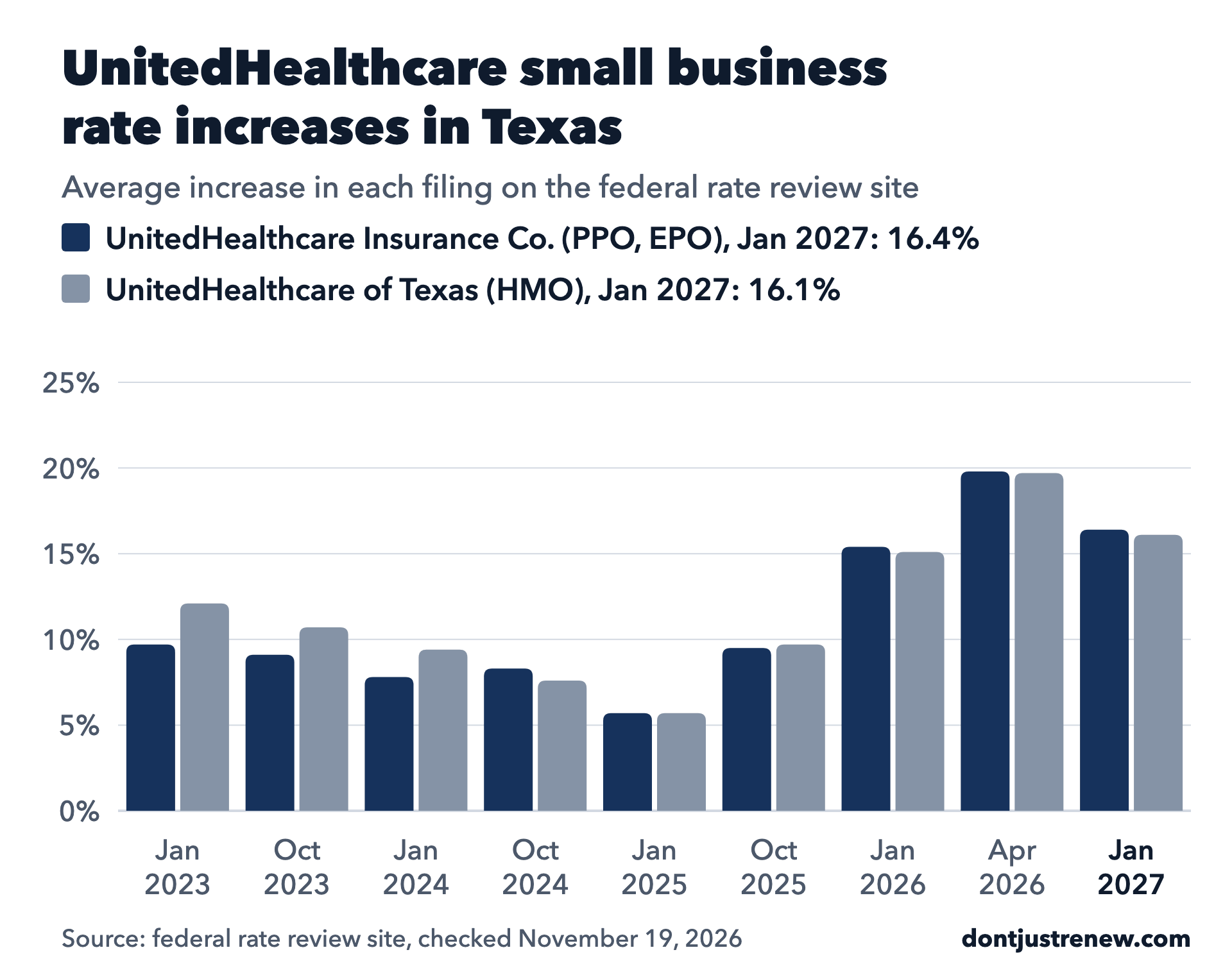
| Rates effective | UnitedHealthcare Insurance Co. | UnitedHealthcare of Texas |
|---|---|---|
| Jan 1, 2023 | 9.66% | 12.07% |
| Oct 1, 2023 | 9.12% | 10.70% |
| Jan 1, 2024 | 7.76% | 9.40% |
| Oct 1, 2024 | 8.30% | 7.62% |
| Jan 1, 2025 | 5.66% | 5.73% |
| Oct 1, 2025 | 9.49% | 9.67% |
| Jan 1, 2026 | 15.43% | 15.07% |
| Apr 1, 2026 | 19.81% | 19.70% |
| Jan 1, 2027 | 16.44% | 16.05% |
Source: federal rate review site, Texas small group filings for 2023 to 2027, checked November 19, 2026. All are final. The Texas Department of Insurance reviewed the 2026 and 2027 filings, and the site lists its finding as “not unreasonable.”
The April 2026 filing also had the widest spread, with some plans up 27.53%. For 2027 the top end comes back to 18.41% at UnitedHealthcare Insurance Company. A group that renewed every January took 5.66% in 2025, 15.43% in 2026, and 16.44% for 2027. Those compound to about 42% more than it paid in 2024, by our math, before any changes for ages, plan, or location.
That’s less than Blue Cross and Blue Shield of Texas, whose 2027 filing averages 19.2%. Our BCBSTX post covers that filing and why its pool is getting sicker as low-risk groups leave.
Where UnitedHealthcare’s Texas premiums went in 2025
UnitedHealthcare’s Texas pool ran well under its premiums last year. UnitedHealthcare Insurance Company paid out 77.2% of its 2025 small business premium in claims, according to its justification and the CMS file, and UnitedHealthcare of Texas 64.7%. Together that’s about 77%, by our math. At BCBSTX, claims took about 89%.
| UnitedHealthcare Insurance Co. | BCBSTX | |
|---|---|---|
| 2025 premium, per month | $837 | $732 |
| 2025 claims, per month | $646 | $653 |
| Enrollees on gold or platinum plans | 78% | 49% |
| 2027 projected premium, per month | $1,137 | $1,043 |
Source: CMS rate review public use file for 2027, checked November 19, 2026. Per-person figures are our math from each company’s premiums, claims, and member months. The gold and platinum share counts both UnitedHealthcare companies’ enrollees.
Claims per person came in about the same at the two carriers in 2025. UnitedHealthcare’s premiums ran about 14% higher, partly because more of its enrollees are on richer gold and platinum plans, which cost more. Each covered spouse or child counts as a person in these figures.
The two carriers also landed on opposite sides of risk adjustment, an ACA program that, within each state’s small business market, “transfers funds from plans with lower-than-average risk enrollees to plans with higher-than-average risk enrollees,” in the words of CMS’s 2025 risk adjustment report. For 2025, UnitedHealthcare Insurance Company was charged $12.9 million and UnitedHealthcare of Texas $1.4 million. The Health Care Service Corporation company behind BCBSTX received $24.3 million.
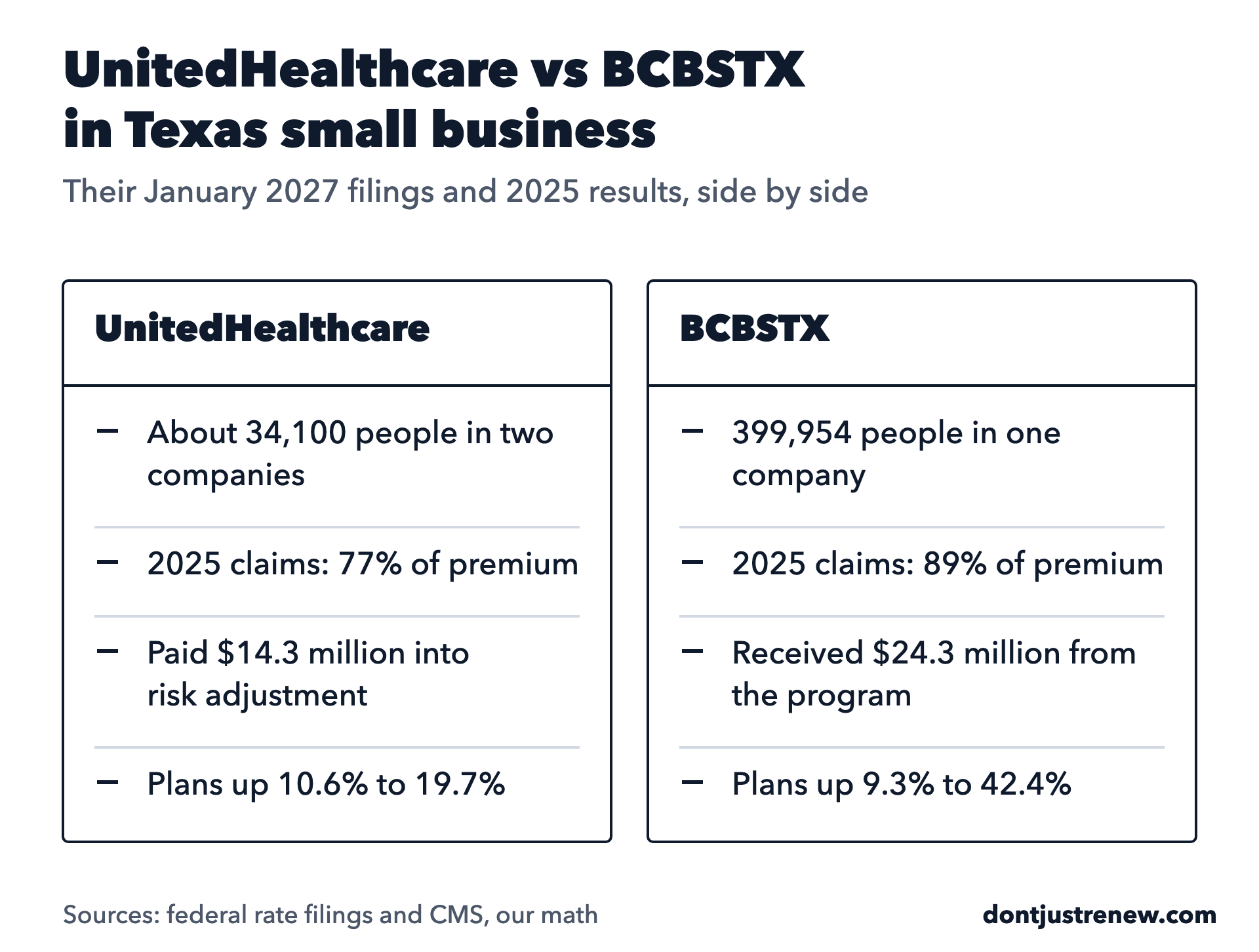
The UnitedHealthcare Insurance Company charge came to about 3.6% of its 2025 small business premium, by our math, and it’s priced in again. The company’s 2027 rate data expects to keep paying, at about $49 per covered person a month. UnitedHealthcare Insurance Company also got $1.7 million back from the federal high-cost risk pool for 2025, which repays part of any one person’s claims above $1 million.
Why UnitedHealthcare expects costs to keep climbing
UnitedHealthcare Insurance Company’s 2027 rate data assumes prices for care rise 3.3% a year and use of care rises 8.0%. Together that’s about 11.6% a year, by our math, then about 12.1% the year after. From its 2025 claims to 2027, that adds up to about 25%. BCBSTX’s figures in the same CMS file come to about 17% over the same two years.
UnitedHealth Group, UnitedHealthcare’s parent company, gave the national picture on its October 13 earnings call. It said cost growth in its employer plans is running above the 11% it expected, driven by costs tied to the No Surprises Act’s billing dispute process, more intensive care from doctors, and high-cost specialty drugs.
UnitedHealthcare’s Texas actuarial memos are almost fully redacted, so the justifications carry most of what it says. Both list higher prices from hospitals, doctors, and drug companies, more office visits and services, deductible leveraging (when a deductible stays the same while costs rise, the plan pays a bigger share), costs hospitals shift from Medicare and Medicaid onto private plans, and new technology. Both also say each company’s own Texas claims aren’t fully credible, meaning there isn’t enough data to price from them alone, so the rates use the two companies’ combined expected costs. The CMS file shows each company gave its own claims no direct weight.
What 16.4% means in dollars
UnitedHealthcare Insurance Company projects an average 2027 premium of about $1,137 a month per covered person, from the CMS file. Backing out the 16.4% average, that’s about $160 a month more, or about $1,900 a year, by our math. For UnitedHealthcare of Texas’s HMO plans, a projected $990 a month works out to about $137 more. Our post on PEPM and PMPM explains why per-person and per-employee figures differ.
The age, plan, and county of each person on your plan change your number. So does your renewal month, since a group renewing between April and December 2026 got its current rates from the April filing.
Three things to check on a UnitedHealthcare Texas renewal
- Find your own plan’s increase. The PPO, EPO, and HMO averages sit within half a point of each other, but single plans range from 10.6% to 19.7%.
- Check whether your plan is one of the 22 UnitedHealthcare is closing for 2027, and if so, which plan it moves you to and how that plan’s network and deductible compare.
- Look at your metal level. Most UnitedHealthcare enrollees in Texas are on gold or platinum plans, so it’s worth seeing the price of a silver or bronze plan from the same line alongside your renewal.
Don’t Just Renew is not associated with, endorsed by, or sponsored by UnitedHealthcare, UnitedHealth Group, or Blue Cross and Blue Shield of Texas. These names are trademarks of their owners, and we use them only to report public rate data. This article is general information, not insurance advice. Figures are current as of November 19, 2026.