 Don’t just renew
Baylor Scott & White small business plans in Texas: 18.4% for 2027, one increase for nearly every plan
Baylor Scott & White’s small business HMO plans in Texas go up an average of 18.4% for 2027, and its PPO plans 14.3%. Within each company, the increase barely moves from plan to plan. Leave out one IVF plan and every HMO plan lands between 18.15% and 18.88%. Its premiums also start lower than at the other Texas carriers we’ve covered.
At a glance
- Scott and White Health Plan’s HMO plans average 18.35% for groups renewing January 1, 2027. Baylor Scott & White Insurance Company’s PPO plans average 14.34%.
- Not counting one IVF plan in each company, HMO plans range from 18.15% to 18.88% and PPO plans from 14.15% to 14.86%.
- The two companies cover 13,985 people on these plans, about 3.5% as many as Blue Cross and Blue Shield of Texas.
- By our math, the increase adds about $114 a month per person on the HMO plans and about $109 on the PPO plans.
Who sells Baylor Scott & White small business plans?
Baylor Scott & White Health Plan is part of Baylor Scott & White Health, the Texas hospital system, and its plans include the system’s doctors and hospitals. It started in 1982 and covers nearly 500,000 people across all its plans, according to its About page. Its small business plans are for companies with 2 to 50 employees headquartered in its 141-county Texas service area, according to its employer plans page.
Two companies file the rates. Scott and White Health Plan sells HMO plans, which generally cover care only inside the network, except emergencies. Baylor Scott & White Insurance Company sells PPO plans, which also pay part of out-of-network bills. Our HMO vs PPO guide has more on the trade-offs. Between them, the companies list 168 bronze, silver, gold, and platinum plans for 2027.
The same employer page also lists level-funded plans under the SteadyFund name. Level funding works differently, as our level-funded plans post explains, and the filings below don’t cover it.
Why a different plan won’t change your increase much
Most carriers’ increases spread out across their plans. BCBSTX’s 2027 plans run from 9.31% to 42.45%, and UnitedHealthcare Insurance Company’s from 12.65% to 18.41%. Baylor Scott & White’s hardly spread at all. In the CMS rate review public use file for 2027, 84 of its 85 HMO plans rise between 18.15% and 18.88%, and 82 of its 83 PPO plans between 14.15% and 14.86%.
The exceptions are a bronze plan in each company that adds IVF coverage. Each had one enrollee in the file, and they rise 15.89% on the HMO side and 8.13% on the PPO side.
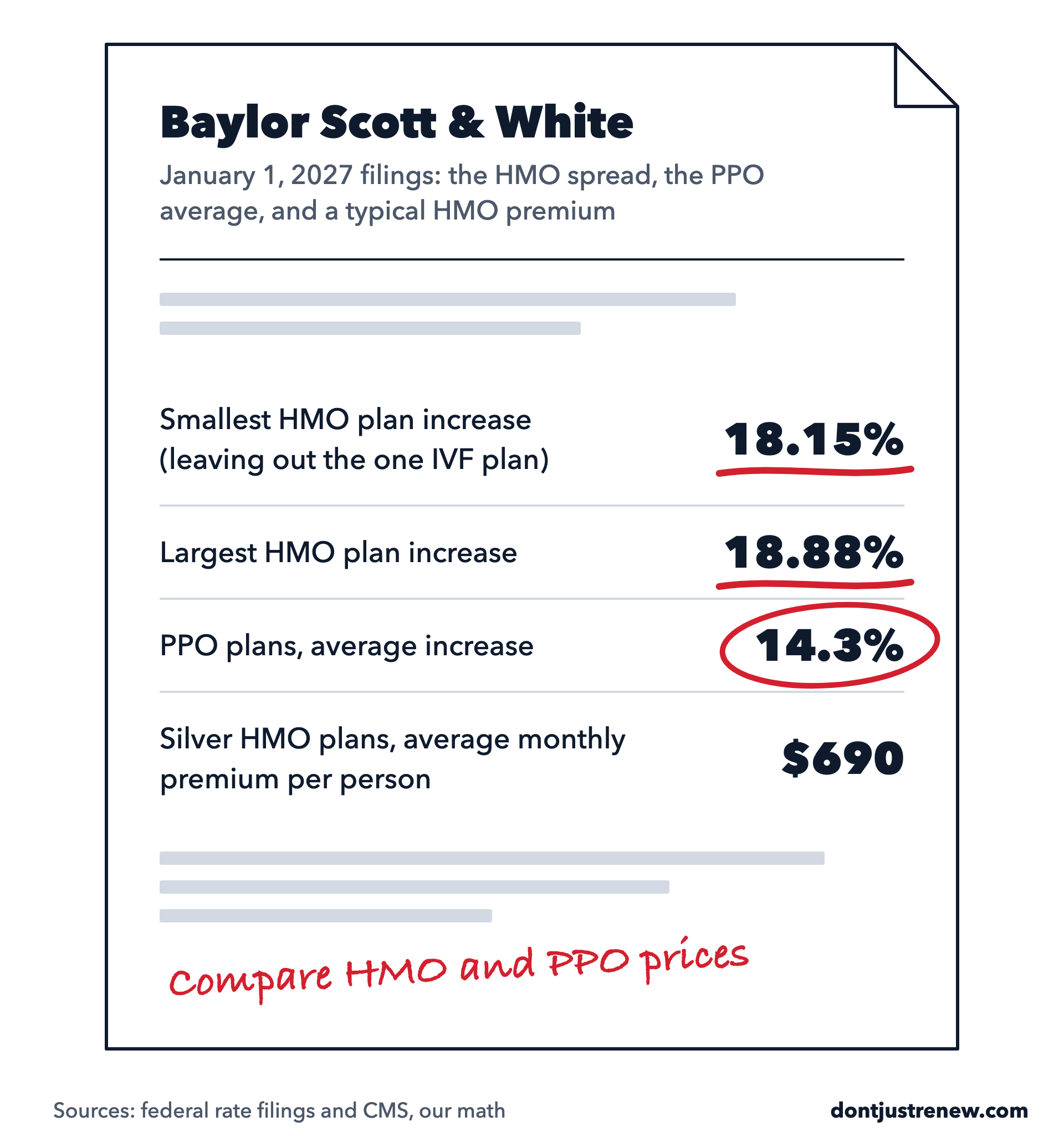
So the choice that moves your percentage is the company. The HMO plans go up about 4 points more than the PPO plans. The PPO plans still cost more per person, as the premium table below shows, so a smaller increase doesn’t make them the cheaper option.
The two filings were also handled differently. Under federal rules, a filing gets a formal review when any plan in it goes up 15% or more. Every HMO plan is over that line, and the federal site shows the Texas Department of Insurance found that filing “not unreasonable.” The PPO company’s largest plan increase is 14.86%, so its filing wasn’t subject to review and has no public justification.
Four bigger filings in a row, then a step down
Baylor Scott & White files new small business rates every quarter, and each filing sets the increase for groups renewing in those three months. Through 2025 its filings stayed between 5.4% and 9.3%. In 2026 the HMO filings grew every quarter, from 9.5% in January to 20.4% in October. The PPO filings went from 11.3% to 19.3%, with a dip in April.
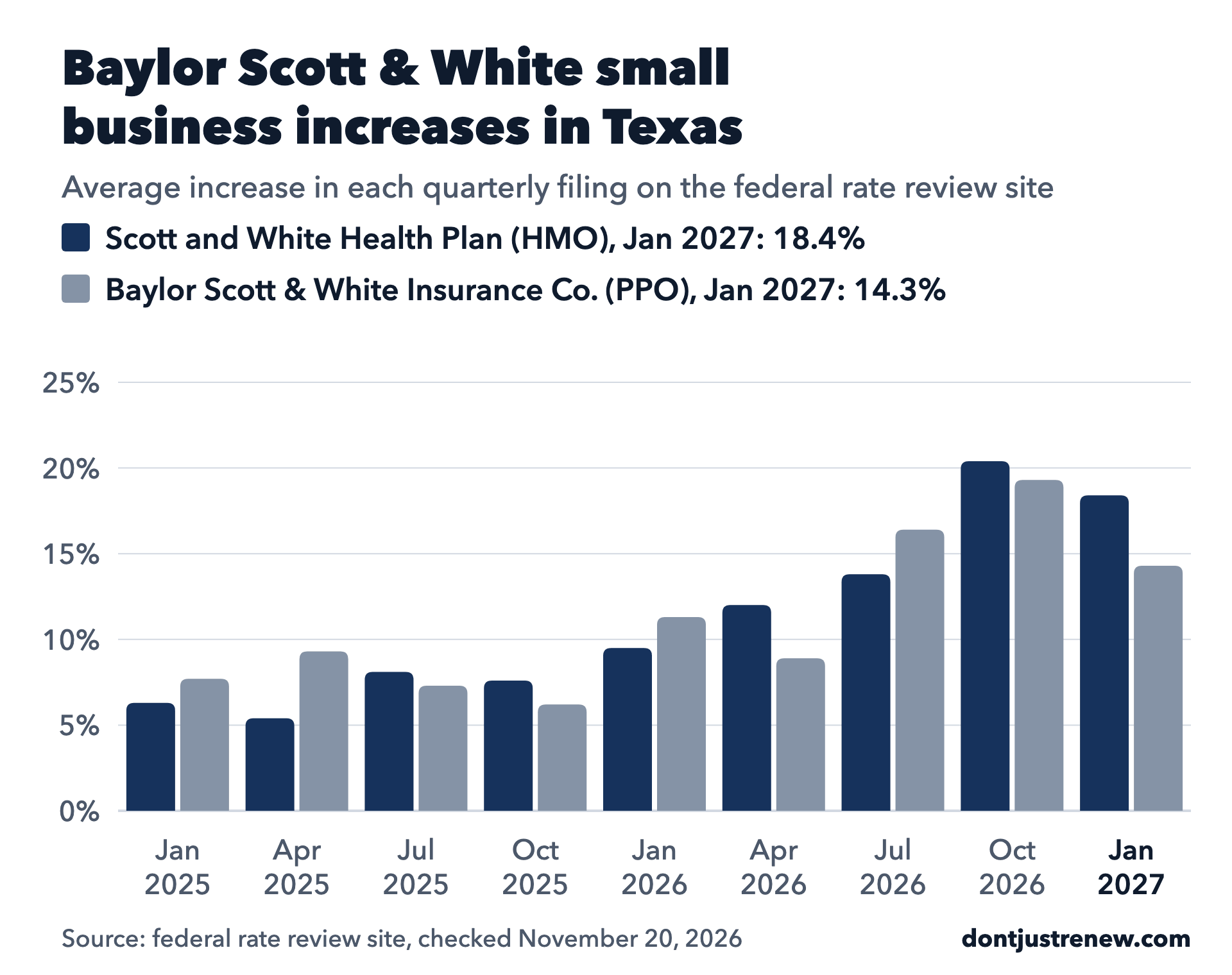
| Rates effective | Scott and White Health Plan (HMO) | Baylor Scott & White Insurance Co. (PPO) |
|---|---|---|
| Jan 1, 2025 | 6.28% | 7.68% |
| Apr 1, 2025 | 5.42% | 9.27% |
| Jul 1, 2025 | 8.07% | 7.34% |
| Oct 1, 2025 | 7.62% | 6.19% |
| Jan 1, 2026 | 9.48% | 11.33% |
| Apr 1, 2026 | 11.96% | 8.88% |
| Jul 1, 2026 | 13.81% | 16.39% |
| Oct 1, 2026 | 20.39% | 19.26% |
| Jan 1, 2027 | 18.35% | 14.34% |
Source: federal rate review site, Texas small group filings for 2025 to 2027, checked November 20, 2026. All are final.
January 2027 is lower than October at both companies. A group that renewed its HMO plan every January still took 6.28% in 2025, 9.48% in 2026, and 18.35% for 2027. Those compound to about 38% more than it paid in 2024, by our math, before any changes for ages or plan. A January PPO group comes out about 37% higher.
If you renew later in 2027, your increase will come from a filing that isn’t posted yet. So far the federal site lists only the January filings for 2027.
The lowest premiums in our Texas posts
Baylor Scott & White starts from a lower price than the other Texas carriers we’ve covered. Its HMO plans project an average 2027 premium of about $735 a month per covered person and its PPO plans about $871, by our math from the CMS file. In the same file, BCBSTX projects about $1,043 and UnitedHealthcare Insurance Company about $1,137.
| BSW HMO | BSW PPO | BCBSTX | UnitedHealthcare | |
|---|---|---|---|---|
| Bronze | $590 | $703 | $824 | $931 |
| Silver | $690 | $808 | $921 | $1,017 |
| Gold | $823 | $961 | $1,119 | $1,127 |
| All plans | $735 | $871 | $1,043 | $1,137 |
Source: CMS rate review public use file for 2027, checked November 20, 2026. Our math: each company’s projected 2027 premiums divided by its projected member months, for its plans at each metal level. BSW HMO is Scott and White Health Plan, BSW PPO is Baylor Scott & White Insurance Company, and UnitedHealthcare is UnitedHealthcare Insurance Company.
These averages reflect each company’s own mix of ages and counties, so they aren’t quotes, and Baylor Scott & White sells only to companies based in its service area. Richer plans don’t explain the gap: 43% of its HMO enrollees and 47% of its PPO enrollees are on gold or platinum plans, close to BCBSTX’s 49%. Level for level, a silver HMO plan averages about 25% less than a BCBSTX silver plan.
Backing the average increase out of those premiums, the HMO plans’ 18.35% adds about $114 a month per covered person, or about $1,370 a year. The PPO plans’ 14.34% adds about $109 a month. Each covered spouse or child counts as a person here. Our post on PEPM and PMPM explains why per-person figures run lower than per-employee ones.
What’s driving the 18.4%
Mostly medical costs. Scott and White Health Plan’s 2027 justification says prices for care are rising, use of care is rising slightly, and it assumed 9.1% for medical inflation. It puts the rest down to changes in membership mix, benefits, administrative costs, and risk adjustment.
The CMS file breaks that down by type of care. For the first year, the HMO company expects prescription drug costs to rise about 14%, outpatient hospital care about 10%, doctor visits about 9%, and inpatient hospital stays about 5%, by our math from its price and use assumptions.
In 2025, claims took about 83% of the HMO company’s small business premium and 80% of the PPO company’s, by our math from the CMS file. The HMO company has enough members to price 2027 entirely from its own claims, while the PPO company gave its own claims 87% of the weight. Both build in 17% for administrative costs and 2% for profit and risk, according to the CMS file and their actuarial memos for the HMO and PPO companies.
Risk adjustment weighs far more on Baylor Scott & White than on UnitedHealthcare. Both Baylor Scott & White companies paid into risk adjustment for 2025, the ACA program that moves money from insurers with healthier-than-average enrollees to those with sicker ones (our UnitedHealthcare Texas post explains it). CMS’s 2025 risk adjustment report charged Scott and White Health Plan $6.2 million and Baylor Scott & White Insurance Company $3.9 million for their small business plans.
That’s about 11% of their 2025 small business premium, by our math, or about $61 to $70 per covered person a month. UnitedHealthcare Insurance Company’s charge came to about 3.6% of its premium. The CMS file shows both Baylor Scott & White companies expect to keep paying in 2027, and their rates include it.
Checking your Baylor Scott & White renewal notice
- See which company your plan is with. Scott and White Health Plan’s HMO plans go up about 18.4% and Baylor Scott & White Insurance Company’s PPO plans about 14.3%, while switching metal levels inside either one barely changes the percentage.
- Check your renewal date. A January 1 renewal uses these filings. A later one uses a quarterly filing that hasn’t been posted yet.
- Match the network to where your employees get care. The plans are built around Baylor Scott & White Health’s doctors and hospitals and sold to companies based in its 141-county service area.
We’ve also covered the other big Texas filings: Blue Cross and Blue Shield of Texas at 19.2% and UnitedHealthcare at 16.4%.
Don’t Just Renew is not associated with, endorsed by, or sponsored by Baylor Scott & White Health, Baylor Scott & White Health Plan, Blue Cross and Blue Shield of Texas, or UnitedHealthcare. These names are trademarks of their owners, and we use them only to report public rate data. This article is general information, not insurance advice. Figures are current as of November 20, 2026.