 Don’t just renew
What is Angle Health, and how do its level-funded plans work?
Angle Health sells level-funded health plans to small and mid-size employers and describes itself as an insurer, claims administrator, and underwriter in one. The doctors and hospitals come from a network Angle rents from another company, such as Cigna, Aetna, or PHCS, depending on the plan. Angle isn’t part of Cigna. Cigna’s PPO is one of the networks its plans can use.
Key points
- Angle’s employer and broker pages describe level-funded plans, where a set monthly payment covers claims, administration, and stop-loss insurance.
- Angle’s doctor search lists 12 networks its plans can use, and Cigna’s PPO network is one of them.
- Angle says its quotes stay firm for 90 days and change only in limited cases, like a big change in who’s enrolling.
- Its public pages don’t say whether leftover claims money comes back to the employer, so ask.
What is Angle Health?
Angle Health launched in 2021 and says it now serves more than 5,000 employers with plans in 47 states, according to its September 2026 announcement. It describes itself as three businesses in one: an insurance carrier, a third-party administrator (a company that processes claims for a self-funded plan), and a managing general underwriter (a company that prices and approves coverage).
In most states, the fine print on its website says its employer plans are sold through Angle Insurance Services and administered by Adrem Administrators. In Utah, they’re offered by Balanced Insurance Company of Utah, which Angle calls its Utah insurer. Employees get an app, a digital ID card, and a care team they can call or message, according to its member pages.
Is Angle Health level funded or fully insured?
Mostly level funded. Angle’s employer page describes a level-funded plan as a self-funded plan with a set monthly payment that covers claims, administrative costs, and stop-loss insurance, which pays when claims run high. Its FAQ puts the trade-off plainly: stop-loss caps what the employer can owe, but the employer still takes the financial risk up to that cap.
Utah works differently. Balanced Insurance Company of Utah sells fully insured plans to employers with 51 or more employees and level-funded plans to smaller ones. Angle’s FAQ also says it offers fully insured group plans, so check which kind your quote is before you compare it with anything else.
A level-funded plan is self-funded underneath, so the employer picks up some federal filings an insurer would otherwise handle, like the yearly PCORI fee.
Is Angle Health part of Cigna?
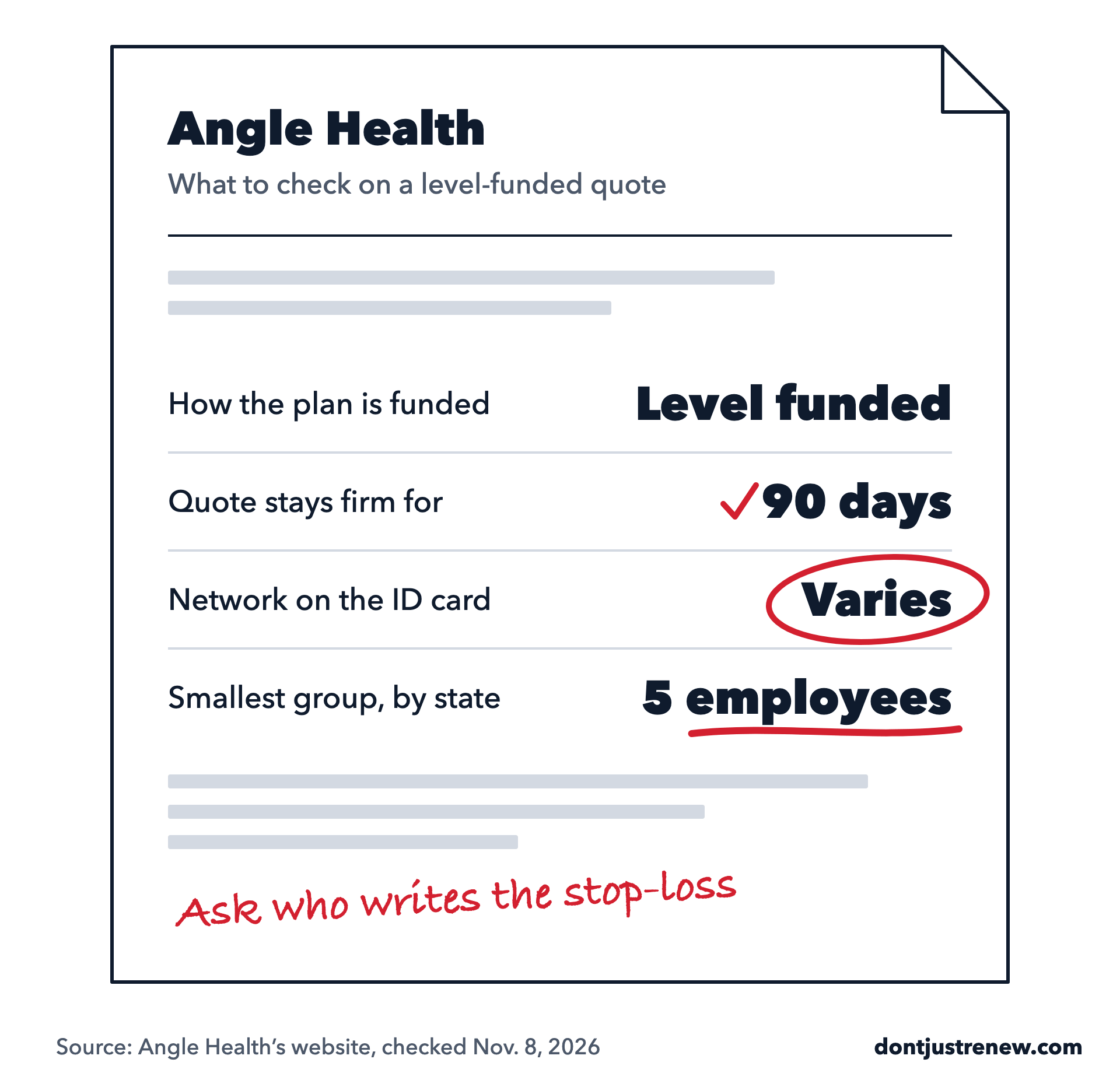
No. Angle rents provider networks from other companies, and its doctor search lists 12 of them: Cigna PPO, Aetna, First Health, PHCS PPO, HAP, CareFirst, First Choice Health Network (Washington, Idaho, and Montana), Ohio PPO Connect, Employers Health Network, Mississippi Physicians, Health Direct Contact from Nomi Health, and Evolutions. Each network has its own enrollment guide on Angle’s member pages.
So two companies on Angle can have very different sets of doctors. If your plan uses the Cigna PPO network, your employees use Cigna’s doctors and hospitals, but the plan itself is Angle’s, and questions about claims and benefits go to Angle’s care team. A PPO lets people see doctors outside the network for a higher cost. Our HMO vs PPO guide covers the differences.
How is an Angle Health plan priced?
On your group. Angle builds a quote from a member-level census, meaning a list of the people who’d be covered, and its broker page says brokers can get a firm quote in minutes for groups of 5 or more, depending on the state. The quote stays firm for 90 days. Angle says it adjusts only in limited cases, such as a material change in the census or catastrophic risk.
Pricing a group on its own makeup is called underwriting. ACA small business plans can’t do it: their prices can vary only by age, location, tobacco use, and family size, under 45 CFR 147.102. Our experience rating guide explains what that means for renewals. Angle also lets brokers set the network, the pharmacy benefit manager (the company that runs the drug benefit), and the deductibles and copays for each group, according to its FAQ.
What changes at an Angle Health renewal?
Your own claims count. As our level-funded guide explains, next year’s price on a level-funded plan follows your group’s claims and makeup, so a year with a few large claims can show up in the renewal even with stop-loss in place. Angle’s broker page says its renewals use its underwriting approach and claims data.
What happens to leftover claims money is less clear. Angle’s employer, broker, and FAQ pages don’t say whether unused claims money comes back. Its Utah insurer’s level-funded plans mention potential refunds when claims are low. If a refund is part of why you’re choosing a level-funded plan, get the terms in writing, including what happens if you leave.
Who Angle tends to fit
Angle says its typical clients have been startups and technology companies, and depending on the state, its plans start at 5 employees and go up to large employers. It tends to suit employers that want PPO plans on a national network, a plan built to their group, and digital tools: Angle says it connects with more than 100 payroll and HR systems. Because each group is underwritten, a group with younger or healthier employees may be priced differently than it would be on an ACA small business plan, and so may a group with high expected claims.
Questions to ask about an Angle Health quote
- Which network is on our plan, and are our employees’ doctors in it?
- Is this plan level funded or fully insured in our state, and who writes the stop-loss?
- If our claims come in low, does any money come back to us, and what happens to it if we leave?
- What could change the price between the quote and the start date?
Don’t Just Renew is not associated with, endorsed by, or sponsored by Angle Health, Balanced Insurance Company of Utah, Cigna, Aetna, or any network named here. Their names are trademarks of their owners, and we use them only to describe public information. This article is general information, not insurance, tax, or legal advice. Figures are current as of November 8, 2026.