 Don’t just renew
Florida Health Care Plans small business plans: 8.8% for 2027, and $147 under the state average
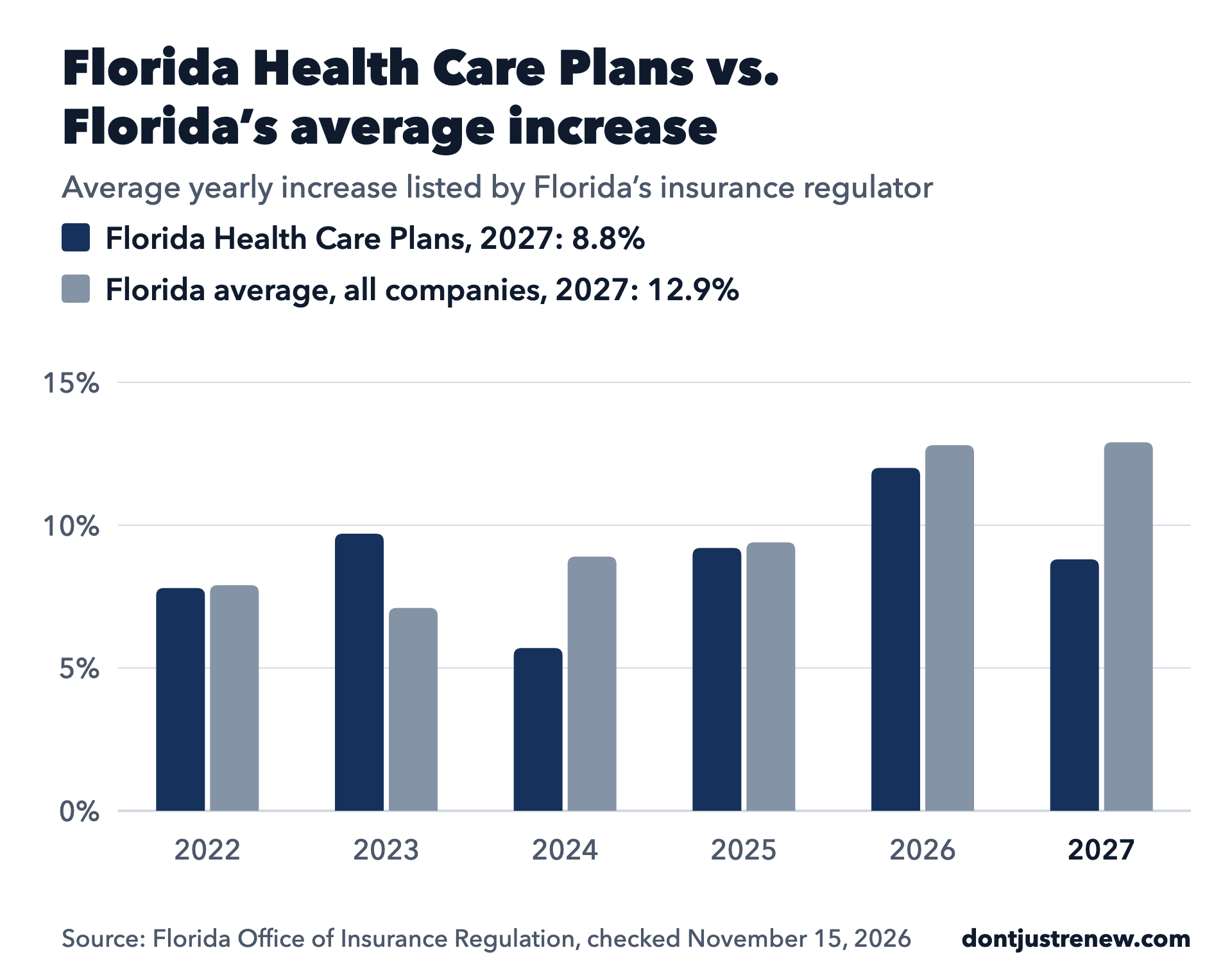
Florida Health Care Plans, often called FHCP, is raising its small business rates an average of 8.8% for 2027, according to Florida’s Office of Insurance Regulation. That’s down from 12.0% for 2026 and well under this year’s state average of 12.9%. After renewal, FHCP’s average premium is $773 a month per person, $147 below the state average. That’s the widest gap in the six years of state tables we checked.
At a glance
- Florida lists FHCP’s 2027 average increase at 8.8%, after 12.0% for 2026. The statewide average is 12.9%.
- The 2027 increase adds about $63 a month per person by our math, against $107 for the state average.
- FHCP sells small business plans in five counties, and its 2026 filing priced the same plan about 23% higher in Flagler than in St. Johns.
- For 2025, FHCP paid about $7.1 million into the federal program that shares risk among the insurers in Florida’s small business pool.
An HMO for five counties, with add-ons for more choice
FHCP sells small business plans in Brevard, Flagler, Seminole, St. Johns, and Volusia counties, according to its employer plans page and Florida’s 2027 county list. It began operating as a not-for-profit in 1974 and has been an affiliate of Florida Blue since January 1, 2009, its About page says.
Its group plans come in three kinds: HMO, Balance, and high-deductible. An HMO generally covers care only from its own network, except in emergencies, as our HMO vs PPO guide explains. Two add-ons, which FHCP calls riders, open that up. The Point of Service rider lets members see doctors outside FHCP’s network without a referral, and it can go on any of the three plan kinds.
The Triple Option rider sets three levels of cost. Members pay least with FHCP’s HMO network, more with a wider network that includes Florida Blue’s providers, and most with doctors in neither, who may also bill them for the difference. Triple Option is sold only in Volusia and Flagler.
FHCP’s 2026 actuarial memo, the technical report filed with its rates, lists 61 small business plans, and every one includes a gym benefit. None is sold on the government’s small business marketplace. FHCP sells them itself and through Florida Blue’s sales channels.
From 12.0% to 8.8%: six years of FHCP increases
| Renewal year | FHCP increase | Florida average | FHCP premium | Under state average |
|---|---|---|---|---|
| 2022 | 7.8% | 7.9% | $549 | $61 |
| 2023 | 9.7% | 7.1% | $586 | $45 |
| 2024 | 5.7% | 8.9% | $605 | $74 |
| 2025 | 9.2% | 9.4% | $653 | $77 |
| 2026 | 12.0% | 12.8% | $734 | $87 |
| 2027 | 8.8% | 12.9% | $773 | $147 |
Sources: Florida Office of Insurance Regulation small group premium tables for 2022, 2023, 2024, 2025, 2026, and 2027, checked November 15, 2026. Premiums are the average monthly premium per person after each year’s renewal. “Under state average” is our math: the state’s average premium after renewal minus FHCP’s.
The 2026 increase was FHCP’s largest in these six years, and 2027 brings it back under 10%, where it stayed every year from 2022 to 2025. Only once, in 2023, did FHCP’s increase top the state average. Of the nine companies on the state’s 2027 list, only Truli for Health, at 8.7%, has a smaller increase, as our Florida Blue post shows. AvMed matches FHCP at 8.8%, and Capital Health Plan is at 8.9%.
By our math, FHCP’s average premium after renewal has grown about 41% since 2022, from $549 to $773. The state average grew about 51%, from $610 to $920. Through 2026, FHCP stayed $45 to $87 a month below the state average, or 7% to 11%. For 2027 the gap is $147, or 16%. Each company’s average reflects its own members’ ages, plans, and counties, so a lower average doesn’t mean every group pays less.
The state’s 2027 table puts FHCP’s 2026 starting point at $710, based on the people it actually covered. So the 2027 increase adds about $63 a month per person, or $756 a year, by our math. The state average adds $107 a month, and two of UnitedHealthcare’s Florida companies add $150 and $158.
The federal rate review site lists FHCP’s small business filings for 2022 through 2026, each within a point of the state’s figure. For 2026 it shows increases by plan from 9.02% to 13.72%. As of November 15 it doesn’t list FHCP’s 2027 small business filing, so we couldn’t check this year’s range by plan or the 2027 memo. The state’s table gives that filing’s log number, 26-029902.
Your county changes the price of the same plan
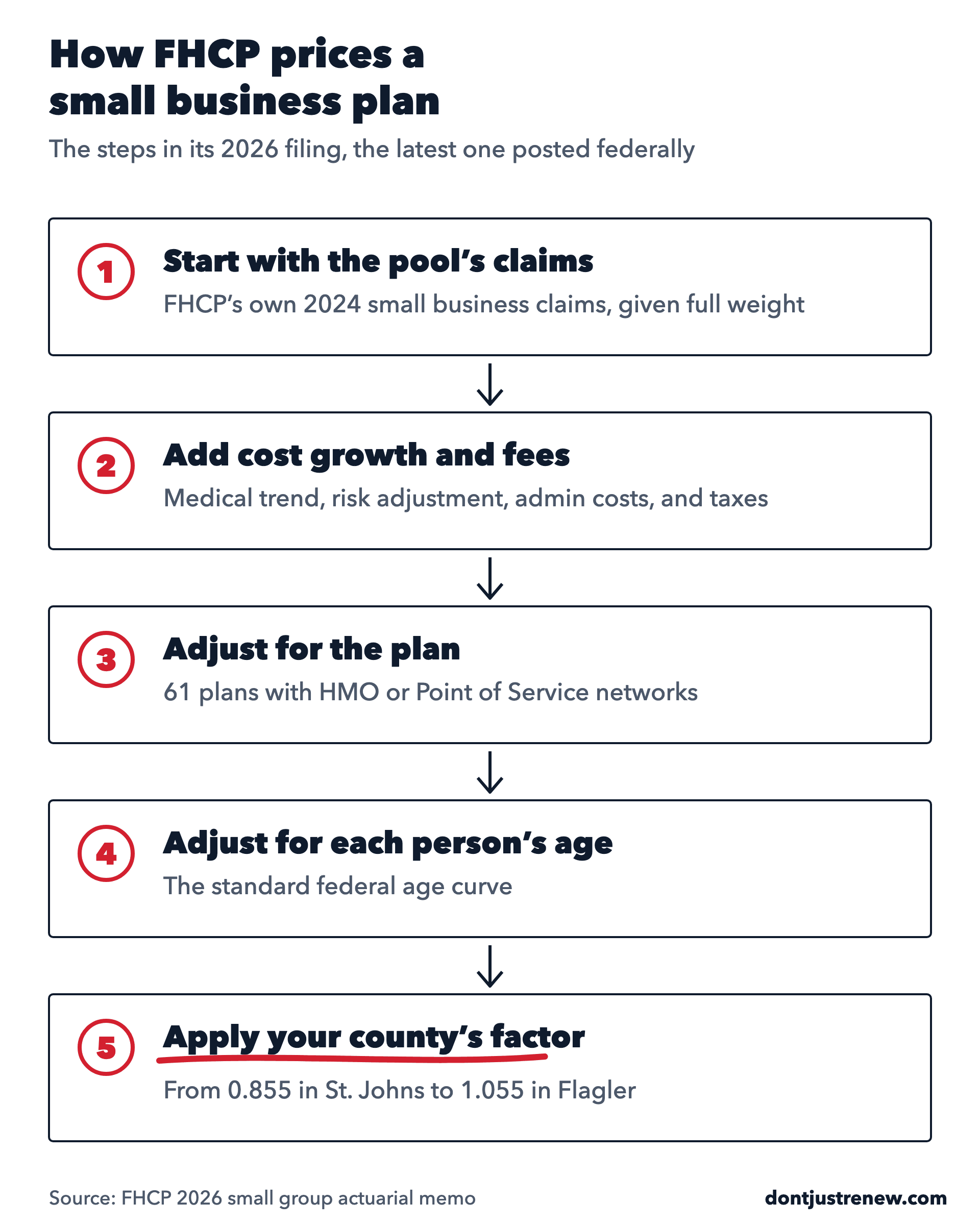
In Florida, every county is its own rating area, according to CMS, and federal rules set a small business’s rating area by its principal business address. FHCP’s 2026 memo lists the factor it applies in each of its five counties. A factor of 1.055 means 5.5% above FHCP’s overall average, and 0.855 means 14.5% below.
| County | 2026 factor | Price vs. St. Johns |
|---|---|---|
| St. Johns | 0.855 | Lowest |
| Brevard | 0.915 | 7% more |
| Seminole | 0.956 | 12% more |
| Volusia | 1.047 | 22% more |
| Flagler | 1.055 | 23% more |
Source: FHCP 2026 small group actuarial memo, checked November 15, 2026. “Price vs. St. Johns” is our math, rounded.
So a business registered in Flagler pays about 23% more than one in St. Johns for the same FHCP plan covering the same people, by our math. The 2025 factors in the same memo were almost the same, 1.050 for Flagler and 0.852 for St. Johns. The memo says the factors reflect only differences in what care costs to deliver in each area, not how healthy people there are. FHCP also runs a separate HMO and Point of Service network for Brevard. We couldn’t check the 2027 factors, since that memo isn’t posted.
What’s behind FHCP’s rates
The 2026 rates started from FHCP’s own small business claims for 2024. The memo gives that experience full weight, since the pool is big enough to rely on alone. Like every ACA small business plan, FHCP prices its pool as a whole, so one group’s own claims don’t set its rate, as our post on experience rating explains. The memo names three main drivers: changes in members’ ages, medical cost growth (higher prices, more use of care, and new treatments), and risk adjustment. It blacks out the size of each, along with the share of premiums FHCP expects to spend on care.
Risk adjustment is a federal program that moves money from insurers with lower-than-average risk to insurers with higher-than-average risk within each state. For 2025, FHCP paid about $7.1 million into Florida’s small business pool, according to CMS’s company-by-company figures. Paying in means the formula rated FHCP’s small business members as lower risk than the state average. The 2026 memo says FHCP changed its target for the share of premiums going to care because of uncertainty about risk adjustment.
| Company | 2025 risk adjustment |
|---|---|
| Blue Cross and Blue Shield of Florida | Received $33.3 million |
| UnitedHealthcare Insurance Company | Received $19.0 million |
| UnitedHealthcare of Florida | Received $10.5 million |
| AvMed | Paid $0.2 million |
| Truli for Health (BeHealthy Florida) | Paid $2.5 million |
| Florida Health Care Plan | Paid $7.1 million |
| Capital Health Plan | Paid $8.0 million |
| Neighborhood Health Partnership | Paid $12.2 million |
| Health Options (Florida Blue HMO) | Paid $37.8 million |
Source: CMS 2025 benefit year risk adjustment transfers by company, small group market, checked November 15, 2026. Rounded to the nearest $0.1 million by us.
Of the six companies on the list that paid in, FHCP’s charge is the fourth largest. These are company-wide totals for 2025, so they say nothing about any one group’s claims, and FHCP’s posted filings don’t show how much risk adjustment moved its rates.
What to check on an FHCP renewal notice
- The county your business is registered in. FHCP prices by that address, and its 2026 factors ran from 0.855 in St. Johns to 1.055 in Flagler.
- Which plan kind you have, and whether it carries the Point of Service or Triple Option rider. Each changes what employees pay outside the HMO network, and Triple Option is sold only in Volusia and Flagler.
- Your plan’s ID against last year’s. FHCP’s 2026 filing dropped three plans and added three, so make sure your renewal hasn’t moved you to a different one.
Don’t Just Renew is not associated with, endorsed by, or sponsored by Florida Health Care Plans or Florida Blue. These names are trademarks of their owners, and we use them only to report public rate data. This article is general information, not insurance advice. Figures are current as of November 15, 2026.